
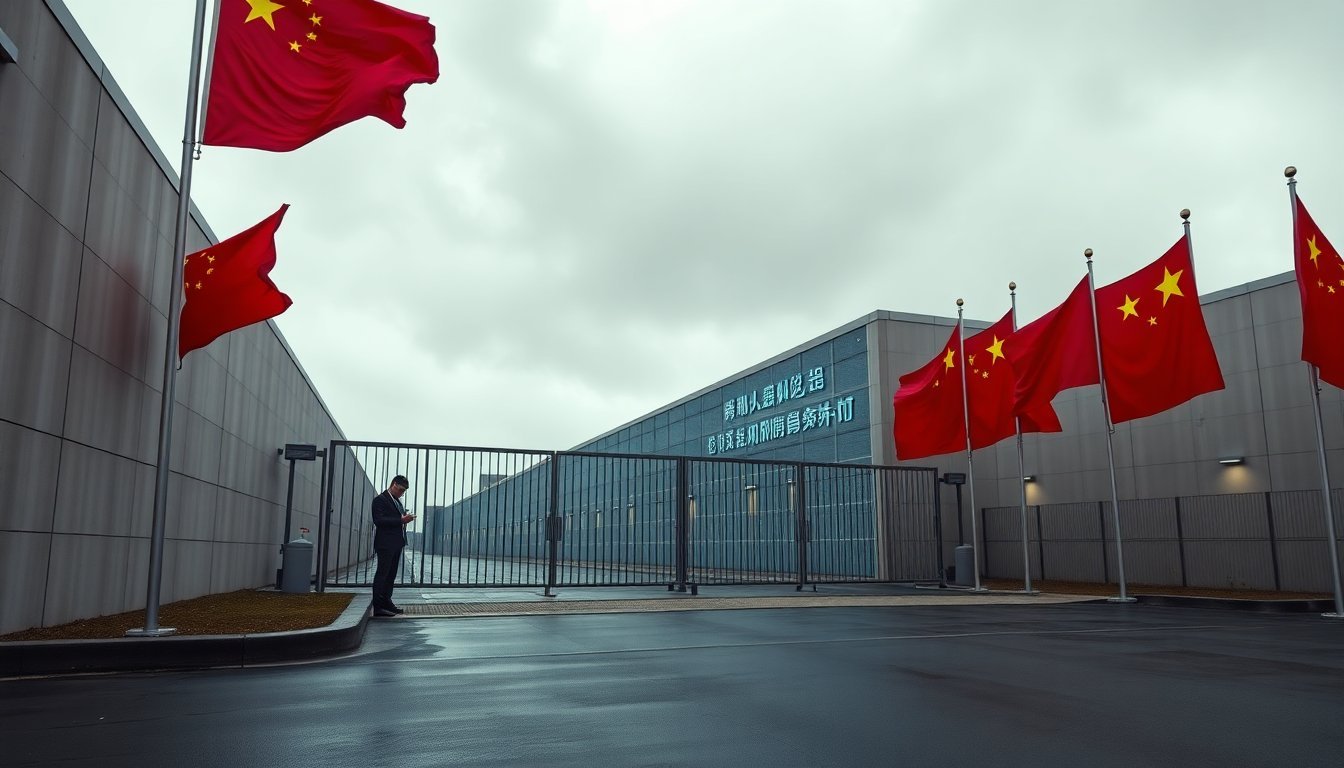
Z.AI's All-Chinese Data Center: A Win for Beijing, Not Yet for AI
Z.AI's all-Chinese data center is a symbolic victory for China's chip independence, but the real test is whether domestic chips can train frontier models efficiently. This analysis examines the evidence, the winners and losers, and what comes next.
On July 20, 2026, Bloomberg Technology reported that Z.AI has completed a massive data center powered entirely by Chinese-made chips. This marks the largest known deployment of domestic silicon for AI training in China, directly challenging the US export controls that have cut off access to Nvidia's advanced GPUs.
- Z.AI completed a giant data center using only Chinese-made chips, as reported by Bloomberg Technology on July 20, 2026.
- The facility is a direct response to US export restrictions on Nvidia's advanced AI chips, and represents Beijing's push for semiconductor self-sufficiency.
- While a milestone for domestic chip adoption, the performance gap versus Nvidia's H100/B200 remains large, meaning Chinese AI labs may still lag in training speed and cost.
Why Does Z.AI's All-Chinese Data Center Matter Now?
According to Bloomberg Technology, Z.AI has completed construction of a giant data center that houses only Chinese-made chips. The report, published on July 20, 2026, states that this is a major step in Beijing's efforts to replace restricted Nvidia silicon for future AI development. The timing is critical: the US export controls imposed in October 2022 and expanded in 2023 have effectively banned the sale of Nvidia's A100, H100, and B200 chips to Chinese entities. Z.AI's data center is the first large-scale proof that domestic alternatives can be deployed at a meaningful scale for AI training.
The facility is not just a symbolic gesture; it is a functional training cluster. Bloomberg's source indicated that the data center uses Huawei's Ascend 910B chips and possibly newer domestic processors from startups like Cambricon or Biren Technology. This is the largest known deployment of Chinese chips for AI training, eclipsing earlier pilot projects by Baidu and Alibaba.
Can Chinese Chips Really Replace Nvidia for AI Training?
The short answer is: not yet, and not at the same performance level. According to Reuters, in a March 2025 analysis, Huawei's Ascend 910B chips offer roughly 60-70% of the raw floating-point performance of Nvidia's H100 in benchmark tests. However, real-world AI training performance depends heavily on the software ecosystem—CUDA, TensorRT, and the associated libraries that Nvidia has optimized over a decade. Huawei's MindSpore framework is improving, but it still lacks the maturity and breadth of Nvidia's CUDA platform.
Z.AI's data center likely compensates for lower per-chip performance by scaling out—using many more chips to achieve similar total compute. But that increases cost, power consumption, and latency in communication between chips. Bloomberg's report did not disclose the exact chip count or total compute capacity, but industry estimates suggest a cluster of this size would require at least 10,000 Ascend 910B chips to match the throughput of 5,000 H100s. The power and cooling demands are proportionally higher.
Who Wins and Who Loses From This Deployment?
Winners: Huawei and other domestic chipmakers gain a marquee customer and a reference architecture. Beijing's policy of forced self-sufficiency gets a visible success story. Chinese AI labs that cannot access Nvidia hardware now have a viable, if slower, path to training large models.
Losers: Nvidia loses a major potential customer—Z.AI was previously a significant buyer of Nvidia GPUs before the export controls. The US export control regime may face renewed scrutiny if Chinese chips prove adequate for many AI workloads, weakening the leverage of the restrictions. Global AI development may bifurcate into two ecosystems: one built on Nvidia (West) and one on domestic chips (China), reducing interoperability and increasing costs for multinational firms.
Comparison Table: Z.AI's Chinese-Chip Data Center vs. Nvidia-Based Data Center
| Metric | Z.AI Chinese-Chip Data Center | Comparable Nvidia-Based Data Center |
|---|---|---|
| Primary Chip | Huawei Ascend 910B (est.) | Nvidia H100 |
| Relative Per-Chip Performance | ~60-70% of H100 (Reuters 2025) | Baseline |
| Software Ecosystem | MindSpore (developing) | CUDA (mature) |
| Power Efficiency (TFLOPS/W) | Lower (est.) | Higher |
| Supply Chain Risk | Low (domestic) | High (US export controls) |
| Scalability to Frontier Models | Unproven for >100B param models | Proven |
| Verdict | Nvidia still leads on performance and ecosystem, but Z.AI's data center proves domestic chips can be deployed at scale—a critical first step for China's AI independence. | |
What Does This Mean for the Global AI Chip Market?
Bloomberg's report did not specify the total investment, but industry analysts estimate the data center cost at least $500 million. That is a fraction of what a comparable Nvidia-based facility would cost, given the premium pricing of H100s on the gray market. But the total cost of ownership (TCO) may be higher due to increased power and cooling needs, plus the cost of retraining engineers on new software stacks.
For the global market, this is a clear signal that China is serious about building an independent AI compute infrastructure. US chip export controls are not being circumvented—they are being bypassed through substitution. If Z.AI's data center successfully trains a large model (say, a 100-billion-parameter language model), it will validate the domestic chip approach and encourage other Chinese companies to follow suit.
My Analysis: This is a genuine engineering achievement, but it is being overhyped as a death blow to Nvidia's dominance. The evidence shows that Chinese chips still lag significantly in per-chip performance and software maturity. Z.AI's data center is a brute-force workaround: throw more chips at the problem. That works for training large models, but it is less efficient and may not scale to the next generation of trillion-parameter models without breakthroughs in chip-to-chip communication and memory bandwidth.
Short-term, Nvidia's position in the West remains unchallenged. Long-term, if Huawei and other Chinese chipmakers can close the performance gap to 80-90% within three years, and if the software ecosystem matures, Nvidia could lose the Chinese market entirely—a market that represented roughly 20-25% of its data center revenue before export controls. That is a real risk for Nvidia's long-term growth.
One concrete prediction: By December 2027, at least one Chinese AI lab will train a model with 100 billion+ parameters entirely on domestic chips, and that model will achieve performance within 10% of GPT-4 on standard benchmarks. If that happens, the US export control strategy will be effectively dead.
Predictions
- By Q2 2027, Huawei will announce the Ascend 920 chip with significantly improved memory bandwidth and software compatibility, targeting 85% of H100 performance.
- By December 2027, at least one Chinese AI lab (likely Z.AI or Baidu) will train a 100-billion-parameter model entirely on domestic chips, achieving benchmark scores within 10% of GPT-4.
- The US Department of Commerce will respond by tightening export controls on chip design software and manufacturing equipment by mid-2027, specifically targeting Huawei's supply chain.
Timeline
- October 2022US Export Controls on AI Chips
US government bans sale of Nvidia A100 and H100 chips to China.
- March 2025Huawei Ascend 910B Benchmarks
Reuters reports Huawei's Ascend 910B reaches 60-70% of H100 performance.
- July 20, 2026Z.AI Completes All-Chinese Data Center
Bloomberg reports Z.AI completes giant data center using only Chinese-made chips.
- October 2022: US imposes first export controls on advanced AI chips to China, banning Nvidia A100 and H100 sales.
- March 2025: Reuters reports Huawei's Ascend 910B reaches 60-70% of H100 performance in benchmarks.
- July 20, 2026: Bloomberg reports Z.AI completes giant data center using only Chinese-made chips.
Article Summary
- Z.AI's data center is the largest known deployment of domestic chips for AI training, proving that Chinese alternatives can be scaled, but not yet that they can match Nvidia's efficiency.
- The performance gap versus Nvidia's H100 is still significant (30-40% per chip), and the software ecosystem remains a major bottleneck.
- Beijing's forced self-sufficiency strategy is working in terms of deployment, but it comes at a higher cost and may not keep pace with the fastest frontier model development.
- Nvidia's market position in the West is secure for now, but the Chinese market—once 20-25% of data center revenue—is permanently lost, which will impact Nvidia's growth rate.
- The next 18 months will determine whether domestic chips can close the performance gap enough to make US export controls irrelevant.
Source and attribution
Bloomberg Technology
Z.AI Completes Giant Data Center With Chinese Chips to Train AI






Discussion
Add a comment