
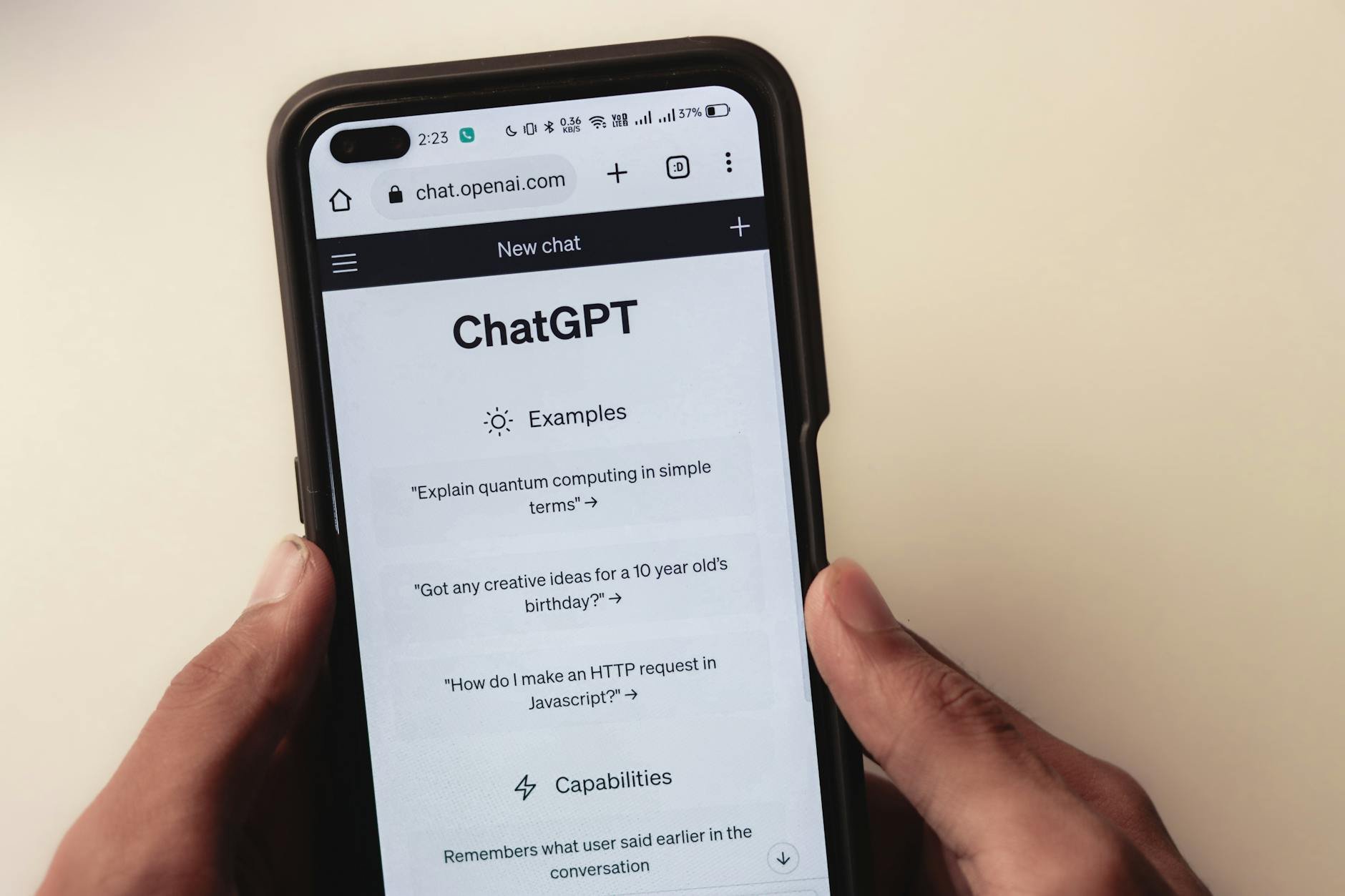
What's the Real Energy Cost of Your AI Chat?
While headlines focus on AI training's massive energy appetite, the hidden truth is that answering billions of daily queries consumes over 90% of total power. A new benchmark, TokenPowerBench, finally gives us the tools to measure and manage this invisible cost.
Every time you ask an AI a question, you're switching on a tiny, invisible power plant. That single chat might seem free, but its energy bill is very real.
While the world debated training massive models, the true cost has been hiding in plain sight: answering your daily queries now consumes over 90% of AI's total energy. We've been measuring the wrong thing, and the real power drain is just coming into focus.
While the world debated training massive models, the true cost has been hiding in plain sight: answering your daily queries now consumes over 90% of AI's total energy. We've been measuring the wrong thing, and the real power drain is just coming into focus.
The Invisible Power Drain of AI Inference
You ask a large language model to summarize a document, draft an email, or explain a complex concept. In milliseconds, it responds. That single interaction feels effortless, but behind the sleek interface lies a significant and largely unmeasured energy expenditure. While the tech world has been fixated on the colossal power required to train models like GPT-4 or Gemini—a process that can consume as much electricity as thousands of homes—a more persistent and growing problem has been hiding in plain sight: inference.
According to industry analyses, the act of running these trained models to answer user queries, known as inference, accounts for a staggering more than 90% of an LLM's total lifetime power consumption. With services like ChatGPT, Copilot, and Claude fielding billions of requests daily, this represents a massive, continuous draw on global energy resources. Yet, until now, we've lacked the fundamental tools to properly audit it.
The Benchmarking Blind Spot
"We have sophisticated benchmarks for how fast a model can generate tokens, how accurate its answers are, or how much memory it uses," explains the team behind a new research paper from arXiv. "But when it comes to the actual energy cost of serving each of those tokens to a real user, we're largely in the dark."
Existing benchmarks are ill-suited for the task. Training benchmarks measure power over hours or days of continuous, stable computation. Performance benchmarks like HELM or MMLU track accuracy and speed, not watts. This creates a critical gap in our understanding. Developers optimizing for latency might inadvertently select a model architecture or hardware configuration that is devastatingly inefficient. Cloud providers and companies deploying private AI lack the data to make cost-effective and sustainable choices.
"Without measurement, there can be no meaningful optimization," the researchers state. "We are flying blind on the single largest operational expense for running LLMs."
Introducing TokenPowerBench: The Power Meter for AI
To solve this, researchers have introduced TokenPowerBench, described as the first lightweight and extensible benchmark designed specifically for LLM inference power consumption studies. Its goal is not to replace performance benchmarks but to complement them, adding the crucial dimension of energy efficiency.
So, how does it work? TokenPowerBench is built to be pragmatic and accessible. It's a software framework that standardizes the process of measuring power draw during inference across different models, hardware setups, and query types. Key to its design is the connection between granular performance metrics and physical power sensors.
- Lightweight Instrumentation: It integrates with common power measurement tools (like NVIDIA's NVML for GPUs or Intel's RAPL for CPUs) to collect real-time power data without introducing significant overhead that would skew the results.
- Controlled Workloads: It runs a standardized set of prompts and tasks, ranging from short Q&A to long-form generation, simulating real-world usage patterns. This allows for apples-to-apples comparisons.
- Token-Granular Analysis: Crucially, it correlates power consumption with output—measuring not just total energy for a job, but energy-per-token. This is the key metric for understanding operational efficiency at scale.
- Hardware & Software Agnostic: The benchmark is designed to work across different GPU vendors, cloud instances, and even emerging AI accelerators, making its findings broadly applicable.
Why Measuring Per-Token Power Changes Everything
The shift to a "per-token" perspective is revolutionary for cost and sustainability planning. Consider two models: Model A is slightly faster, but Model B uses 30% less energy per generated word. For a low-volume application, Model A might be preferable. But for a service processing millions of queries daily, Model B's efficiency translates directly into massive reductions in electricity bills and carbon footprint.
TokenPowerBench allows stakeholders to ask and answer critical questions: Does using a quantized (smaller) version of a model cut energy use in half? How much extra power does a "reasoning" or chain-of-thought task consume versus a simple classification? What is the energy overhead of running a model locally on a laptop versus querying a massive cloud data center?
The Immediate Implications: Cost, Carbon, and Competition
The deployment of a standard power benchmark will have ripple effects across the AI industry.
1. The Sustainability Imperative: As scrutiny of tech's environmental impact intensifies, companies can no longer ignore inference power. TokenPowerBench provides the hard data needed for ESG reporting and to guide development toward genuinely "greener" AI. It moves the conversation beyond vague commitments to measurable efficiency gains.
2. The Bottom Line: For businesses, inference is an operational cost center. A 20% improvement in tokens-per-watt directly improves gross margins. Cloud providers like AWS, Google Cloud, and Azure will likely use such benchmarks to tout the efficiency of their AI-optimized instances, and customers will use them to compare offerings.
3. Hardware and Software Co-Design: Chipmakers (NVIDIA, AMD, Intel, and startups like Groq) now have a standardized test to prove their hardware's inference efficiency. Similarly, software frameworks (PyTorch, TensorRT-LLM, vLLM) can be optimized and compared based on the energy profile they enable.
What Comes Next: A New Era of Efficient AI
The introduction of TokenPowerBench is just the beginning. The researchers envision it becoming a foundational tool that sparks a wave of innovation focused on inference efficiency. We can expect to see:
- "Energy Star" Ratings for AI Models: Public leaderboards that rank models not just by capability, but by efficiency.
- Smarter Cloud Scaling: Auto-scaling systems that consider both latency requirements and power budgets, potentially routing queries to the most energy-efficient available hardware.
- Informed Policy: Data that could inform future regulations around AI and energy use, ensuring growth is managed sustainably.
The Bottom Line: Knowledge is Power (Efficiency)
For too long, the astronomical power draw of AI training has overshadowed the persistent, cumulative drain of inference. TokenPowerBench shines a light into this blind spot, providing the essential toolkit for measurement. In an industry hurtling toward ever-larger models and ubiquitous deployment, this isn't just an academic exercise. It's a necessary step toward responsible growth.
The next time you get a helpful answer from an AI, remember: there's a tangible energy cost behind those tokens. Thanks to this new benchmark, we can finally start to understand it, manage it, and ultimately reduce it. The race for smarter AI is now also a race for more efficient AI.
Source and attribution
arXiv
TokenPowerBench: Benchmarking the Power Consumption of LLM Inference






Discussion
Add a comment