
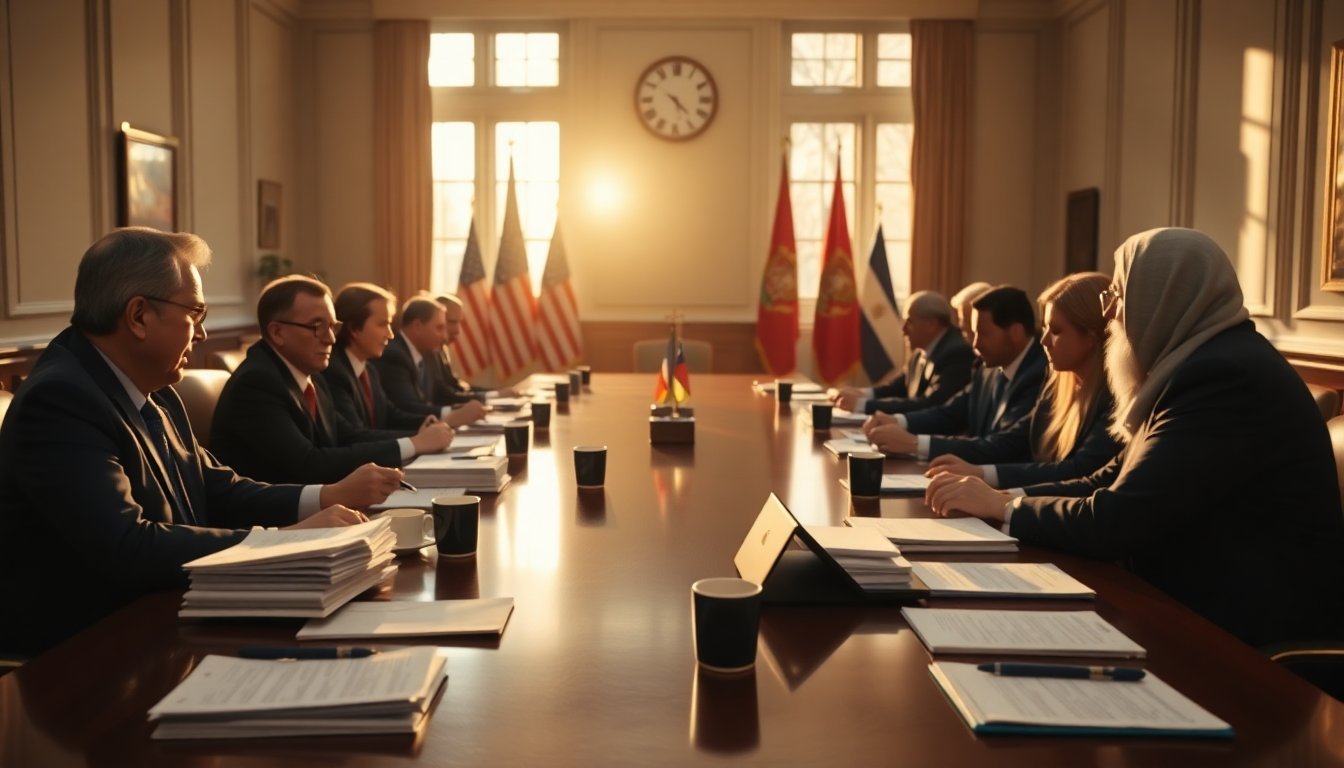
US-China AI Race: Five Flashpoints, No Off-Ramp
Trump's 'whoever wins AI, wins' declaration has turned a technological rivalry into an existential scoreboard, with five flashpoints—chips, talent, data, standards, and military use—hardening into parallel ecosystems. This analysis argues the US and China will not cooperate, and predicts which side gains ground by 2027.
On Sept. 13, 2026, President Donald Trump said 'whoever wins AI, wins,' and that single sentence is now the organizing principle of US economic policy toward China. Bloomberg Technology's Sept. 29 explainer lays out five flashpoints where the two AI superpowers are colliding—and where cooperation keeps failing. What changed is not the rivalry itself but the explicit framing: AI is no longer a sector, it is the scoreboard.
- President Trump declared on Sept. 13, 2026, that 'whoever wins AI, wins,' framing AI as the core of US-China economic rivalry.
- Bloomberg Technology's Sept. 29 explainer identifies five flashpoints where the two powers are colliding: chips, talent, data, standards, and military applications.
- The key tension: neither side trusts the other's motives, and neither wants to slow down—so cooperation on AI safety remains theoretical.
- This article argues the race is a cold tech war with no off-ramp, and picks the likely winners at each flashpoint.
Why Did Trump Declare 'Whoever Wins AI, Wins'?
According to Bloomberg Technology, President Donald Trump declared on Sept. 13, 2026, that 'whoever wins AI, wins.' That statement is not rhetorical flourish—it is a policy signal. It elevates AI from a technology sector to the central axis of US economic and national security strategy, and it implicitly tells every agency, ally, and chipmaker that alignment with American AI leadership is non-negotiable.
The framing matters because it changes the incentive structure. If AI is the scoreboard, then export controls, talent visas, and data rules are not trade policy—they are war-fighting tools. Bloomberg Technology reported that both the US and China see AI as the new focal point of their economic rivalry, and that neither trusts the other's motives. That mutual distrust is the engine of the race.
What Are the Five Flashpoints—and Who Is Winning Each?
Bloomberg Technology's Sept. 29 explainer lays out five flashpoints: advanced chips, AI talent, data access, technical standards, and military AI. Each is a distinct battlefield with different dynamics. On chips, the US leads in design but depends on Asian fabrication; on talent, China produces more AI graduates but the US retains the top researchers; on data, China's scale and state access give it an edge in volume, while the US leads in diversity and quality; on standards, the EU and US are pushing rules-based frameworks while China exports its own model; on military AI, both are racing without guardrails.
The evidence supports a split verdict: the US leads in frontier model quality and chip design, China leads in deployment scale and manufacturing integration. Neither has a knockout blow. According to Bloomberg Technology, the question is whether the two nations can put aside their disagreements and cooperate in building a safe and sustainable AI environment—and the answer, based on their behavior, is no.
Can the US and China Cooperate on AI Safety?
Short answer: not in any meaningful way before 2028. Bloomberg Technology reported that 'for now, neither trusts the other's motives, and neither wants to slow down.' That is the core obstacle. AI safety cooperation requires shared threat perception and mutual verification, and neither condition exists. The US views China's AI development as a security threat; China views US export controls as an attempt to strangle its tech sector.
There is a precedent for limited cooperation—the US and Soviet Union negotiated arms control during the Cold War—but AI is dual-use, diffuse, and fast-moving. Verification is nearly impossible, and the commercial incentives to cheat are enormous. I expect no binding bilateral AI safety treaty before 2028. Instead, expect unilateral safety frameworks and competing international standards.
Who Gains and Who Loses From the AI Cold War?
The clearest winners are US chip designers like Nvidia and AMD, which benefit from export controls that lock out Chinese competitors, and Chinese AI champions like Huawei and Baidu, which gain a protected domestic market. The clearest losers are neutral countries and open-source researchers. Third countries like India, Brazil, and EU members face pressure to choose a side, and open-source AI communities are caught between US export rules and Chinese data regulations.
Bloomberg Technology's framing suggests the race is zero-sum in the minds of policymakers. That is dangerous. Zero-sum thinking leads to overinvestment in military AI and underinvestment in safety research. The market dynamic that changes: capital flows to national champions, not to the best ideas. That is a recipe for duplication and waste, but it is also the likely path.
| Flashpoint | US Position | China Position | Likely 2027 Leader |
|---|---|---|---|
| Advanced chips | Leads in design (Nvidia, AMD) | Leads in packaging, catching up in fab | US |
| AI talent | Retains top researchers | Produces more graduates | Tie |
| Data access | Quality and diversity | Scale and state access | China |
| Technical standards | Rules-based, allied push | Exporting own model | Contested |
| Military AI | Advanced but fragmented | Integrated, fast deployment | China |
| Verdict | US leads frontier | China leads deployment | No knockout; parallel stacks |
Thesis: The US-China AI race is not a sprint or a marathon—it is a cold tech war with no off-ramp, and the side that converts capital and chips into deployed industrial capability fastest will set the rules for everyone else.
In the short term (2026-2027), the US retains the frontier model advantage and will use export controls to slow China's access to advanced chips. But China will accelerate domestic substitution, as evidenced by Huawei's rise and DeepSeek's efficient models. The US will win benchmarks; China will win installations. In the long term (2028-2030), China's advantage in deployment scale and data volume could allow it to set de facto standards across the Global South, while the US and EU fragment into competing regulatory blocs.
Who gains? Nvidia, Huawei, and national champions on both sides. Who loses? Neutral countries, open-source researchers, and anyone who believed AI safety cooperation was possible. The market dynamic that changes: capital allocates by geopolitical alignment, not by merit. That is inefficient but it is the reality.
Prediction: By Q2 2027, the US Commerce Department will expand export controls to cover AI model weights and inference chips, not just training hardware. China will retaliate with rare-earth export restrictions. No bilateral AI safety agreement will be signed before 2028.
What Should We Expect Next?
Expect escalation, not de-escalation. The US will tighten chip controls; China will accelerate its domestic stack. The EU will try to carve out a third way but will lean toward US standards. The most likely near-term development is a US-led coalition on AI standards that excludes China, followed by a Chinese counter-coalition. According to Bloomberg Technology, the question of cooperation remains open, but the evidence points to a hardening split.
The one wild card is a major AI safety incident—a military AI accident or a catastrophic model failure—that forces both sides to the table. Absent that, the race continues.
Predictions
- By Q2 2027, the US Commerce Department will extend export controls to AI model weights and inference chips, targeting Chinese cloud providers.
- By 2028, China will announce a domestic AI chip that matches Nvidia's H100 in training performance, reducing reliance on US hardware.
- No binding US-China AI safety treaty will be signed before 2030; instead, the EU will broker a plurilateral safety accord excluding both the US and China.
- September 2026Trump declares 'whoever wins AI, wins'
President Trump frames AI as the central axis of US economic rivalry with China.
- September 2026Bloomberg publishes five flashpoints explainer
Bloomberg Technology outlines chips, talent, data, standards, and military AI as key battlegrounds.
US vs China AI Capability by Flashpoint (2026 estimated)
Article Summary
- Trump's 'whoever wins AI, wins' declaration on Sept. 13, 2026, formalized AI as the core of US-China rivalry.
- Bloomberg Technology identifies five flashpoints—chips, talent, data, standards, military AI—where the two powers are colliding.
- The US leads in frontier models and chip design; China leads in deployment scale and data volume.
- Cooperation on AI safety is unlikely before 2028 because neither side trusts the other's motives or wants to slow down.
- The biggest losers are neutral countries and open-source researchers caught between incompatible regulatory regimes.
Source and attribution
Bloomberg Technology
US-China AI Race: Five Key Flashpoints Explained






Discussion
Add a comment