
TPO Kills PPO: The End of Unstable RLHF Alignment
Target Policy Optimization (TPO) separates the selection of which completions to reward from the mechanics of updating model parameters, eliminating the instability that has made RLHF a black art. This development favors lean, open-source teams and threatens the alignment infrastructure of major labs.
For years, the RLHF community has tolerated a dirty secret: policy-gradient methods like PPO are inherently unstable, requiring hand-tuned clipping, learning rate schedules, and a prayer that the update doesn't overshoot into a degenerate policy. A new paper from an independent research team finally solves this by decoupling the two fundamental questions of policy optimization. This changes everything.
- TPO decouples the 'what to promote' and 'how to update' questions in RL for LLMs, solving the core instability of PPO and GRPO.
- This makes alignment cheaper, more predictable, and more controllable, threatening the competitive moat of labs that rely on proprietary RLHF pipelines.
- DeepSeek and other open-source-first teams are positioned to adopt TPO fastest, while OpenAI and Anthropic face a costly infrastructure rewrite.
Why Does TPO Kill PPO and GRPO Dead?
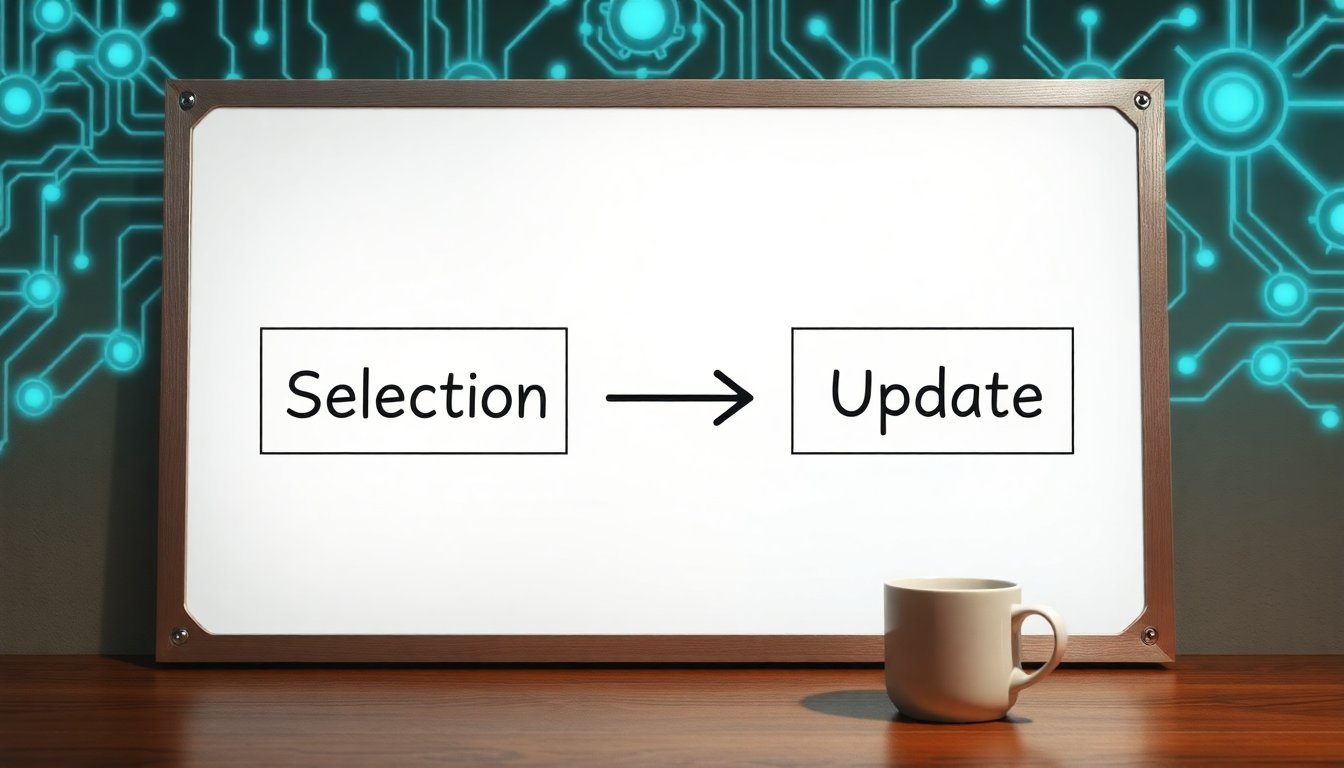
The paper, published on arXiv on April 7, 2026, identifies a fundamental flaw in all current policy-gradient methods: they simultaneously decide which completions deserve higher probability and how to adjust the model's parameters to achieve that. This coupling means that a bad learning rate or aggressive clipping can cause the update to 'overshoot' into a degenerate policy or 'undershoot' and make no progress. TPO splits this into two stages: first, it computes a target distribution over completions based purely on their scores; second, it uses a separate, stable procedure to move the model's parameters toward that target. This is not a tweak—it is a conceptual refactoring of RL for language models.
My view: This is the most important RL alignment paper since the original RLHF paper. The teams at OpenAI and Anthropic have spent years engineering around PPO's fragility—custom clipping, KL penalties, reward normalization, and a dozen other hacks. TPO eliminates the need for all of them. The labs that invested heavily in PPO infrastructure now have a stranded asset.
Who Benefits First From This Separation?
Smaller teams and open-source projects benefit disproportionately. TPO's stability means you don't need a team of RL engineers to tune the optimizer—you can run it with default hyperparameters and get reliable results. This directly undercuts the argument that frontier alignment requires massive compute and specialized talent. DeepSeek, which has already shown a willingness to adopt novel RL techniques, could integrate TPO into its pipeline within weeks. By contrast, OpenAI's internal RLHF stack is deeply optimized for PPO—rewriting it for TPO would be a multi-month engineering project with no guarantee of immediate improvement over their hand-tuned baseline.
What Does This Mean for the Cost of Alignment?
The paper does not provide explicit compute benchmarks, but the implications are clear: TPO reduces the number of failed training runs caused by policy collapse. In practice, RLHF today requires running multiple seeds and discarding those where the policy diverges. TPO's stable updates mean fewer wasted runs, lower total compute, and faster iteration. For a lab spending $10M per training run, a 20% reduction in failed runs saves $2M per attempt. This is a direct economic advantage for early adopters.
| Dimension | PPO / GRPO | TPO |
|---|---|---|
| Update mechanism | Joint selection and update | Decoupled target and update |
| Stability | Fragile, requires clipping and KL penalties | Stable by construction |
| Hyperparameter sensitivity | High (learning rate, clip range, batch size) | Low (defaults work) |
| Infrastructure complexity | High (custom optimizers, reward normalization) | Low (standard optimizer) |
| Failed runs | Common (policy collapse) | Rare |
| Verdict | Legacy approach, high maintenance | Winner: TPO — cheaper, simpler, more reliable |
My thesis is that TPO is not just an incremental improvement—it is a paradigm shift that will force every major AI lab to reconsider their RL alignment stack within the next year. I believe this because the paper identifies a genuine structural flaw in existing methods, not a mere empirical advantage. The separation of selection and update is mathematically cleaner and practically more robust. In the short term, we will see a flurry of replication and extension papers. Within six months, every serious open-source RLHF library will have a TPO implementation. The losers are the closed-source labs that have optimized their entire alignment pipeline around PPO—they face a painful migration or a growing technical debt. I predict that DeepSeek will publish a TPO-based alignment result on a frontier model by Q3 2026, because they have the technical agility and the incentive to demonstrate superiority over closed-source methods.
- DeepSeek will release a TPO-aligned model with superior instruction-following compared to its PPO-based predecessor by Q3 2026.
- OpenAI will publicly acknowledge TPO's advantages but delay adoption until late 2026 due to infrastructure inertia.
- Within 12 months, at least three major open-source RLHF libraries will deprecate PPO in favor of TPO as the default algorithm.
- TPO eliminates the primary source of instability in RL for LLMs, making alignment more accessible to smaller teams.
- The real competitive moat in AI is shifting from massive compute to algorithmic efficiency—TPO is a case in point.
- Closed-source labs that resist adopting TPO will face a growing gap in alignment quality and cost.






Discussion
Add a comment