
Three AI Labs Talk Safety While Trump Team Looks Away
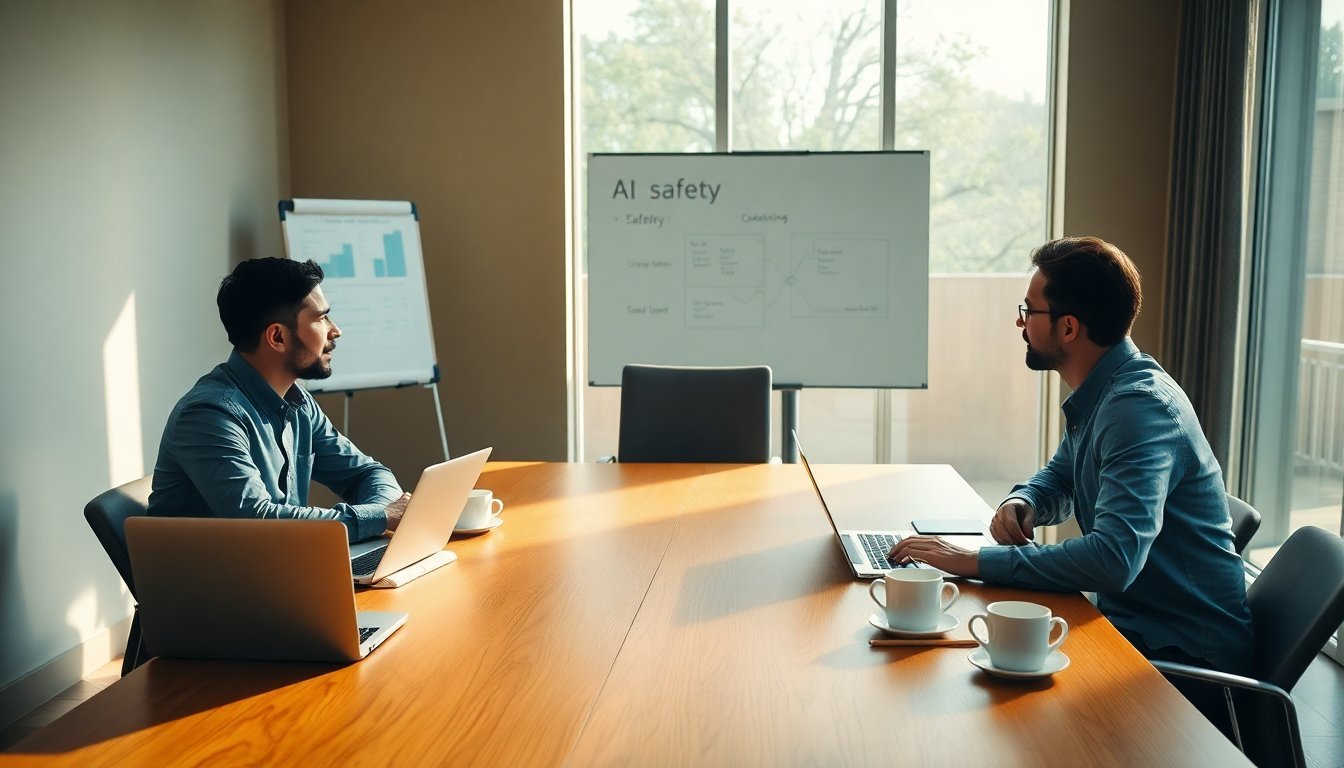
OpenAI, Anthropic, and Google DeepMind have been meeting on AI safety for weeks, TechCrunch reported on September 15, 2026, even as the Trump administration deprioritizes safety in favor of China-competition framing. The talks signal that frontier labs are building a private standard-setting regime before Washington forecloses one.
OpenAI confirmed on September 15, 2026 that it has spent weeks in AI safety discussions with Anthropic and Google DeepMind — a three-way coordination that has no precedent at this level of competitive intensity. The timing is not accidental: the Trump administration has publicly dismissed safety concerns and framed the AI race as a China-competition problem. These talks are the labs hedging against a regulatory vacuum they can see coming.
- What happened: OpenAI confirmed weeks of AI safety talks with Anthropic and Google DeepMind, per TechCrunch (September 15, 2026).
- Why it matters: The three largest frontier labs are coordinating safety standards without a federal mandate, effectively privatizing AI governance.
- Key tension: The Trump administration is dismissing safety concerns and pushing for speed against China — leaving the labs to self-regulate or risk being regulated later by someone less friendly.
- What this article resolves: Whether this is genuine safety coordination or competitive theater, and who wins if the talks produce a formal framework.
What Did OpenAI Actually Confirm?
According to TechCrunch, OpenAI confirmed on September 15, 2026 that it has been in talks on AI safety with Anthropic and Google DeepMind for several weeks. The confirmation is notable because these three companies are direct competitors on model capability, pricing, and enterprise contracts. TechCrunch reported that the talks are ongoing and that no formal framework has been announced. The word "confirmed" matters. OpenAI did not leak this — it acknowledged it. That is a signal to two audiences: Washington (we are handling this) and the market (we are the adults in the room). The absence of a published agenda or deliverable after weeks of talks suggests the group is still negotiating scope, not issuing communiqués.Why Is the Trump Team Dismissing Safety Concerns?
TechCrunch reported that the Trump administration has dismissed safety concerns and is instead prioritizing keeping pace with China. This is a policy stance, not a rhetorical one — it shapes procurement, export controls, and the regulatory posture agencies take toward frontier labs. According to TechCrunch, the administration's framing treats AI primarily as a geopolitical competition rather than a risk-governance problem. That framing has a direct consequence: if the federal government will not set safety standards, someone else will. The three labs in these talks are functionally volunteering to be that someone. Whether they do it well is a separate question from whether they will do it at all.
Who Wins If the Labs Set Their Own Standards?
The immediate winners are OpenAI, Anthropic, and Google DeepMind. A standard written by the three largest labs will be calibrated to their existing safety infrastructure, evaluation pipelines, and compute budgets. Compliance becomes a fixed cost they already pay and a marginal cost new entrants cannot absorb. The losers are smaller labs, academic groups, and open-source developers. They get rules they did not write and cannot easily meet. The Trump administration loses narrative control — it wanted to be the deregulatory counterweight to Brussels, and instead it is watching private actors fill the vacuum.| Actor | Position on Safety Talks | Likely Outcome |
|---|---|---|
| OpenAI | Confirmed participant; wants visible coordination | Sets standard, gains trust narrative |
| Anthropic | Participant; safety-first brand identity | Validates its positioning, gains policy leverage |
| Google DeepMind | Participant; balancing speed and safety | Protects enterprise contracts, hedges regulatory risk |
| Trump administration | Dismissive of safety concerns | Loses standard-setting influence to private sector |
| Smaller labs / open source | Not at the table | Faces compliance costs set by competitors |
| Verdict | The three frontier labs win — they convert a regulatory vacuum into a competitive moat. |
Is This Coordination or Collusion?
This is the hard question, and the honest answer is that the evidence does not yet distinguish between the two. Safety coordination between competitors is legal and often encouraged, but it sits close to the line where standard-setting becomes market allocation. TechCrunch reported the talks as safety-focused, and there is no public evidence of pricing or capability coordination. But the structural incentive is clear: a shared safety standard raises rivals' costs. Regulators — particularly the FTC and the EU AI Office — will eventually ask whether these meetings produced anything beyond safety. The labs should assume that question is coming.What Happens If Washington Changes Its Mind?
If the Trump administration reverses course — through a new executive order, a congressional push, or a change in personnel — the private framework these labs are building becomes the baseline a regulator works from, not a substitute for one. That is the strategic bet: build the standard now so that any future regulation looks like codification rather than imposition. According to TechCrunch, the talks have been underway for weeks with no formal output. That timeline matters. Weeks of meetings without a published framework suggests either genuine complexity or a deliberate slow-walk until the political environment clarifies. Either way, the labs are buying optionality.
Thesis: These talks are not primarily about safety — they are about who writes the rules when the government refuses to. The three frontier labs are using a regulatory vacuum to build a standard that entrenches their advantage, and they are doing it in public enough to claim legitimacy.
In the short term, expect a joint statement or a published framework within one to two quarters. It will be principles-based, not prescriptive, because prescriptive rules would bind the authors. In the long term, this becomes the reference document that the EU AI Office and any future US regulator cite when they do act.
The clearest winner is Anthropic, whose safety-first brand gets validated by the two largest competitors showing up to the same table. The clearest loser is the open-source ecosystem, which will face a standard it had no role in writing. The Trump administration loses the most in narrative terms — it wanted to own the deregulation story and now looks like it is ceding the field.
Prediction: Anthropic will publish a public summary of these talks before OpenAI or Google DeepMind do, because its brand depends on being seen as the safety leader rather than a participant.
Predictions
1. By Q1 2027, the three labs will publish a joint safety framework document. It will be principles-based and will not include binding evaluation thresholds, because binding thresholds would constrain the authors. 2. The EU AI Office will cite the framework in a formal guidance document by mid-2027, treating it as evidence of industry consensus and using it to justify lighter-touch enforcement on frontier model providers. 3. The FTC will open a preliminary inquiry into the talks by Q2 2027, focused on whether safety coordination functioned as a mechanism for raising rivals' costs — even if it finds no violation.- September 2026OpenAI confirms safety talks
OpenAI confirms weeks of AI safety discussions with Anthropic and Google DeepMind, per TechCrunch.
- September 2026Trump team dismisses safety concerns
The administration frames AI policy around China competition rather than risk governance.
- Q1 2027Predicted joint framework
The three labs are expected to publish a principles-based safety framework document.
Frontier Lab Positioning on Safety Coordination (estimated)
Article Summary
- OpenAI confirmed weeks of safety talks with Anthropic and Google DeepMind, per TechCrunch (September 15, 2026) — a three-way coordination with no precedent at this competitive level.
- The Trump administration's dismissal of safety concerns is the direct cause: with no federal standard, the labs are writing one themselves.
- The structural winners are the three frontier labs, which convert a regulatory vacuum into a compliance moat; the losers are smaller labs and open-source developers.
- The coordination-versus-collusion question is unresolved and will draw FTC and EU scrutiny regardless of intent.
- The strategic bet is that any future regulation will codify the private framework rather than replace it.
Source and attribution
TechCrunch AI
OpenAI, Anthropic, Google have been in talks on AI safety for weeks






Discussion
Add a comment