


Skild's S1 Video Trick Is Real. Production Is the Fight.
Skild AI's S1 foundation model promises to teach robots new long-horizon tasks from one video, announced via NVIDIA's physical-AI blog. The capability is plausible; the evidence is thin. Here is what is known, what is inferred, and who actually wins.
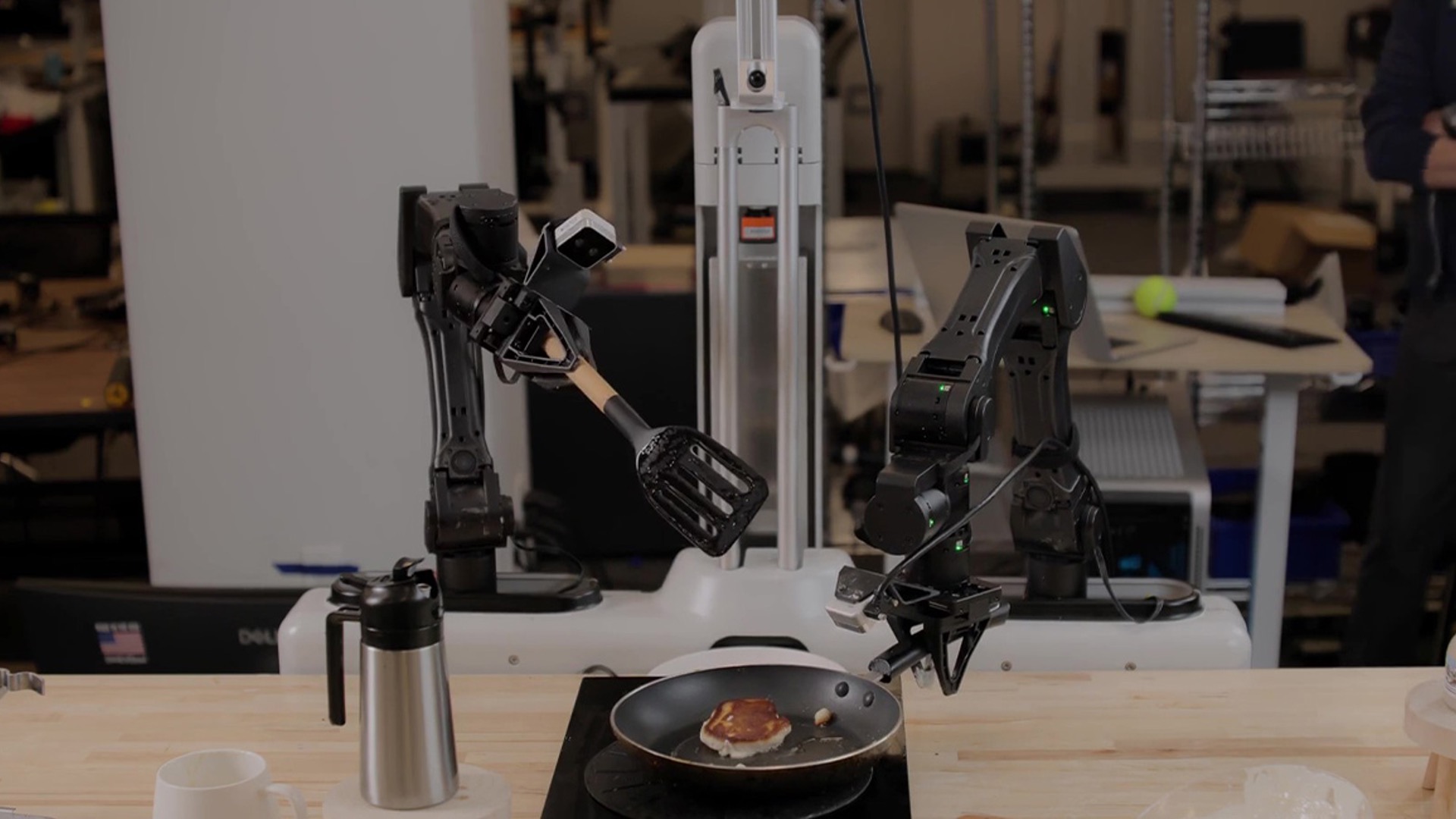
Skild AI launched its S1 robot foundation model last week, and NVIDIA's own blog is the loudest megaphone for it: a machine that learns previously unseen, long-horizon tasks from a single video demonstration. That is a different claim than 'a robot did a trick once.' It is a claim about reprogramming cost — the thing that actually keeps factory robots dumb.
- What happened: Skild AI launched the S1 robot foundation model last week, designed to learn previously unseen, long-horizon tasks from a single video demonstration, per NVIDIA's blog.
- Why it matters: The bottleneck in industrial robotics is not hardware — it is the reprogramming cost every time a line, layout, or product changes.
- The tension: One-shot video learning is a research-grade claim being marketed as a deployment-grade fix, and the launch venue is a vendor blog rather than a peer-reviewed benchmark.
- What to watch: whether third-party operators reproduce the claim outside curated demos, and whether NVIDIA's physical-AI stack becomes the default substrate.
What Exactly Did Skild AI Announce?
According to NVIDIA's blog, Skild AI's S1 robot foundation model is designed to learn previously unseen, long-horizon tasks from a single video demonstration, and the model was launched last week. The post frames the problem in operational terms: manufacturing floors, warehouses and production lines rarely stay fixed, tasks change, layouts shift, new products arrive, and most robots cannot keep up without significant reprogramming. That framing is the most important sentence in the source, because it tells you Skild is selling a reduction in integration labor, not a new robot. The source material available to me is a truncated summary — the NVIDIA post cuts off mid-sentence ("uses […]") — so I am explicitly not claiming details about the model architecture, parameter count, training data, or the specific NVIDIA hardware or software stack involved. What is verifiable is the claim itself and the venue. Everything else in this article is labeled as inference.Why Does 'One Video' Change the Economics?
The reason a single-video demonstration matters is that it attacks the cost line that has always protected incumbent integrators. Traditional industrial robot deployment requires explicit programming or teach-pendant demonstration, then re-validation every time the task drifts. A foundation model that generalizes from one human or robot video collapses that cycle from weeks of engineering to something closer to hours of capture and review. NVIDIA reported the model is aimed at "previously unseen, long-horizon tasks" — long-horizon being the operative phrase. Single-step pick-and-place has been demonstrated in research for years; multi-stage tasks with sequencing and recovery are where generalization usually breaks. Skild is claiming the hard version. That is either a serious technical result or a marketing overreach, and the source does not yet let a reader distinguish which.
Is the Evidence Strong Enough to Believe It?
No — not yet, and the honest answer is that the launch format is the problem. The announcement surfaced on NVIDIA's corporate blog, which is a distribution channel with an interest in the story, not an independent evaluation. NVIDIA said the S1 model learns from a single video demonstration; what the source does not provide is a success rate, a task list, an operator name, or a failure taxonomy. For a claim about production reliability, those are the only numbers that matter. This is not a knock on Skild's engineering. It is a statement about evidentiary standards. A one-shot learning claim is falsifiable in a very specific way: give the model a task it has never seen, in a workspace it has never seen, and count successes over a hundred trials. Until that number is public, the correct posture is interested skepticism. I would revise this position immediately on a published third-party trial.Skild vs. the Incumbents: Who Actually Has the Edge?
The comparison that matters is not Skild versus another foundation-model startup — it is Skild versus the integration model that already owns the factory floor. Traditional integrators win on liability, service contracts, and validated repeatability. Skild wins on adaptability and time-to-new-task, if the claim holds.| Dimension | Skild AI S1 (per NVIDIA blog) | Traditional industrial robot programming |
|---|---|---|
| New task acquisition | Single video demonstration | Explicit code or teach-pendant, engineer-led |
| Time to redeploy on layout change | Claimed to be dramatically shorter (inferred) | Weeks of engineering and re-validation |
| Long-horizon task support | Explicitly targeted | Supported but hand-engineered per task |
| Published reliability data | Not in available source | Mature, contractual, audited |
| Liability and service model | Unclear | Established integrator contracts |
| Verdict | Higher ceiling, unproven floor | Lower ceiling, proven floor — for now |
Who Really Wins From This Launch?
NVIDIA is the unambiguous near-term winner. The story is published on NVIDIA's physical-AI blog, which means Skild's headline capability is being used to validate NVIDIA's positioning as the compute and tooling layer for embodied AI. Even if S1 underdelivers, the narrative that physical AI runs on NVIDIA infrastructure survives intact. Skild captures upside only if the capability is independently reproduced. The likely loser is the mid-tier systems integrator whose margin comes from reprogramming hours. If one-video task acquisition works even partially, that labor gets compressed. The robot OEMs are a split case: they gain a cheaper path to adaptability but risk becoming hardware commodity if the intelligence layer is owned by a third party like Skild.
Thesis: Skild's S1 is a credible technical direction launched with an evidence gap, and the gap — not the model — is what will determine whether Skild becomes a platform or a footnote.
In the short term, expect a wave of "single-video robot learning" announcements from every well-funded embodied-AI startup, because the claim is now a category marker. That is bad for signal and good for NVIDIA, which sells into all of them. In the long term, the winner is whoever publishes the boring number: success rate on unseen long-horizon tasks in a customer facility. My concrete prediction: within nine months, Skild will publish or authorize a third-party trial with a named manufacturing or logistics customer, because the current evidence standard will not survive procurement review at any serious industrial buyer.
Predictions
1. Skild AI will publish a named-customer pilot result — with a success-rate figure on unseen tasks — by mid-2027, or lose its early enterprise pipeline to integrators demanding validated repeatability. 2. NVIDIA will fold S1-style one-shot learning into its physical-AI developer tooling as a first-class workflow by Q2 2027, making the capability a platform feature rather than a startup differentiator. 3. At least two competing robot foundation-model startups will ship "learn from one video" marketing claims within six months, degrading the phrase into a category label rather than a proof point.- September 2026S1 launch
Skild AI launches the S1 robot foundation model, announced via NVIDIA's physical-AI blog, targeting one-video learning of long-horizon tasks.
- Mid-2027 (predicted)Evidence test
Skild publishes or authorizes a named-customer trial with a success-rate figure, or loses enterprise pipeline momentum.
- Q2 2027 (predicted)Platform absorption
NVIDIA folds one-shot learning into its physical-AI developer tooling, commoditizing the capability.
Estimated relative redeployment effort per new task (index, traditional = 100)
What Should Readers Remember?
- The real product here is reprogramming-cost reduction, not robot intelligence — judge every claim against integration hours saved.
- The launch venue (NVIDIA's blog) is a strategic signal: NVIDIA is positioning itself as the substrate for embodied AI regardless of which model wins.
- One-shot video learning is falsifiable, and the falsifying test is a published success rate on unseen tasks in an unseen workspace — demand that number.
- The mid-tier systems integrator is the most exposed incumbent, because its margin is exactly the labor S1 claims to eliminate.
- Skild's window to convert a demo into a platform is roughly four quarters, after which the capability becomes table stakes.
Source and attribution
NVIDIA Blog
Skild AI Taps NVIDIA Physical AI to Teach Robots New Tasks From a Single Video






Discussion
Add a comment