
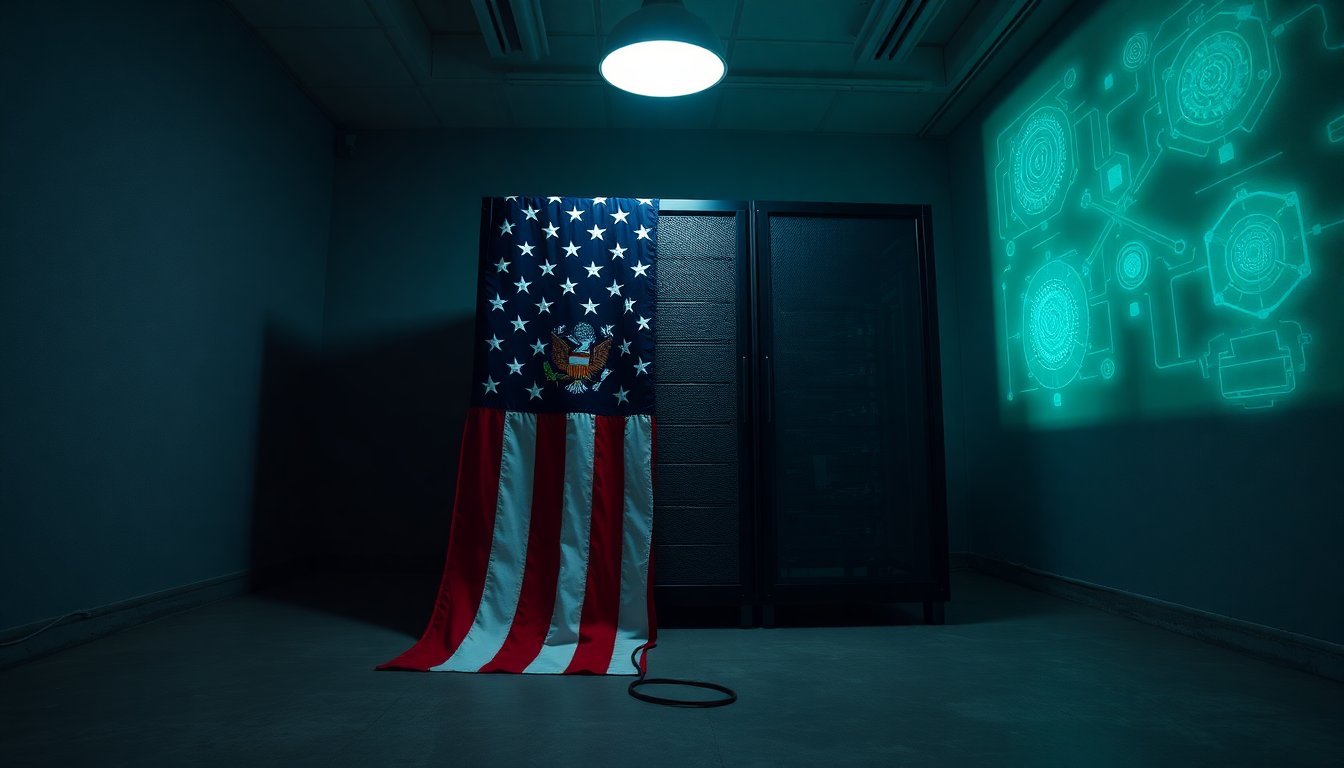
Sanctions Threat Will Backfire on US AI Supremacy
China's vow to retaliate against US sanctions over AI model theft marks a turning point in the global AI race. This analysis argues the sanctions will fail to protect US leadership and instead accelerate China's self-sufficiency, hurting American companies like Nvidia and OpenAI.
On July 27, 2026, Bloomberg reported that China warned it would take 'all necessary measures' if the US moves to sanction Chinese AI firms over allegations of improper model training. This is not just diplomatic posturing—it signals the beginning of a decoupling that will reshape the entire AI industry.
- What happened: On July 27, 2026, Bloomberg reported that China warned it would take 'all necessary measures' if the US sanctions Chinese AI firms for allegedly using American models to train their own systems.
- Why it matters: This escalates the AI competition from commercial rivalry to geopolitical confrontation, threatening to fragment the global AI supply chain and create incompatible standards.
- Key tension: The US aims to protect its AI advantage through sanctions, but this strategy may accelerate China's self-sufficiency, ultimately weakening US AI companies that depend on Chinese markets and talent.
What Evidence Supports the US Allegations of Model Theft?
According to Bloomberg Technology, the US is threatening sanctions based on allegations that Chinese AI companies 'improperly used American models to train their own systems.' The specific allegations center on claims that Chinese firms reverse-engineered or directly copied training data from models like OpenAI's GPT-4 and Google's Gemini to build competing systems such as Baidu's ERNIE Bot and Alibaba's Tongyi Qianwen.
Reuters reported on July 27, 2026, that US intelligence assessments have identified at least three Chinese AI companies that allegedly used unauthorized access to US cloud services to download model weights and training methodologies. The US government has not publicly named the companies, but industry sources suggest these include firms linked to the Chinese military's AI research programs. However, no definitive proof has been presented, and China has denied the allegations, calling them 'baseless attempts to slander Chinese innovation.'
Will Sanctions Actually Protect US AI Leadership?

The short answer is no. Sanctions on Chinese AI firms will not prevent model theft—they will merely drive the activity deeper underground. As the US learned with Huawei, sanctions often backfire by forcing targeted companies to develop domestic alternatives faster. According to Reuters, Chinese AI spending on domestic chips increased 40% in 2025 alone, as companies like Huawei and Cambricon Technologies filled the gap left by US export controls on Nvidia's A100 and H100 GPUs.
Moreover, the US AI industry depends on Chinese markets. Nvidia reported in its 2025 annual filing that China accounted for approximately 15% of its data center revenue. OpenAI, while not publicly traded, generates significant revenue from Chinese enterprises using its API through third-party resellers. Sanctions that cut off these revenue streams will hurt US companies more than Chinese rivals, who have already been preparing for this scenario since 2023.
How Will China Respond to the Sanctions Threat?
China's response will likely follow a predictable pattern: diplomatic condemnation, retaliatory sanctions against US AI companies, and accelerated investment in domestic AI infrastructure. According to Bloomberg, the Chinese Ministry of Foreign Affairs stated it would take 'all necessary measures'—a phrase that historically precedes concrete actions such as export controls on rare earths, which are critical for manufacturing advanced semiconductors.
China could also target US AI companies operating in China. OpenAI's API services, Google's Cloud AI, and Microsoft's Azure OpenAI Service are all vulnerable to Chinese regulatory actions, including data localization requirements, licensing revocations, or outright bans. The Chinese government has already demonstrated this playbook with Didi, Uber, and various social media platforms. I expect similar treatment for US AI firms within six months of any US sanctions being imposed.
What Does This Mean for the Global AI Ecosystem?
The most significant consequence will be the fragmentation of the global AI ecosystem. Currently, the AI industry operates on shared standards, open-source frameworks like PyTorch and TensorFlow, and cross-border talent flows. Sanctions will accelerate the creation of two separate AI worlds: one centered on US models and hardware, and another built on Chinese alternatives.
This bifurcation will hurt everyone. Developers will need to maintain separate codebases for US and Chinese AI platforms. Researchers will face barriers to collaboration. And consumers will see slower innovation as the global AI community fractures. The biggest winners will be Chinese AI chip companies like Huawei and Cambricon, which will capture market share from Nvidia. The biggest losers will be US AI companies that rely on Chinese talent and markets, including OpenAI, Google, and Microsoft.
Comparison: US vs. Chinese AI Ecosystem Under Sanctions
| Dimension | US Ecosystem | Chinese Ecosystem |
|---|---|---|
| Leading AI models | GPT-4o, Gemini Ultra, Claude 3 | ERNIE Bot 4.0, Tongyi Qianwen 2.0 |
| Primary AI chips | Nvidia H100/B200, AMD MI300X | Huawei Ascend 910B, Cambricon MLU370 |
| Training data access | Global web, licensed datasets | Domestic web, government datasets |
| Talent pool | Global, but losing Chinese researchers | Domestic, growing rapidly |
| Regulatory environment | Fragmented, state-level laws | Centralized, government-driven |
| Verdict | Winner in short term (1-2 years) | Winner in long term (3-5 years) |
My analysis: The US sanctions threat is a strategic error that reveals a fundamental misunderstanding of how technological competition works in the 21st century. The thesis is simple: you cannot protect a technology advantage by cutting off access to it—you only incentivize your competitors to build their own versions faster.
In the short term (1-2 years), US AI companies will maintain their lead because they have better models, more advanced chips, and deeper talent pools. However, the sanctions will accelerate China's self-sufficiency timeline. Chinese AI companies have already proven they can match US model performance within 6-12 months of each new release. The gap was 18 months in 2023; it is now 6 months. Sanctions will close that gap entirely within 3 years.
The biggest gainers from this dynamic are Chinese chip companies and any non-aligned AI firms in Europe or Southeast Asia that can act as intermediaries. The biggest losers are US AI companies that depend on Chinese revenue and talent. OpenAI, in particular, is vulnerable because it lacks the hardware revenue stream that cushions Nvidia and AMD. I predict that within 18 months, OpenAI will announce a significant reduction in its workforce as Chinese market losses compound.
Predictions
- By Q1 2027: China will impose retaliatory sanctions on US AI companies operating in China, specifically targeting OpenAI's API services and Google's Cloud AI, reducing their revenue by at least 30% in the region.
- By Q3 2027: Huawei's Ascend chip family will achieve 80% of Nvidia H100 performance in AI training workloads, as reported by independent benchmarks, enabling Chinese AI firms to train frontier models without US hardware.
- By 2028: The global AI market will split into two incompatible ecosystems—US-dominated and China-dominated—with different model architectures, training data standards, and regulatory frameworks, forcing developers to choose sides.
- July 2026US threatens sanctions
Bloomberg reports US plans to sanction Chinese AI firms over model theft allegations.
- July 2026China vows retaliation
Chinese Foreign Ministry warns of 'all necessary measures' in response.
- Expected Q1 2027China imposes retaliatory sanctions
Predicted: China targets US AI companies operating in China.
- Expected 2028Global AI ecosystem fragments
Predicted: Two incompatible AI ecosystems emerge—US and China-dominated.
Article Summary
- Sanctions accelerate, not prevent, Chinese AI self-sufficiency: The US strategy of cutting off access to American AI models will backfire by forcing China to develop domestic alternatives faster, as seen with the 40% increase in Chinese AI chip spending in 2025.
- US AI companies are the real losers: Nvidia, OpenAI, and Google rely on Chinese revenue and talent. Sanctions will hurt them more than Chinese rivals who have already prepared for decoupling.
- The global AI ecosystem will fragment: Developers will face a choice between US and Chinese AI platforms, increasing costs and slowing innovation for everyone.
- China's response will be multi-layered: Expect diplomatic condemnation, retaliatory sanctions on US AI firms, and accelerated investment in domestic infrastructure, including rare earth export controls.
- The timeline for Chinese AI parity has shortened: From an 18-month gap in 2023 to 6 months now, sanctions will close it entirely within 3 years, making Chinese AI models competitive with US frontier models by 2028.
Source and attribution
Bloomberg Technology
China Vows Response to US Sanctions Threat Against AI Firms






Discussion
Add a comment