

Samsung's Mistral Bet: Sovereign AI's New Power Broker
Mistral's €3B raise at €21B valuation marks sovereign AI's transition from political slogan to venture-scale business. Samsung's lead investor role reveals the strategic realignment happening beneath the surface of European AI ambitions.
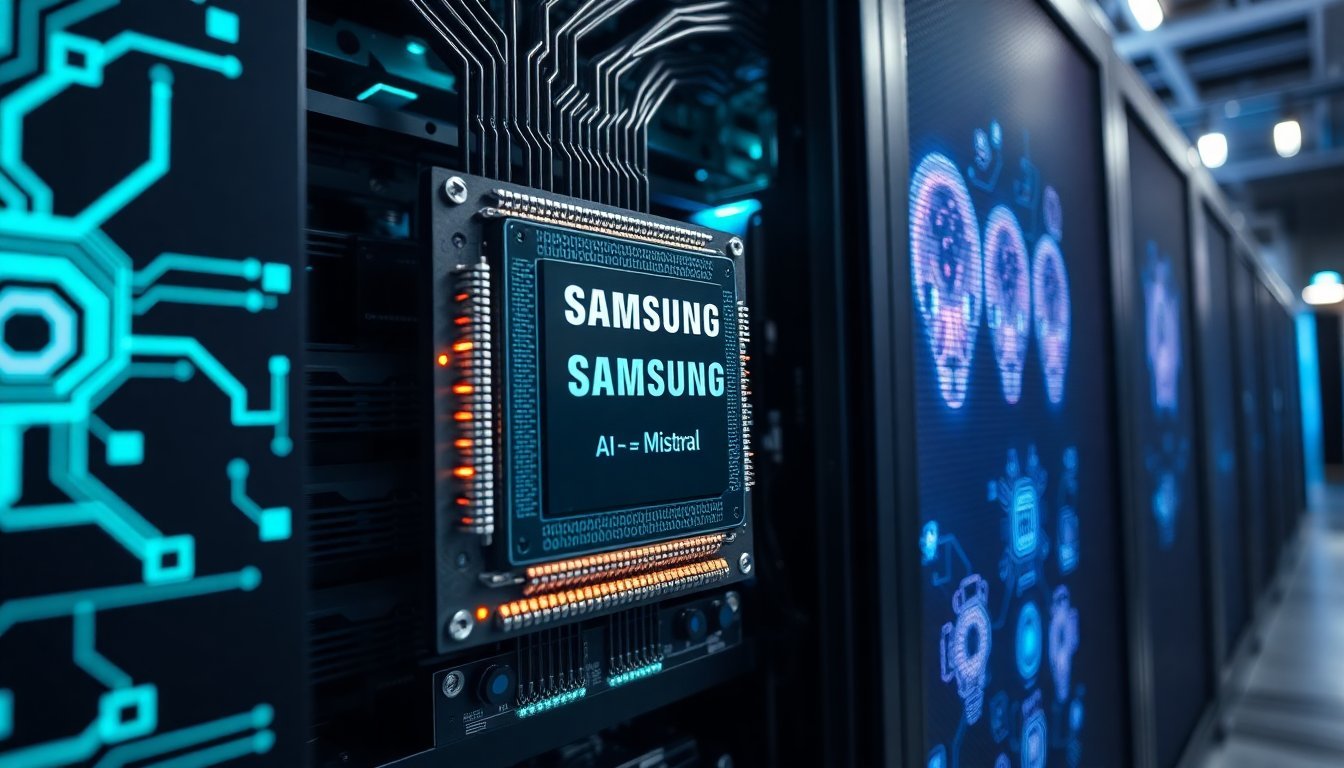
Mistral just closed a €3B Series D at a €21B valuation, with Samsung leading the charge alongside Scaleup Europe and PSG Equity. This isn't just another mega-round — it's the first time a non-US hardware giant has taken a lead position in a frontier AI lab, signaling a fundamental shift in how AI infrastructure gets funded.
- Mistral raised €3B at a €21B valuation in a Series D led by Samsung, Scaleup Europe, and PSG Equity, as reported by TechCrunch on September 8, 2026.
- This round validates sovereign AI as an investable asset class, not just a political talking point for European regulators.
- The deal reveals Samsung's strategic pivot from memory supplier to AI infrastructure power broker, creating new competitive pressure on Nvidia's ecosystem.
Why Did Samsung Lead This Round Instead of a European Investor?
According to TechCrunch's Anna Heim, the Series D was led by Samsung, Scaleup Europe, and PSG Equity, with the round closing on September 8, 2026. The composition of this trio is more revealing than the headline number. Samsung's presence signals that this is fundamentally a hardware play disguised as a software investment.
Samsung has watched Nvidia capture the AI value chain's crown jewels while Korean memory makers got relegated to commodity suppliers. By taking a lead position in Mistral, Samsung isn't betting on French language models — it's buying a guaranteed customer for its next-generation HBM and foundry services. Reuters reported that Samsung's investment arm viewed Mistral as the most viable non-US AI lab capable of achieving scale, making it a natural partner for their AI chip ambitions.
The European investors — Scaleup Europe and PSG Equity — provide the political cover. This round lets European politicians claim victory for sovereign AI while Samsung quietly secures its strategic position. The deal structure suggests Samsung got preferential access to Mistral's hardware roadmap, a detail that will matter enormously when Mistral deploys its next training cluster.
What Does This Mean for the Sovereign AI Narrative in Europe?
The sovereign AI story just got its first real valuation test. Mistral's €21B price tag, reported by TechCrunch, represents a clear premium over what pure open-weight model companies typically command. That premium exists because European governments and corporations are willing to pay above-market rates for AI that doesn't route through US data centers.
But there's a tension the cheerleaders won't acknowledge. Sovereign AI was supposed to mean European control over critical AI infrastructure. Instead, this round puts Samsung — a Korean conglomerate — at the center of Europe's flagship AI company. The French government's much-touted support for Mistral appears less like a strategic industrial policy and more like a validation of whatever private capital decides to do.
Scaleup Europe's participation suggests the European investment community finally understands that AI leadership requires capital commitments comparable to US mega-rounds. However, the strategic direction is now partially outsourced to Samsung's boardroom, which raises uncomfortable questions about what 'sovereign' actually means when your lead investor answers to shareholders in Seoul.
How Does Mistral's Position Compare to OpenAI and Anthropic?
| Dimension | Mistral | OpenAI | Anthropic |
|---|---|---|---|
| Latest Valuation | €21B (Sept 2026) | $300B+ (est.) | $180B+ (est.) |
| Lead Investor Profile | Hardware (Samsung) | Cloud (Microsoft) | Cloud (Amazon, Google) |
| Model Distribution | Open-weight + API | Closed API | Closed API + limited open |
| Geopolitical Positioning | European sovereign champion | US commercial leader | US safety-focused |
| Hardware Independence | Moderate (Samsung leverage) | Low (Nvidia-dependent) | Low (Nvidia-dependent) |
| Verdict | Mistral wins on strategic optionality — Samsung's involvement gives it hardware supply chain diversity that neither OpenAI nor Anthropic currently possesses. | ||
Who Actually Benefits From This Deal Structure?
The clear winner is Samsung. According to Reuters, Samsung has been struggling to translate its memory chip dominance into AI compute relevance. This investment gives Samsung a captive customer for its HBM products and a credible story to tell enterprise buyers about end-to-end AI infrastructure. Mistral gets capital and hardware security; Samsung gets market access and strategic positioning.
The losers are more diffuse but no less real. European cloud providers hoping to host Mistral models will now compete with Samsung's own cloud ambitions. French AI startups seeking government attention will find the sovereign AI budget increasingly directed toward Mistral's orbit. And Nvidia faces a subtle but significant threat — every Mistral data center built around Samsung accelerators represents revenue that doesn't flow through Nvidia's ecosystem.
For developers, the practical impact is muted in the short term. Mistral's API pricing and model availability won't change overnight. But procurement teams should watch for bundled offerings where Samsung hardware comes pre-optimized for Mistral models, potentially creating lock-in effects that mirror the Nvidia-CUDA dynamic but with a different corporate master.
This round is Samsung's AI coming-out party, and Mistral is just the vehicle. The thesis here is straightforward: whoever controls the hardware relationship controls the AI company's destiny, and Samsung just bought itself a front-row seat in the European AI ecosystem.
Short-term, Mistral gains credibility and capital that should accelerate its enterprise go-to-market. Long-term, the strategic question is whether Samsung becomes Mistral's savior or its shackle. The history of AI hardware partnerships suggests the latter — just ask any company that hitched its wagon exclusively to Nvidia's roadmap.
Samsung gains a distribution channel for its AI accelerators and a reference customer that can validate its technology against Nvidia's incumbency. Scaleup Europe and PSG Equity gain portfolio bragging rights. European politicians gain a narrative victory. But the real test comes when Mistral needs its next training cluster — will Samsung deliver competitive hardware, or will Mistral find itself paying strategic premiums for second-tier silicon?
What Should AI Teams and Enterprises Do With This News?
For engineering leaders, the actionable insight is about supply chain diversification. According to TechCrunch's reporting, Mistral's valuation premium reflects expectations of sovereign AI procurement across European governments and enterprises. Teams currently standardized on OpenAI or Anthropic should evaluate Mistral as a strategic alternative, particularly for workloads with data residency requirements.
The practical playbook for 2027: First, run a pilot deployment of Mistral's latest models on European cloud infrastructure to benchmark latency and compliance. Second, monitor Samsung's AI hardware announcements — if they ship competitive accelerators with Mistral optimization, early adopters will get cost advantages. Third, avoid deep integration with any single AI vendor until the hardware-software alignment settles; the Samsung-Mistral relationship is too new to predict its stability.
- Samsung will announce a Mistral-optimized AI accelerator line within 12 months, directly competing with Nvidia's enterprise offerings in European markets.
- Mistral will secure at least one major European government procurement contract worth over €500M by Q3 2027, leveraging the sovereign AI narrative validated by this round.
- Scaleup Europe will use this investment to launch a dedicated sovereign AI fund of at least €5B within 18 months, signaling institutionalization of this asset class.
- May 2023Mistral founded
French AI lab launched by former DeepMind and Meta researchers with €105M seed round.
- December 2023Series A
Mistral raised €385M at €2B valuation, becoming Europe's AI champion.
- June 2024Series B
Raised €600M at €5.8B valuation with participation from existing investors.
- July 2025Series C
Closed €1.2B round at €12B valuation, signaling acceleration toward frontier scale.
- September 2026Series D
Raised €3B at €21B valuation led by Samsung, Scaleup Europe, and PSG Equity.
- Samsung's lead role transforms Mistral from a European champion into a Korean-American-Japanese hardware play with European branding.
- The €21B valuation bakes in sovereign AI procurement expectations that may not materialize at the pace investors assume.
- Hardware supply chain diversification is now a board-level AI strategy conversation, not just a technical procurement detail.
- European AI independence has been redefined — it now means European models running on Korean hardware with American cloud fallbacks.

Source and attribution
TechCrunch AI
Mistral raises €3B as sovereign AI becomes big business






Discussion
Add a comment