

PES Pattern Splits Agent Persona From Execution: Governance Win?
The PES pattern decouples a drifting persona from a faceless, audited execution layer, connected by a governed contract bridge. This architectural split could determine which agent platforms win regulated enterprise contracts.
A new arXiv paper proposes Persona-Execution Separation (PES), an architecture where an LLM agent's personality and its audited work live in different trust domains. The paper argues that a single trust domain cannot cheaply satisfy both rapid persona evolution and strict execution traceability, a tension every governed enterprise is now facing.
- A new arXiv paper (2608.27427v1) formalizes Persona-Execution Separation (PES), an architecture where agent persona and execution live in separate trust domains.
- The pattern lets organizations evolve agent tone and instructions freely while keeping all stateful work under an immutable audit trail.
- The competitive stakes: vendors that productize this separation will win governed enterprise deals; those relying on monolithic agent stacks face architectural debt.
Why does a single trust domain fail for governed LLM agents?
According to the arXiv paper published August 27, 2026, a single trust domain does not satisfy both requirements cheaply. The paper's authors argue that if the persona and execution share one environment, every persona update risks invalidating the audit trail of past executions, and every audit control slows down persona iteration. This is not a theoretical concern: regulated enterprises in finance, healthcare, and government are already required to explain exactly which instructions produced which stateful actions.
My read: this is the architectural equivalent of separating database reads from writes. The paper is identifying that LLM agents in production have two fundamentally different lifecycles — the persona changes weekly as product teams tune tone and instructions, while the execution log must remain immutable for years to satisfy compliance. Forcing both into one trust domain means compromising one or the other, and most current agent frameworks quietly compromise auditability.
Who wins if Persona-Execution Separation becomes standard practice?
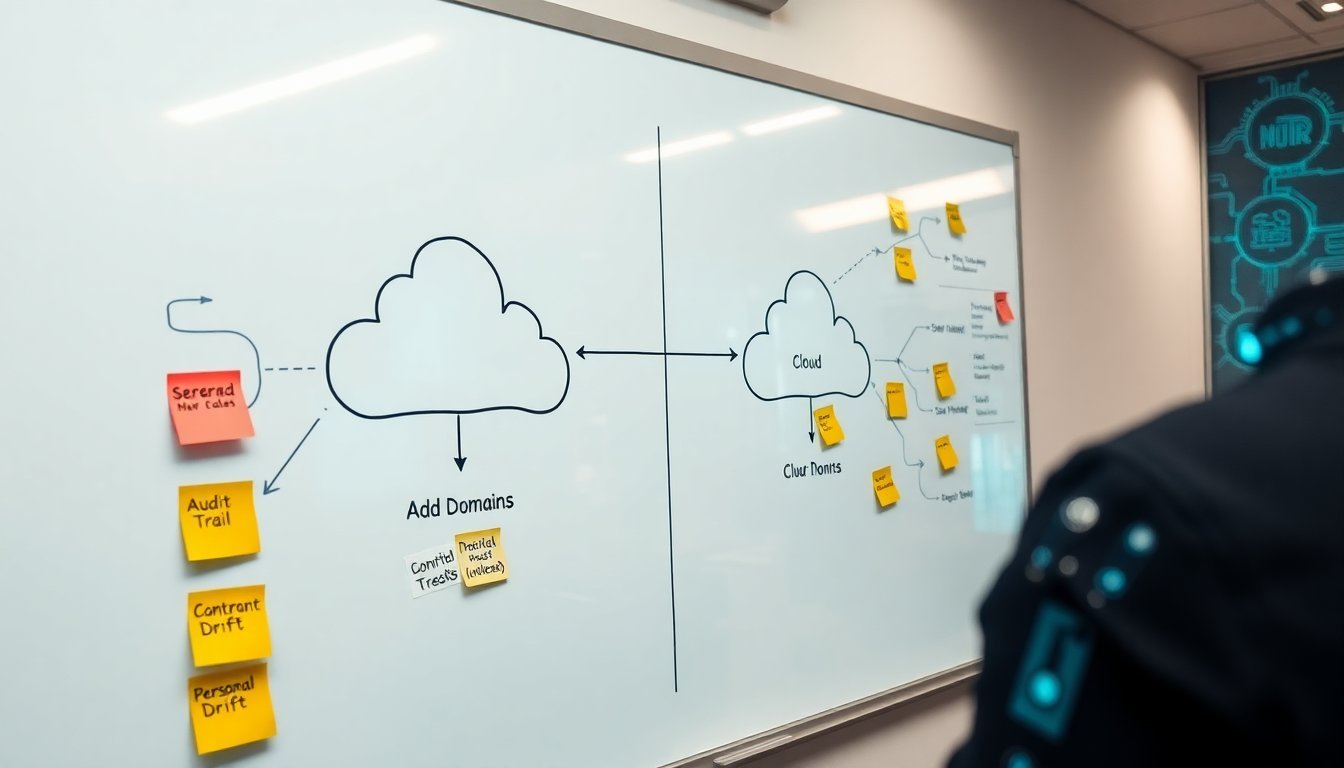
The clear winners are orchestration-layer vendors who can implement the governed contract bridge without requiring enterprises to rebuild their entire stack. Anthropic reported in its June 2026 governed-agents guidance that enterprise buyers are increasingly asking for "behavioral iteration without compliance regression," a phrase that maps almost directly onto the PES pattern. The losers are monolithic agent platforms that treat the persona and execution as inseparable — these will require forklift upgrades as audit requirements tighten.
The paper specifies that the persona is singly-homed and may drift, while execution is faceless and audited. Status summaries may return across the bridge, but raw execution internals stay sealed. This is a clean separation of concerns that maps well onto existing governance frameworks like SOC 2 and ISO 42001, which already distinguish between policy configuration and evidence of control operation.
What does the governed contract bridge actually enforce?
The contract bridge is where the pattern earns its keep. It is not a simple API call; it is a governed interface that defines what persona state can influence execution, what execution results can flow back, and what gets logged at the boundary. The paper's design implies that every crossing of the bridge generates its own audit record, creating a chokepoint that compliance teams can monitor without touching either domain's internals.
This matters because the alternative — instrumenting the persona domain itself — is fragile. According to the paper, allowing persona drift inside the execution domain would contaminate the audit trail with irrelevant stylistic changes. The bridge solves this by making the persona's influence explicit and bounded. For enterprises, this means an auditor can verify that a specific instruction version produced a specific set of actions, without wading through thousands of prompt-tweak commits.
How does PES compare to current agent governance approaches?
| Dimension | Persona-Execution Separation | Monolithic Agent Stack | External Audit Overlay |
|---|---|---|---|
| Persona iteration speed | High — persona drifts freely in its own domain | Medium — every change risks audit invalidation | Low — changes gated by external review |
| Execution auditability | High — faceless, immutable execution domain | Medium — audit mixed with persona state | High — overlay captures actions |
| Implementation cost | Medium — requires bridge design | Low — single deployment | High — retrofitted instrumentation |
| Regulatory alignment | High — matches SOC 2 / ISO 42001 separation | Low — conflates policy and evidence | Medium — depends on overlay completeness |
| Failure isolation | High — persona bug cannot corrupt audit trail | Low — single trust domain propagates faults | Medium — overlay can miss internal state |
| Verdict | Winner for governed enterprises | Suitable only for unregulated, low-stakes use | Useful stopgap, not an architecture |
What remains uncertain about the PES pattern?
The paper is an architecture proposal, not a reference implementation. It does not specify how the governed contract bridge handles multi-step agent workflows where persona influence is deeply interleaved with execution decisions. Nor does it address performance overhead — every bridge crossing adds latency and storage requirements for boundary audit records.
The bigger open question is whether the bridge itself becomes a bottleneck for agentic workflows that require tight feedback loops. If an agent's persona needs to react to execution results in real time, the separation could introduce unacceptable latency. The paper acknowledges status summaries may return, but does not quantify the round-trip cost. Until someone publishes a benchmark on bridge overhead, enterprises should treat PES as a promising pattern, not a proven solution.
My thesis: PES is the first agent architecture pattern that treats governance as a first-class design constraint rather than a bolt-on compliance layer, and it will reshape how enterprises buy agent platforms.
In the short term, expect early adopters to be financial services firms already running strict change-management processes. They will recognize the bridge as analogous to their existing production/development environment separation. In the long term, this pattern will push model vendors to expose cleaner hooks for persona versioning and execution logging, because enterprises will demand them in procurement.
The big winner is any orchestration vendor (LangChain, Microsoft Semantic Kernel, or a startup) that ships a reference implementation of the contract bridge with built-in audit logging. The losers are platforms that bake persona and execution into a single runtime — they will find themselves locked out of regulated deals despite having superior model quality. The risk is that PES becomes a paper pattern that no one implements well, leaving enterprises with the same monolithic choices they have today.
One concrete prediction: within 12 months, at least one major cloud provider will announce a managed agent service that explicitly markets persona-execution separation as a compliance feature, citing this arXiv paper as the architectural foundation.
What should enterprises do with this pattern today?
Do not wait for a vendor to implement PES perfectly. The paper's core insight — that persona and execution have different lifecycle requirements — can be applied immediately by separating prompt version control from action logging in existing agent deployments. Enterprises should begin mapping which of their agent interactions are persona-driven versus execution-critical, and identify where audit requirements are currently being satisfied by weak proxies like full conversation logging.
For procurement teams, add a question to every agent platform evaluation: "Can the persona be updated without invalidating or obscuring the execution audit trail?" If the answer requires a workaround, the vendor has not internalized the PES lesson. This single question will separate governed-agent-ready platforms from demos that only work in sandboxes.
- By Q3 2027, Microsoft will ship a PES-inspired separation layer in Azure AI Agent Service, explicitly marketing persona drift isolation as a compliance feature for financial services.
- Within 18 months, the EU AI Office will reference the persona-execution distinction in updated guidance for high-risk AI systems, requiring auditable separation for stateful agents.
- By mid-2027, at least one major enterprise (a top-10 global bank or insurer) will publish a case study showing PES reduced audit preparation time for agent-driven workflows by over 60%.
- PES reframes the agent governance problem: it is not about restricting what agents can do, but about separating what changes (persona) from what must not (execution record).
- The governed contract bridge is the pattern's key innovation, creating an audit chokepoint that does not exist in monolithic or overlay approaches.
- Vendor lock-in risk is shifting: the differentiator is no longer model quality but governed orchestration, and PES is the blueprint for that layer.
- Enterprises can adopt the PES mindset today through prompt/action separation, even before vendors ship full implementations.
- Audit-readiness is becoming an architectural property, not a compliance afterthought, and PES is the first pattern to treat it that way.
Source and attribution
arXiv
Persona-Execution Separation: An Architecture Pattern for Evolving LLM Agents under Execution Audit






Discussion
Add a comment