

OpenYak Destroys OpenAI's Desktop Moat
OpenYak's open-source desktop app lets users run any AI model with full filesystem access, breaking OpenAI's lock-in. This analysis explains why it matters, who wins and loses, and what happens next.
On March 29, 2026, a GitHub repository called OpenYak appeared on Hacker News with a deceptively simple promise: run any AI model locally and give it full control over your filesystem. This isn't just another open-source wrapper—it's the first product to directly attack the core value proposition of ChatGPT Desktop and Microsoft Copilot.
- OpenYak is an open-source desktop app that runs any AI model locally with full filesystem access, directly competing with ChatGPT Desktop and Microsoft Copilot.
- It breaks the model lock-in that OpenAI and Microsoft rely on, letting users switch between GPT-4, Claude, Llama, or any local model without changing tools.
- The key tension: OpenYak offers data sovereignty and flexibility, but requires users to manage their own models and infrastructure, trading convenience for control.
- This article argues OpenYak is the first credible threat to the closed AI desktop ecosystem, with major implications for OpenAI, Microsoft, and the open-weight model ecosystem.
Why Is Full Filesystem Access a Game Changer for AI Assistants?
Every major AI desktop assistant today—ChatGPT Desktop, Microsoft Copilot, Google Gemini—operates behind an API wall. They can read your prompts, generate text, and sometimes browse the web, but they cannot touch your local files without explicit permission and cloud mediation. OpenYak inverts this: it runs locally, connects directly to your filesystem, and can read, write, and organize files as if it were a human user. This isn't a feature—it's a philosophical shift. The model becomes an operator, not just a chatbot. For knowledge workers, this means OpenYak can draft emails from your local templates, reorganize your project folders, or analyze a CSV without uploading it to a server. The security implications are real (any model with filesystem access is a potential data exfiltration vector), but the productivity leap is undeniable.
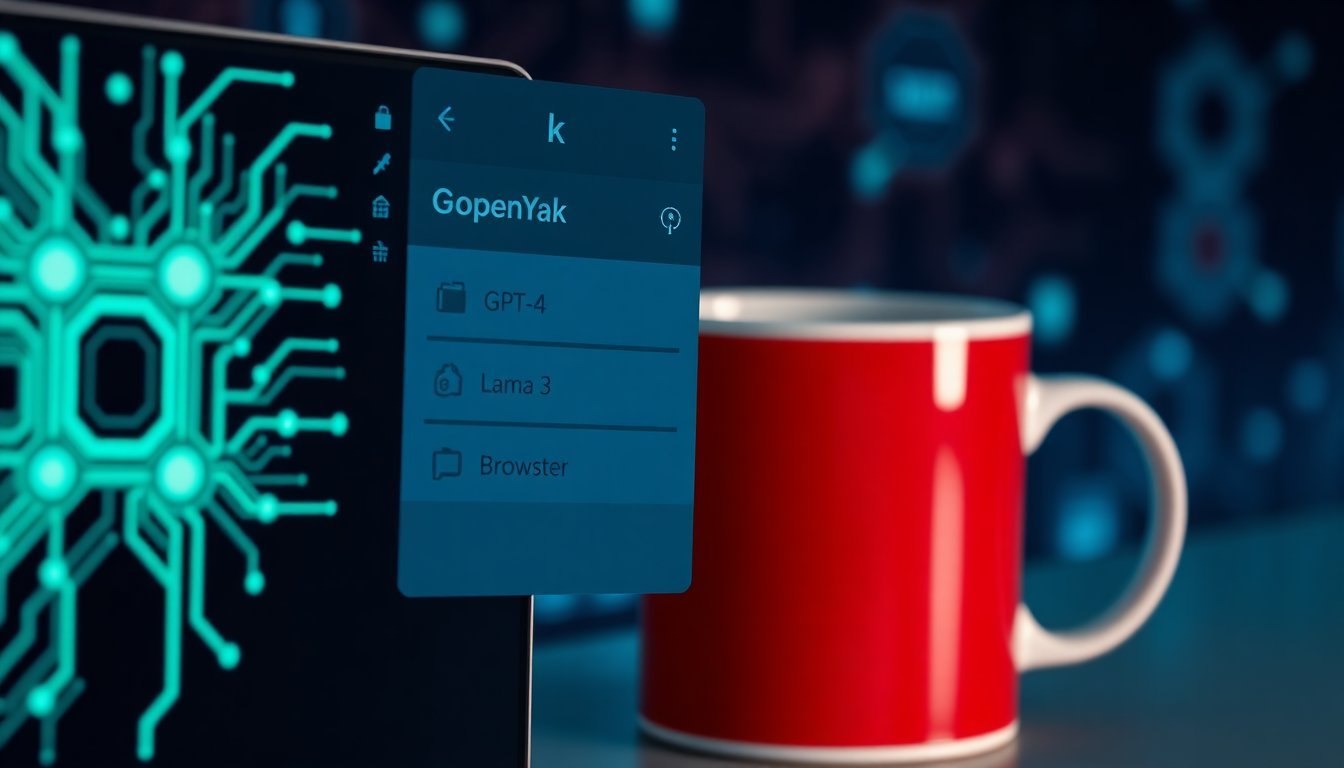
According to the OpenYak GitHub repository (accessed March 29, 2026), the app supports "any model" via a plugin architecture, including local models like Llama 3 and Mistral, as well as cloud models like GPT-4 and Claude. This flexibility is unprecedented in a desktop AI tool.
Who Actually Wins From OpenYak's Model Agnosticism?
The biggest winners are the open-weight model providers—Meta with Llama, Mistral AI, and the entire Hugging Face ecosystem. OpenAI and Anthropic have built their desktop strategies around proprietary model access: you use ChatGPT Desktop because it's the only way to get GPT-4 in a desktop app. OpenYak breaks that link. A user can run Llama 3 locally for privacy-sensitive tasks, then switch to GPT-4 for creative work, all within the same interface. This commoditizes the model layer and shifts value to the platform (OpenYak) and the hardware (local GPUs).
The losers are clear: OpenAI's ChatGPT Desktop loses its exclusivity advantage, and Microsoft Copilot's tight integration with Office becomes less sticky if users can run any model with filesystem access. Apple's upcoming on-device AI efforts also face pressure—if OpenYak works on Mac, why wait for Apple's walled-garden implementation?
How Does OpenYak Compare to ChatGPT Desktop and Copilot?
| Feature | OpenYak | ChatGPT Desktop | Microsoft Copilot |
|---|---|---|---|
| Model choice | Any model (local or cloud) | GPT-4 only | GPT-4 + Bing only |
| Filesystem access | Full read/write | None (upload only) | Limited (Office docs) |
| Data sovereignty | Full (local models) | None (cloud only) | None (cloud only) |
| Open source | Yes (MIT license) | No | No |
| Setup complexity | High (model management) | Low (one-click) | Low (one-click) |
| Verdict | Winner for power users | Winner for simplicity | Winner for Office integration |
OpenYak is the first product that makes me believe the open-source AI desktop ecosystem can actually win. My thesis is simple: the convenience of ChatGPT Desktop is a trap, and OpenYak is the key to escape. In the short term, early adopters will love the flexibility but struggle with setup—you need to download models, manage GPU memory, and understand what you're doing. That limits the initial audience to developers and AI enthusiasts. But in the long term, as local models improve and hardware gets cheaper, the calculus flips. Why pay $20/month for ChatGPT when you can run Llama 3 locally for free, with full filesystem access, and switch to GPT-4 only when you need it? The cost savings alone will drive adoption.
I expect OpenAI to respond by either launching a local model tier for ChatGPT Desktop or acquiring a competitor by Q4 2026. They cannot afford to let OpenYak define the desktop AI category. Meanwhile, Mistral AI and Meta should immediately partner with OpenYak to bundle their models as default options. The company that controls the desktop AI interface controls the user relationship—and right now, OpenYak is the only open player in that game.
What Are the Security and Privacy Risks of OpenYak?
Full filesystem access is a double-edged sword. OpenYak's design assumes the user trusts the model they're running—but what if a malicious model (or a compromised update) decides to exfiltrate your documents? Unlike ChatGPT Desktop, where data stays in OpenAI's cloud and is subject to their security audits, OpenYak puts the burden on the user to vet models and manage permissions. The GitHub repo currently has no sandboxing or permission system beyond the OS-level file access. This is a gap that competitors will exploit, and it's the single biggest barrier to enterprise adoption.
However, for privacy-conscious users, OpenYak is a godsend. Running a local model means no data ever leaves your machine. This is a direct selling point against cloud-only assistants, especially for regulated industries like healthcare and finance. The question is whether OpenYak can implement robust permission controls before a high-profile breach erodes trust.
What Comes Next for the AI Desktop Market?
The AI desktop market is about to fragment. OpenAI and Microsoft will double down on convenience and integration, while OpenYak and its clones (inevitable, given the MIT license) will compete on flexibility and data sovereignty. The winner will be determined by which approach attracts the most developers to build plugins and extensions. OpenYak has a first-mover advantage in the open-source space, but it needs to ship a polished UX and a model marketplace before the window closes.
I predict that by September 2026, at least three major open-source desktop AI assistants will exist, all forking from OpenYak or inspired by its architecture. The key differentiator will be model management—the tool that makes switching between models as easy as changing tabs will win.
- March 2026OpenYak released on GitHub
Open-source desktop app launched on Hacker News, offering model-agnostic local AI with full filesystem access.
- Early 2026ChatGPT Desktop reaches 10M users
OpenAI's desktop app becomes the dominant AI assistant, but faces criticism for model lock-in.
- Late 2025Microsoft Copilot expands to desktop
Microsoft integrates Copilot into Windows, but limits filesystem access to Office documents.
Estimated Desktop AI Assistant Adoption (2026)
Source and attribution
Hacker News
OpenYak – An open-source Cowork that runs any model and owns your filesystem






Discussion
Add a comment