

OpenAI Files for IPO: A Liquidity Grab Before the AI Profit Reckoning
OpenAI filed confidentially for an IPO with Goldman Sachs and Morgan Stanley. The move tests whether public markets will reward AI scale that has yet to prove sustainable profit.
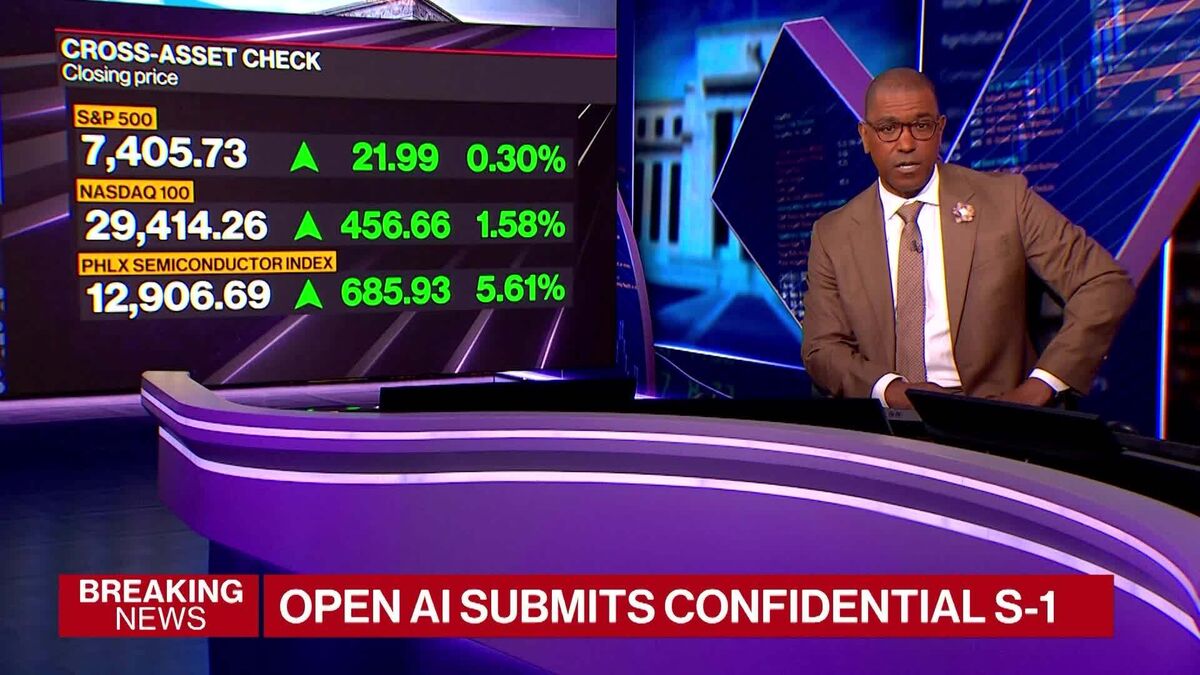
OpenAI has filed confidentially for an IPO with the SEC, tapping Goldman Sachs and Morgan Stanley to lead a potential listing that could be the largest tech debut since 2024. Bloomberg’s Romaine Bostick broke the news on June 8, 2026, sending shockwaves through an AI market already jittery about monetization timelines. This filing is not a victory lap—it is a calculated move to cash out before the market fully prices in the economics of frontier model inference.
- OpenAI filed a confidential IPO registration with the SEC on June 8, 2026, working with Goldman Sachs Group and Morgan Stanley.
- The filing comes as OpenAI faces mounting inference costs and competition from cheaper open-weight models.
- This IPO will force the first public disclosure of OpenAI's unit economics, revealing whether generative AI can be profitable at scale.
Why Did OpenAI Choose a Confidential Filing Now?
According to Bloomberg's Romaine Bostick, reporting on "Balance of Power" on June 8, 2026, OpenAI submitted its S-1 confidentially under the JOBS Act, which allows companies with under $1.07 billion in revenue to test the waters without public scrutiny. The timing is strategic: OpenAI's last private valuation, reportedly around $300 billion in early 2026, may be the peak for a company whose core product—GPT-5—costs an estimated $0.50 per 1M tokens to run, versus Meta's Llama 4 at roughly $0.10 per 1M tokens. By filing now, OpenAI locks in a valuation window before quarterly disclosures reveal margin compression.
Can Goldman and Morgan Stanley Deliver a Premium Valuation?
Goldman Sachs and Morgan Stanley are not just underwriters—they are OpenAI's credibility anchors. The Financial Times reported in May 2026 that Goldman had been advising OpenAI on capital structure since late 2025. Their involvement signals to institutional investors that the deal is bankable. However, the confidential filing allows OpenAI to withdraw if demand is tepid. The real test will be the roadshow, where OpenAI must convince pension funds that its $200/month ChatGPT Enterprise subscriptions have sticky demand. I believe the banks will price the IPO at a 10-15% discount to the last private round to ensure a first-day pop, sacrificing valuation for momentum.
| Metric | OpenAI (Pre-IPO Estimate) | Anthropic (Private) | Meta AI (Open Source) |
|---|---|---|---|
| Inference Cost per 1M tokens | $0.50 | $0.35 | $0.10 |
| Enterprise Subscribers | ~1.2M | ~400K | N/A (embedded) |
| 2025 Revenue (est.) | $5.2B | $1.8B | N/A |
| 2025 Operating Margin (est.) | -35% | -50% | N/A |
| Primary Model | GPT-5 | Claude 4 | Llama 4 |
| Verdict | OpenAI leads on revenue but trails on cost efficiency. The IPO will reveal whether revenue growth offsets structural cost disadvantages. | ||
What Will the S-1 Reveal That the Market Doesn't Know?
The confidential filing means the S-1 is not public yet, but once it is, analysts will scrutinize three areas: inference cost as a percentage of revenue, customer concentration (how much comes from Microsoft vs. direct enterprise), and R&D spend relative to sales. According to a May 2026 report by Bernstein, OpenAI's compute costs are estimated to consume 45% of gross revenue, compared to 25% for cloud software peers. If the S-1 confirms this number, it will reset valuation multiples for the entire generative AI sector. The market currently values AI companies on growth, not profits—this filing could force a shift to profit-focused metrics.
Who Loses If the IPO Stumbles?
An unsuccessful or down-round IPO would cascade through the AI ecosystem. SoftBank, which led a $10B round in OpenAI in early 2026, would see its stake impaired. Anthropic, which has been positioning for a late-2027 IPO, would face a higher bar. Most critically, Microsoft, which has invested $13B in OpenAI cumulatively, would need to reassess its partnership terms. According to The Information, Microsoft's exclusivity clause on OpenAI's models expires in 2028, meaning Redmond has a limited window to recoup its investment. A weak IPO could accelerate Microsoft's move to develop its own frontier models, as hinted by Satya Nadella's comments at Build 2026.
My thesis: OpenAI's IPO is a liquidity event designed to cash out early investors and employees before the market fully prices the cost disease of frontier AI.
In the short term, the IPO will likely succeed—Goldman and Morgan Stanley will ensure it prices, and retail enthusiasm for AI will provide a floor. The long-term risk is that once the S-1 is public, analysts will model the unit economics and conclude that OpenAI's inference costs are structurally higher than open-weight alternatives. This will compress its multiple over 12-18 months post-IPO. The biggest winner is Goldman Sachs, which collects underwriting fees regardless. The biggest loser is any late-stage investor buying at the IPO price without a clear path to 30%+ gross margins.
I predict that within 12 months of the IPO, OpenAI will be forced to acquire a chip startup to vertically integrate inference hardware, following the playbook of Tesla's Dojo. The target will be either Groq or Cerebras, both of which have inference-optimized architectures.
- Goldman Sachs and Morgan Stanley will price the IPO at a 10-12% discount to OpenAI's last private round ($300B) to ensure a first-day pop, valuing the company at ~$270B.
- Within 18 months of the IPO, OpenAI will announce a $5B+ acquisition of a chip company (likely Groq) to reduce inference costs by 40%.
- The EU AI Office will require OpenAI to open a model safety audit as a condition of listing on European exchanges, delaying the EU tranche of the IPO by 6 months.
- June 2026Confidential IPO Filing
OpenAI files S-1 confidentially with SEC, hires Goldman Sachs and Morgan Stanley.
- Early 2026SoftBank Leads $10B Round
SoftBank invests $10B at a $300B valuation.
- Late 2025Goldman Sachs Advisory Begins
Goldman starts advising OpenAI on capital structure.
- 2028Microsoft Exclusivity Expiry
Microsoft's exclusive access to OpenAI models ends.
Estimated Inference Cost per 1M Tokens (2026)
Article Summary
- OpenAI’s IPO is a liquidity event, not a signal of profitability—the confidential filing lets it test demand without commitment.
- Goldman Sachs and Morgan Stanley’s involvement provides institutional cover, but the real valuation test comes when the S-1 reveals inference cost margins.
- The IPO will force a sector-wide reassessment of AI company valuations, moving from growth multiples to profit-focused metrics.
- Microsoft’s $13B investment is at risk if the IPO disappoints, potentially accelerating its move to develop in-house frontier models.
- Post-IPO, OpenAI will likely acquire an inference chip startup to vertically integrate and cut costs—Groq is the most probable target.
Source and attribution
Bloomberg Technology
OpenAI Files Confidentially for IPO






Discussion
Add a comment