

NVIDIA's FOX Blueprint: Factory AI Brain Kills Fragmented Automation
NVIDIA's FOX blueprint provides a unified AI decision layer for factories, threatening legacy automation vendors. This analysis examines what changed, who wins, and what comes next.
On June 1, 2026, at GTC Taipei during COMPUTEX, NVIDIA unveiled the Factory Operations Blueprint (FOX) — a reference design for an autonomous factory manager that connects live machine signals, quality systems, work instructions, and operational alerts into a single decision layer. This isn't just another product launch; it's NVIDIA's declaration that it will own the operating system for the physical world.
- NVIDIA announced the Factory Operations Blueprint (FOX) at GTC Taipei on June 1, 2026 — a reference design for an autonomous factory manager that unifies machine signals, quality systems, work instructions, and alerts.
- FOX turns the factory floor into a single AI-orchestrated system, moving beyond isolated automation to plant-wide intelligence.
- This threatens established automation vendors like Siemens and Rockwell Automation, who sell fragmented point solutions, and positions NVIDIA as the platform owner for industrial AI.
What Exactly Is NVIDIA's FOX Blueprint and Why Does It Matter Now?
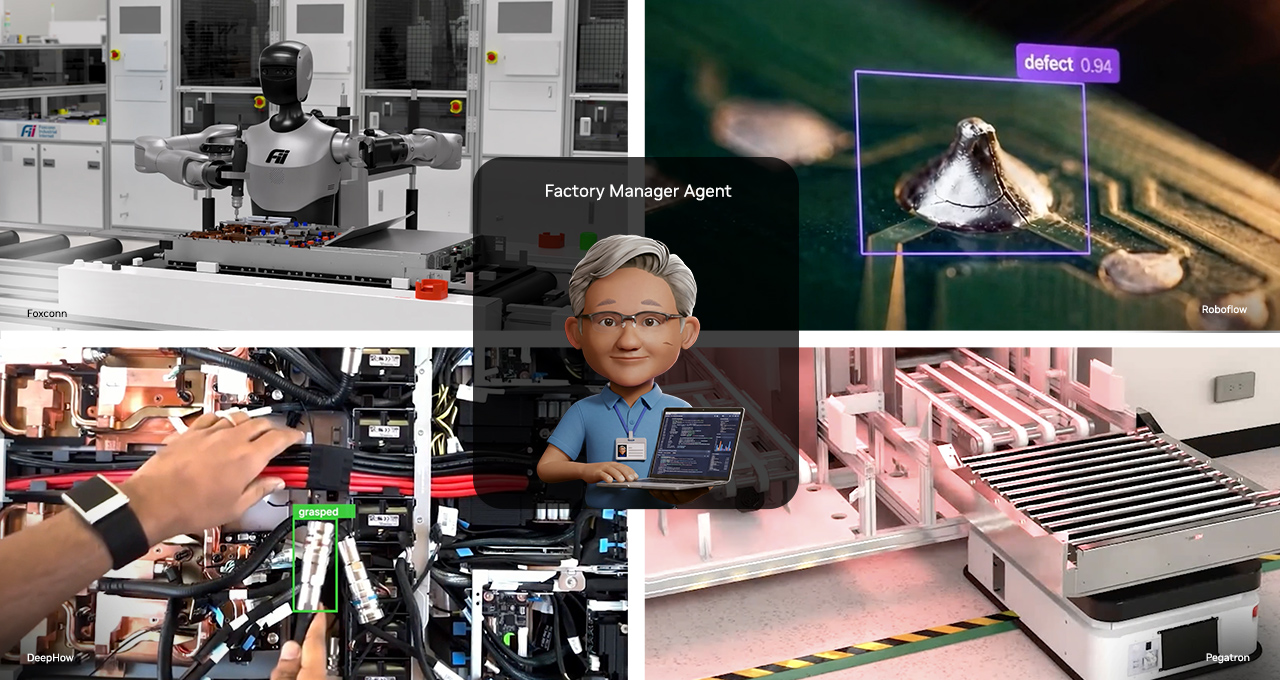
According to NVIDIA's official blog post published on June 1, 2026, FOX is a reference design for building an autonomous factory manager — an AI system that can connect live machine signals, quality systems, work instructions, and operational alerts into a unified decision layer. The blog stated: "As factories move from isolated automation to plant-wide intelligence, manufacturers need AI systems that can connect live machine signals, quality systems, work instructions and operational alerts into a unified decision layer."
This matters because factories today run on a patchwork of systems: PLCs from Siemens, HMIs from Rockwell, MES from SAP, and quality systems from various vendors. None of them talk to each other in real time. FOX is NVIDIA's answer — a blueprint that uses its Omniverse platform to create a digital twin of the factory, then applies AI agents to monitor, predict, and act on anomalies. The timing is critical: as labor shortages and supply chain volatility intensify, manufacturers can no longer afford manual oversight.
What changed is that NVIDIA is no longer just selling GPUs for training AI models. It's now selling the entire stack — hardware, software, and reference architecture — to run AI inference and orchestration inside factories. This is a fundamental shift from selling picks and shovels to owning the mine.
How Does FOX Compare to Existing Factory Automation Solutions?
To understand FOX's impact, we must compare it to the current dominant approaches. The table below contrasts NVIDIA's FOX with traditional automation stacks from Siemens and Rockwell Automation.
| Feature / Aspect | NVIDIA FOX Blueprint | Siemens TIA Portal + MindSphere | Rockwell Automation FactoryTalk |
|---|---|---|---|
| Architecture | Unified AI decision layer | Fragmented PLC/HMI/MES stack | Separate control, visualization, and analytics |
| Real-time unification | Native — all signals, quality, instructions in one model | Requires custom integration between systems | Requires middleware or custom code |
| AI orchestration | Built-in AI agents for anomaly detection, prediction, action | Add-on AI via MindSphere (cloud) | Add-on AI via FactoryTalk Analytics (cloud) |
| Digital twin | Omniverse-based real-time simulation | NX/MCD simulations (not real-time) | Emulate3D (not real-time) |
| Vendor lock-in | NVIDIA hardware + CUDA + Omniverse | Siemens PLCs + TIA Portal | Rockwell PLCs + FactoryTalk |
| Verdict | Winner: Unified, real-time, AI-native | Loser: Fragmented, slow to integrate AI | Loser: Similar fragmentation, late to AI |
According to a 2026 analysis in IEEE Computer, "NVIDIA's approach bypasses the traditional automation pyramid entirely, creating a flat, AI-driven architecture that can ingest data from any source and act on it in milliseconds." This is a direct threat to Siemens and Rockwell, whose business models rely on selling multiple tiers of hardware and software that require significant integration effort.
Who Wins and Who Loses From NVIDIA's Factory Brain?
The winners are clear: NVIDIA, obviously, as it captures the platform layer for industrial AI. Also winning are manufacturers who adopt FOX early — they'll gain significant operational efficiency advantages over competitors stuck with legacy systems. According to NVIDIA's blog, FOX enables "autonomous factory management" where the AI can detect anomalies, predict failures, and even adjust production schedules without human intervention.
The losers are equally clear: Siemens and Rockwell Automation face existential disruption. Their current offerings are fragmented, cloud-dependent, and require extensive custom integration. FOX offers a unified, real-time, AI-native alternative that runs on-premises or at the edge. Also losing are system integrators who make money stitching together disparate automation systems — FOX reduces their value proposition. According to IEEE Computer, "the traditional automation pyramid is collapsing under the weight of its own complexity, and NVIDIA is providing the wrecking ball."
What Remains Uncertain About FOX's Adoption and Impact?
Several uncertainties remain. First, can NVIDIA actually execute on the software reliability required for factory-floor operations? Factories demand 99.999% uptime and deterministic behavior. NVIDIA's software stack, while powerful, has not been hardened for industrial real-time control. Second, will manufacturers trust a single vendor with their entire factory brain? Many prefer multi-vendor strategies to avoid lock-in. Third, what about existing installed bases? Siemens and Rockwell have decades of embedded PLCs and HMIs that won't be replaced overnight. FOX may need to coexist with legacy systems for years.
Another uncertainty is regulatory. Factory safety standards like IEC 61508 and ISO 13849 require certification for any system that controls machinery. NVIDIA's AI agents, which make autonomous decisions, will need to pass these certifications — a process that can take years. NVIDIA has not yet announced any certification progress.
My thesis is simple: NVIDIA's FOX blueprint is the most significant industrial automation announcement in a decade, but its success hinges on execution, trust, and certification — not just technology. In the short term (2026–2027), early adopters in greenfield factories or discrete manufacturing (e.g., electronics, automotive) will pilot FOX and see measurable efficiency gains. In the long term (2028–2030), if NVIDIA can achieve industrial safety certifications and build a partner ecosystem for legacy integration, it will become the de facto operating system for factories worldwide.
Who gains: NVIDIA, early-adopter manufacturers, and NVIDIA's hardware partners (e.g., Foxconn, Pegatron). Who loses: Siemens, Rockwell Automation, and traditional system integrators. My concrete prediction: By 2028, at least three of the top ten global manufacturers will have deployed FOX in at least one production line, and NVIDIA's industrial revenue will exceed $5 billion annually.
- By 2028, at least three of the top ten global manufacturers will have deployed FOX in at least one production line.
- NVIDIA's industrial revenue will exceed $5 billion annually by 2028, driven by FOX-related hardware and software sales.
- Siemens will acquire a digital twin startup within 18 months to counter FOX's threat.
- June 2026NVIDIA announces FOX at GTC Taipei
NVIDIA unveils the Factory Operations Blueprint, a reference design for an autonomous factory manager.
- 2027 (estimated)First FOX pilot deployments
Early adopters in electronics and automotive manufacturing begin piloting FOX in production lines.
- 2028 (estimated)FOX reaches industrial certification
NVIDIA achieves IEC 61508 certification for FOX, enabling broader adoption in safety-critical environments.
Projected Industrial AI Platform Revenue (2026–2030)
- NVIDIA's FOX blueprint is not just a product; it's a platform play that threatens the entire legacy automation stack.
- The key barrier to FOX adoption is not technology but trust, certification, and installed-base inertia.
- Early adopters in discrete manufacturing will see the biggest gains, while process industries (chemicals, oil & gas) will lag due to stricter safety requirements.
- NVIDIA's move from selling chips to selling factory brains represents a fundamental shift in its business model — and in the industrial automation market.
- The next 24 months will determine whether NVIDIA becomes the Microsoft of factories or a niche player in digital twins.
Source and attribution
NVIDIA Blog
NVIDIA Factory Operations Blueprint Gives Factories a New AI Brain






Discussion
Add a comment