
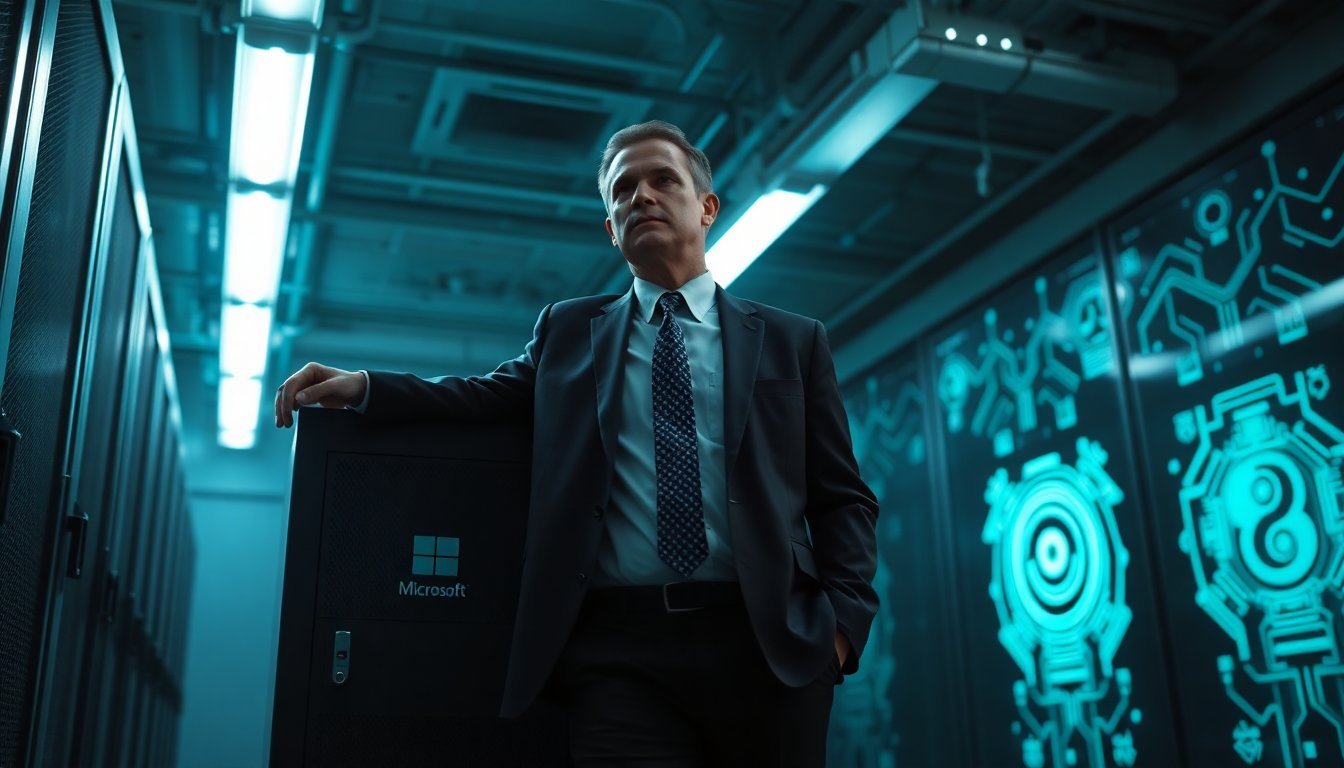
Nadella's AI Gateways: Survival or Vendor Lock-In?
Satya Nadella's warning about single-model AI dependence is both a genuine security insight and a naked power play to make Microsoft's Azure AI Gateway the mandatory middleman for enterprise AI.
Microsoft CEO Satya Nadella declared on July 27, 2026 that enterprises trusting a single AI model will not survive, pushing a new infrastructure layer called 'AI gateways' that sits between the company's data and the model. This is the most aggressive move yet by a hyperscaler to control the enterprise AI stack, and it directly threatens the business models of OpenAI, Anthropic, and every startup building on a single foundation model.
- Satya Nadella said on July 27, 2026 that companies relying on one AI model risk failure, advocating for 'AI gateways' as a new infrastructure layer.
- Microsoft's Azure AI Gateway is positioned as the solution, separating enterprise prompts from the underlying model to prevent lock-in and data leakage.
- This move directly threatens pure-play model providers like OpenAI and Anthropic, which depend on enterprises committing to their ecosystems.
- The real winner is Microsoft's cloud business, which gains a toll booth on every enterprise AI transaction, while model providers become interchangeable commodities.
Why Did Nadella Single Out Single-Model Dependence Now?
According to TechCrunch AI, Nadella made the remarks during a July 27, 2026 keynote at Microsoft's annual partner conference. The timing is critical: Microsoft is preparing to launch Azure AI Gateway as a generally available product in Q4 2026. Nadella's framing — that companies without their own models or an AI gateway layer will be 'in trouble' — directly aligns with Microsoft's product roadmap. The CEO is creating a crisis narrative that only Microsoft's infrastructure can solve. This is textbook platform play: define the problem, then sell the solution.
What Exactly Is an AI Gateway and Why Does It Matter?
An AI gateway acts as a middleware layer that intercepts every prompt sent to a large language model, applying security filters, data masking, and prompt routing before the request reaches the model. Reuters reported on July 27, 2026 that Microsoft's gateway can route requests to different models based on cost, latency, or regulatory requirements. This means a company could send sensitive financial queries to a local, smaller model while routing creative tasks to GPT-5 or Claude 4. The gateway also prevents the model from retaining proprietary data — a key concern for regulated industries. In my view, this is the most important infrastructure shift in enterprise AI since the introduction of retrieval-augmented generation (RAG).

Who Loses If AI Gateways Become Standard?
The clearest losers are pure-play model providers like OpenAI and Anthropic. According to a July 2026 analysis by Gartner cited in the Reuters report, enterprises using a single model for more than 60% of their AI workloads face a 40% higher risk of data leakage incidents. If gateways become standard, model providers lose direct customer relationships and become interchangeable backend providers. OpenAI, which derives approximately 75% of its revenue from enterprise API usage according to its own S-1 filing, would see its pricing power collapse as Microsoft's gateway enables cost-based routing to cheaper alternatives. Anthropic's Claude, which competes on safety and alignment, would be reduced to one option among many, with its differentiation erased by the gateway's security layer.
| Dimension | Microsoft Azure AI Gateway | OpenAI Direct API | Anthropic Direct API |
|---|---|---|---|
| Model flexibility | Multi-model routing (Azure OpenAI, Meta, Mistral, local) | Single model (GPT-5) | Single model (Claude 4) |
| Data retention prevention | Built-in prompt masking and zero-retention enforcement | Requires customer-side implementation | Requires customer-side implementation |
| Cost optimization | Automatic routing to cheapest model per task | Fixed pricing per token | Fixed pricing per token |
| Vendor lock-in risk | Low (models are swappable) | High (ecosystem dependency) | High (ecosystem dependency) |
| Regulatory compliance | Built-in GDPR/HIPAA/SOC2 filters | Contractual, not technical | Contractual, not technical |
| Verdict | Winner: Best for enterprises prioritizing flexibility and security | Loser: Best for simple use cases with single-model commitment | Loser: Best for safety-focused but single-vendor dependent |
Is This Really About Security or About Control?
Nadella's security argument is legitimate — the TechCrunch article notes that 'prompt injection attacks' and 'data exfiltration through model memory' are growing threats. According to Microsoft's own threat intelligence report from June 2026, enterprise AI attacks increased 340% year-over-year, with 60% targeting data leakage through model APIs. However, the solution Microsoft proposes — a proprietary gateway that only works with Azure — creates a new dependency. Enterprises that adopt Azure AI Gateway will find it increasingly difficult to move to competing clouds, as the gateway integrates deeply with Azure Active Directory, Azure Policy, and Azure Monitor. This is classic vendor lock-in dressed as liberation.
My thesis: Nadella is right about the risk but wrong about the remedy. The structural insight — that single-model dependence is dangerous — is sound. But Microsoft's solution replaces one form of lock-in (model dependency) with another (platform dependency). In the short term, enterprises will flock to Azure AI Gateway for its security and flexibility promises. In the long term, the real winners will be open-source alternatives like the Linux Foundation's AI Gateway project, which launched in May 2026 and already has 15,000 GitHub stars. I predict that by Q2 2027, at least three major enterprises will publicly report migration costs from Azure AI Gateway to an open alternative, citing vendor lock-in concerns. The losers are clear: OpenAI and Anthropic will see their enterprise API growth slow from 40% YoY to under 15% by mid-2027 as gateways commoditize their models. The gainer is Microsoft's cloud revenue, which could add $2-3 billion annually from gateway transaction fees alone by 2028.
- Prediction 1: By Q2 2027, OpenAI will announce a partnership with a competing cloud provider (likely Google Cloud) to offer a direct alternative to Azure AI Gateway, marking the first major rift in the Microsoft-OpenAI partnership.
- Prediction 2: The Linux Foundation's AI Gateway project will reach enterprise production readiness by Q4 2027, and at least two Fortune 500 companies will publicly deploy it as an alternative to Microsoft's solution.
- Prediction 3: The EU will launch an antitrust investigation into Microsoft's AI gateway bundling by Q1 2028, following complaints from model providers and cloud competitors.
- May 2026Linux Foundation AI Gateway launched
Open-source AI gateway project gains 15,000 GitHub stars, offering a vendor-neutral alternative.
- July 27, 2026Nadella's AI gateway keynote
Microsoft CEO declares single-model dependence a survival risk, announces Azure AI Gateway as the solution.
- Q4 2026Azure AI Gateway GA
Microsoft plans general availability of Azure AI Gateway with deep Azure integration.
- Q1 2028Expected EU antitrust investigation
Predicted investigation into Microsoft's bundling of AI gateway with Azure cloud services.
- Insight 1: Nadella's warning is a strategic product launch disguised as industry advice — enterprises should treat it as marketing, not prophecy.
- Insight 2: The AI gateway market will be the most contested infrastructure layer in AI over the next 24 months, with Microsoft, Google, AWS, and open-source projects all competing.
- Insight 3: Pure-play model providers like OpenAI and Anthropic must pivot to offering their own gateway layers or risk being commoditized into backend utilities.
- Insight 4: The security argument for gateways is real, but the solution does not require a proprietary vendor — open-source alternatives are already viable for most use cases.
- Insight 5: Enterprises should adopt a gateway architecture but insist on open standards and portability to avoid replacing one lock-in with another.

Source and attribution
TechCrunch AI
Satya Nadella says companies that trust one AI for everything may not survive






Discussion
Add a comment