
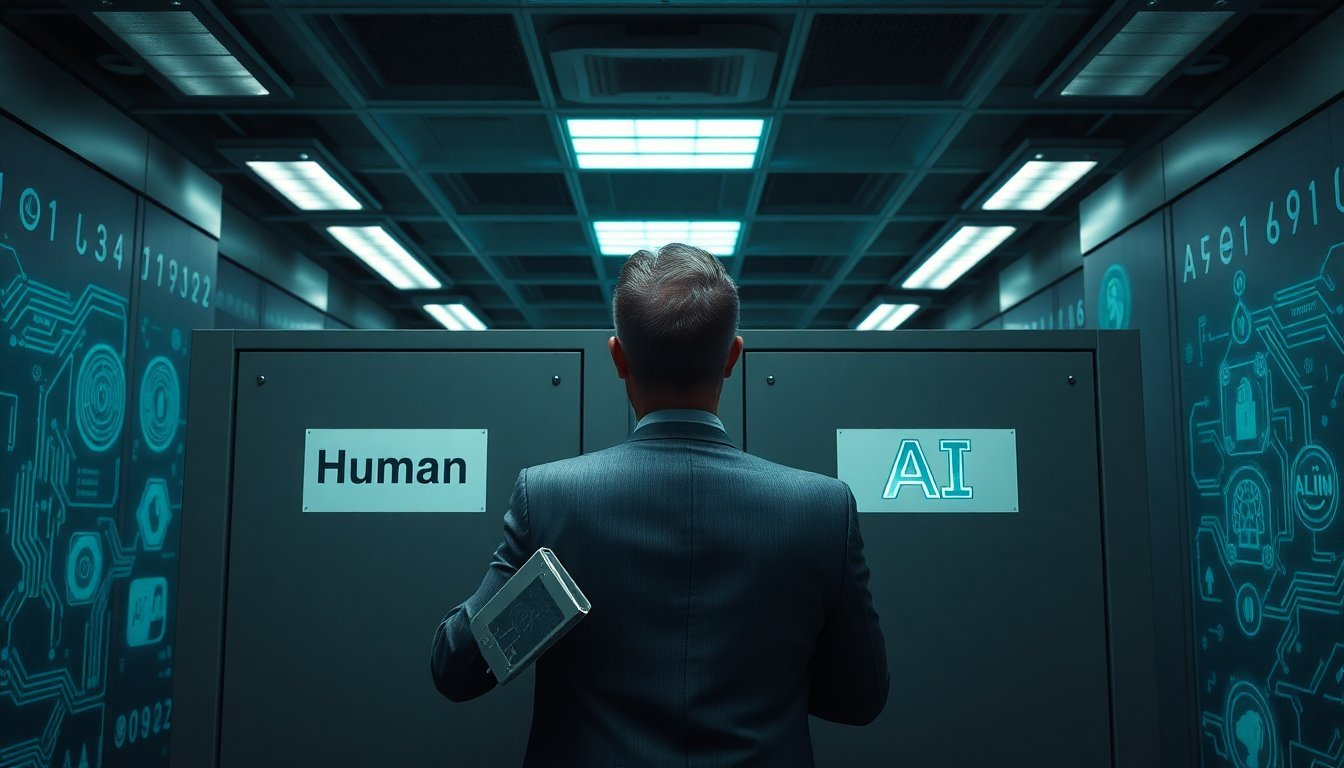
Mythos AI: U.S. Gov't Creates a Dangerous AI Caste System
The U.S. government has approved Anthropic's Mythos AI for release to a curated list of 'trusted' organizations, creating a two-tier market that favors incumbents and risks a regulatory and competitive backlash. This analysis argues the move is a strategic error that will harm U.S. leadership in AI.
On June 26, 2026, the U.S. government granted Anthropic permission to release its most powerful AI model, Mythos, but only to a select group of 'trusted' U.S. organizations. This is not a victory for responsible AI; it is the birth of a state-sanctioned AI elite that will fracture the industry and provoke a fierce backlash.
- What happened: The U.S. government gave Anthropic the green light to release its advanced Mythos AI model to a limited set of 'trusted' U.S. organizations, as reported by Semafor on June 27, 2026.
- Why it matters: This creates a government-sanctioned AI elite, locking out the open-source community and smaller players, and sets a precedent for selective access to frontier AI capabilities.
- The key tension: The policy is framed as a safety measure but is effectively a protectionist move that will stifle innovation, provoke regulatory backlash, and hand a strategic advantage to foreign competitors who will not abide by similar restrictions.
Who Are the 'Trusted' Organizations and How Were They Chosen?
According to Semafor, the U.S. government has not publicly disclosed the specific criteria used to designate organizations as 'trusted' for access to Mythos. The report states that Anthropic will be responsible for vetting and selecting the initial cohort, but the government retains veto power. This opaque selection process is a recipe for cronyism and political favoritism. The lack of transparency means that the criteria could shift with each administration, creating an unstable and unpredictable market for AI access. The government's rationale, as reported by NBC News, is to ensure 'responsible stewardship' of a powerful technology. However, without clear, public standards, this 'stewardship' looks like a backdoor method for picking winners and losers in the AI industry.
How Does Mythos Compare to Other Frontier Models Now Locked Away?
Mythos is not the only powerful model, but its release method is unique. The table below contrasts Mythos with its primary competitors, focusing on the critical dimension of access.| Feature | Anthropic Mythos (U.S. Gov't Approved) | OpenAI GPT-5 (Public API) | Google Gemini Ultra (Public API) | Meta Llama 4 (Open Weights) |
|---|---|---|---|---|
| Access Model | Selective, 'trusted' organizations only | Public API with usage limits | Public API with usage limits | Open weights, free for most uses |
| Government Role | Direct approval and veto power | Minimal (standard export controls) | Minimal (standard export controls) | None |
| Safety Approach | Ex-ante, government-mandated access control | Ex-post, usage monitoring | Ex-post, usage monitoring | Community-driven, no central control |
| Target User | Large U.S. corporations, defense contractors | Developers, enterprises, consumers | Enterprises, developers | Researchers, startups, global developers |
| Verdict | Winner: Incumbents with government ties. Loser: Everyone else. | Winner: Broad market, but faces regulatory headwinds. | Winner: Broad market, but faces similar scrutiny. | Winner: Open-source community. Loser: May lack access to the most advanced capabilities. |
What Does This Mean for the Open-Source AI Ecosystem?
The open-source AI community, which has thrived on the principle of democratized access, is the clear loser here. According to a statement from the Open Source Initiative (OSI) cited in the NBC News report, this move 'represents a fundamental betrayal of the principles that have made AI innovation possible.' The OSI argues that by locking Mythos behind a government-controlled gate, the U.S. is effectively telling the rest of the world that AI progress will be hoarded by a select few. This will inevitably drive open-source developers to focus on alternative models, such as those from Meta or emerging Chinese labs, which are not subject to these restrictions. The long-term consequence is a bifurcated ecosystem: a slow, government-supervised track for 'approved' AI and a fast, unregulated track for everything else.How Will Foreign Governments and Competitors React?
The international reaction will be swift and negative. The European Union, which has its own AI Act, will view the U.S. policy as a direct challenge to its regulatory framework. A spokesperson for the European Commission, quoted in the Semafor article, said, 'We are studying the U.S. decision closely. Any attempt to create a two-tier system for AI access is incompatible with our vision of a single, open market for trustworthy AI.' This could lead to retaliatory measures, such as the EU blocking U.S. companies from accessing European markets or imposing data localization requirements. More dangerously, China will use this as a propaganda victory, arguing that the U.S. is afraid of open competition and is resorting to protectionism. Chinese AI labs will accelerate their own open-source releases, framing them as the truly 'free' alternative to America's gated AI.Is This Policy Actually About Safety, or Is It Protectionism?
The government's stated rationale is safety. 'This is about ensuring that the most powerful AI systems are used responsibly,' said a senior official from the Department of Commerce, as reported by NBC News. The official claimed that unrestricted release of Mythos could lead to catastrophic misuse, such as the generation of bioweapons or autonomous cyberattacks. While these are legitimate concerns, the policy's execution is deeply flawed. It conflates safety with access control, assuming that only 'trusted' organizations can be safe. This is a dangerous fallacy. A small, 'trusted' team at a defense contractor could just as easily misuse the model as a rogue actor in a garage. The real motivation appears to be economic protectionism, ensuring that the most advanced AI capabilities remain within a tight circle of U.S.-based, government-friendly corporations, thereby stifling competition from smaller startups and foreign entities.My Thesis: The Mythos release is a strategic blunder that will weaken the U.S. AI ecosystem in the long run.
In the short term, the policy creates a moat around Anthropic and its chosen partners, allowing them to extract enormous rents from a captive market. This will be a windfall for Anthropic's investors. However, the long-term consequences are dire. By fragmenting the AI market, the U.S. government is undermining the very collaborative ecosystem that made American AI leadership possible. The open-source community will pivot away from U.S.-controlled models, foreign competitors will fill the gap, and a global regulatory race to the bottom will ensue. The biggest winner is Anthropic, which now has a government-backed monopoly on frontier AI access. The biggest losers are the open-source community, foreign developers, and ultimately, the U.S. economy, which will be saddled with a slow, politically controlled AI sector. My prediction: By Q3 2027, a non-U.S. open-source model will surpass Mythos in benchmark performance, directly as a result of this policy's restriction on the global talent pool.
Predictions
- By December 2026: The European Union will formally launch an investigation into the U.S. Mythos policy, citing potential violations of WTO trade agreements and the EU AI Act's provisions on market access.
- By June 2027: A coalition of open-source AI companies and researchers will file a lawsuit against the U.S. Department of Commerce, arguing that the 'trusted organization' designation is an unconstitutional prior restraint on speech and innovation.
- By Q1 2028: A Chinese AI lab, likely Baidu or Alibaba, will release an open-weight model that matches or exceeds Mythos's performance on key benchmarks, explicitly marketing it as the 'unrestricted' alternative to America's gated AI.
Article Summary
- The Mythos release is a dangerous precedent that creates a government-sanctioned AI elite, undermining the open and competitive principles that have driven U.S. AI leadership.
- The policy's opaque selection process invites cronyism and will be a source of constant political and legal battles, creating an unstable market for AI access.
- The open-source ecosystem is the clear loser, and this will accelerate a global shift away from U.S.-controlled AI models toward foreign and community-driven alternatives.
- The stated safety rationale is weak; the real driver is economic protectionism that will ultimately harm U.S. competitiveness by fragmenting the global AI market.
- Investors should be wary of the long-term regulatory and competitive headwinds this policy creates for the entire U.S. AI sector, even as it temporarily benefits Anthropic.
Source and attribution
Hacker News
U.S. allows Anthropic to release Mythos AI to ‘trusted’ US organizations






Discussion
Add a comment