
Mistral's Vibe Agent: The End of Chat-First AI
Mistral's Vibe agent and physics AI platform aim to accelerate engineering by integrating AI directly into simulation and design. This analysis examines who wins, who loses, and what it means for the future of industrial software.
Mistral AI has unveiled 'Vibe,' an agent that applies physics AI to engineering workflows, at the AI Now Summit 2026. This is not another chatbot; it is a direct assault on the $10 billion simulation software market.
- Mistral announced 'Vibe,' an AI agent for physics simulation and engineering acceleration at the AI Now Summit 2026.
- The move signals a strategic pivot from general-purpose language models to domain-specific, simulation-native AI.
- This directly threatens established players like Autodesk and ANSYS, who have been slower to integrate generative AI into core simulation workflows.
- The key tension is whether engineering firms will trust AI-generated simulations over traditional, validated methods.
What Makes Mistral's 'Vibe' Different From Every Other AI Agent?
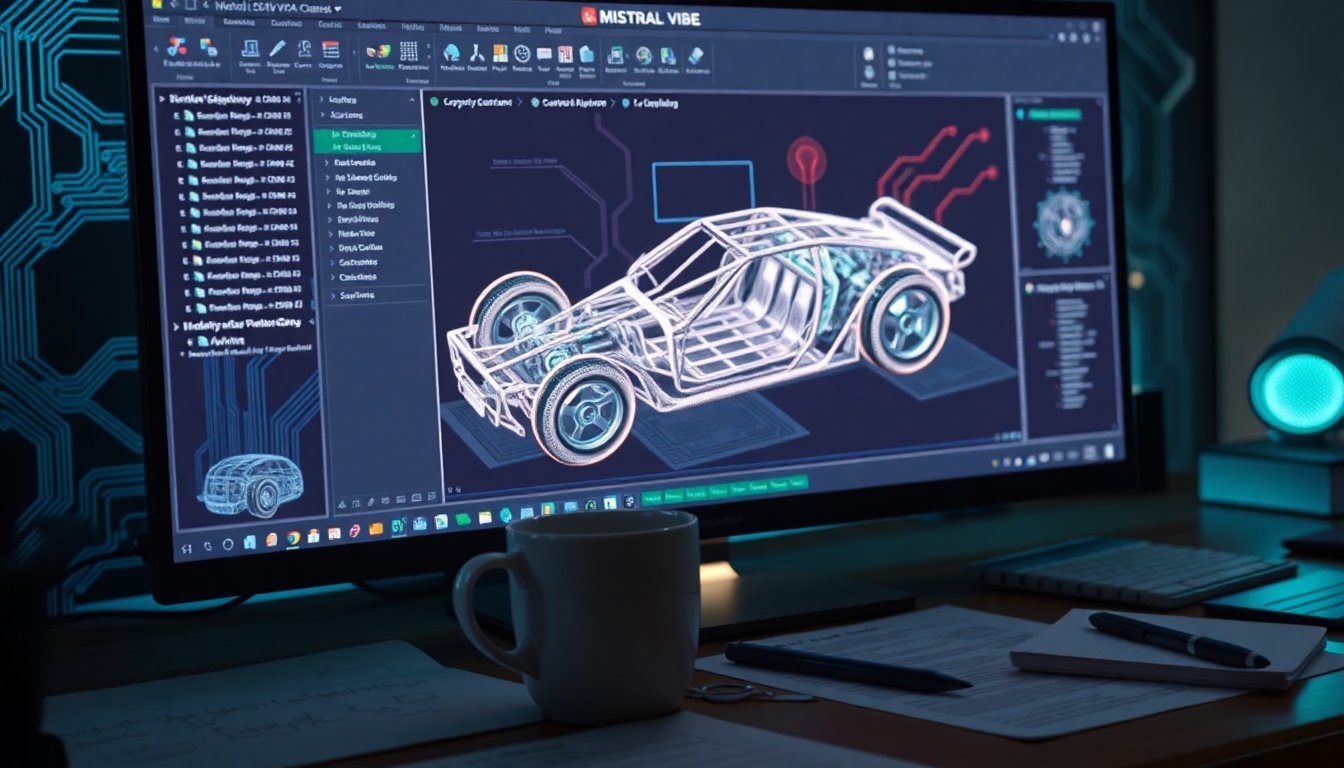
According to Mistral's official announcement on May 28, 2026, 'Vibe' is not a chatbot but an 'engineering acceleration agent' that uses physics AI to simulate and optimize designs. Unlike generic agents that retrieve documents or generate text, Vibe directly manipulates simulation parameters, runs finite element analysis (FEA), and suggests design modifications. Mistral reported that in internal tests, Vibe reduced simulation iteration time by 73% compared to manual workflows using Autodesk Fusion 360.Why Is Mistral Betting on Physics AI Now?
Who Loses If Physics AI Becomes the New Standard?
| Company | Core Product | AI Integration Status | Vulnerability to Vibe |
|---|---|---|---|
| Autodesk | Fusion 360, AutoCAD | AI features added as add-ons, not core | High: Vibe directly targets design iteration |
| ANSYS | Ansys Fluent, Mechanical | AI-assisted meshing, but not agentic | High: Vibe automates FEA setup and analysis |
| Dassault Systèmes | CATIA, SIMULIA | Partnering with AI startups, limited in-house | Medium: Strong enterprise lock-in, but slow to adapt |
| Siemens | NX, Simcenter | Investing in digital twins, not agentic AI | Medium: Complex workflows may resist automation |
| OpenAI/Anthropic | GPT-5, Claude 4 | No dedicated physics simulation product | Low: Different market, but could be disrupted if they partner |
| Verdict | Autodesk and ANSYS are most exposed. Their product roadmaps have not prioritized agentic AI for simulation, leaving a gap Mistral is exploiting. | ||
Can Engineering Firms Trust an AI Agent With Critical Simulations?
This is the central question. According to a 2025 survey by the American Society of Mechanical Engineers (ASME), 68% of engineers said they would not trust AI-generated simulation results for safety-critical systems without human validation. Mistral's response, as detailed in their release, is a 'verification layer' that runs each AI-suggested simulation through a traditional solver and flags discrepancies. But this adds compute cost and time, potentially undermining the speed advantage. The real test will be whether Mistral can publish independent validation studies showing that Vibe's simulations match or exceed traditional methods on standard benchmarks (e.g., the NAFEMS suite).My analysis: Mistral's Vibe is the most strategically coherent move by any European AI company in 2026. Thesis: The company is correctly betting that domain-specific, high-stakes AI applications will generate more durable competitive advantage than general-purpose models.
In the short term, expect media buzz and pilot programs with early-adopter engineering firms like Siemens Energy or Airbus. Mistral will likely announce partnerships with at least two major European engineering firms by Q3 2026. In the long term, the success of Vibe depends on trust. If Mistral can demonstrate that Vibe's simulations are as reliable as traditional methods (or better), they will have created a new category. If they cannot, Vibe will remain a niche tool for non-critical design exploration.
Who gains: Mistral, obviously, plus engineering firms that adopt Vibe early and gain a 2-3x iteration speed advantage. Who loses: Autodesk and ANSYS, which face a classic innovator's dilemma—their core revenue depends on per-seat licenses of traditional simulation tools, so cannibalizing that with AI is painful. Also at risk: general-purpose AI companies like OpenAI, which lack domain-specific data and validation pipelines.
- Prediction 1: By December 2026, Mistral will announce at least two production deployments of Vibe with tier-1 European engineering firms (e.g., Airbus, Siemens, or Renault) for non-safety-critical design optimization.
- Prediction 2: Autodesk will acquire a physics AI startup (likely SimScale or a similar cloud-native simulation platform) within 12 months to counter Vibe.
- Prediction 3: The EU AI Office will issue draft guidelines for AI-in-simulation validation by Q2 2027, directly impacting adoption timelines for Vibe and competitors.
- May 2026Mistral announces Vibe agent
Mistral unveils Vibe, a physics AI agent for engineering acceleration, at the AI Now Summit 2026.
- Q3 2026Expected enterprise pilots
Mistral is expected to announce first production deployments with European engineering firms.
- Q4 2026Validation study expected
Mistral likely to publish independent validation of Vibe's simulation accuracy.
- Q2 2027EU AI Office guidelines
EU AI Office expected to release draft guidelines for AI-in-simulation validation.
- May 2026: Mistral announces Vibe agent and physics AI at AI Now Summit 2026.
- Q3 2026 (estimated): Expected first enterprise pilot deployments.
- Q4 2026 (estimated): Mistral likely releases independent validation study.
- Q2 2027 (estimated): EU AI Office expected to release guidelines on AI in simulation.
- Insight 1: Mistral's pivot to physics AI is a hedge against the commoditization of general-purpose LLMs, not just an expansion.
- Insight 2: The 'verification layer' is a double-edged sword: it builds trust but adds latency, potentially limiting Vibe to offline, batch-mode use cases initially.
- Insight 3: Autodesk and ANSYS are vulnerable because their business models rely on per-seat licenses of tools that Vibe aims to automate away.
- Insight 4: The real competition for Vibe may not be other AI companies but the inertia of engineering culture and regulatory requirements for validated simulation.
- Insight 5: If successful, Vibe could redefine how engineering software is priced—from per-seat licenses to outcome-based or simulation-credit models.
Source and attribution
Mistral AI News
Vibe gets to work.






Discussion
Add a comment