

Microsoft Foundry: The Agent Lock-In Begins
Microsoft is using NVIDIA's GTC to launch Foundry agent capabilities that will lock enterprises into Azure for AI development, deployment, and operations. The move signals Microsoft's ambition to own the entire AI agent lifecycle, from training to runtime.
On March 16, 2026, Satya Nadella stood on the GTC stage and announced that Microsoft Foundry would now support production-ready AI agents. This isn't a product update—it's a declaration of war against every AI platform that doesn't sit on Azure.
- Microsoft Foundry now supports building, deploying, and operating production-ready AI agents on Azure, announced at NVIDIA GTC on March 16, 2026.
- This expands Microsoft's AI platform beyond model hosting to agent orchestration, competing directly with startups like LangChain and AWS Bedrock.
- The announcement deepens Microsoft-NVIDIA co-dependency: NVIDIA provides the compute, Microsoft provides the cloud distribution.
- Key tension: Is Foundry an open platform or a migration trap for enterprises already on Azure?
Why Is Microsoft Suddenly Pivoting to Agent Orchestration?
Microsoft's Foundry announcement at GTC 2026 is not about models—it's about control. The AI industry is shifting from model-as-a-service to agent-as-a-service, and Microsoft needs to own the runtime layer. According to the official Microsoft blog, Foundry now lets enterprises "build, deploy and operate production-ready AI agents." This means Microsoft is no longer just renting GPUs; it's dictating how AI workflows are designed, monitored, and monetized. The timing is critical: OpenAI's API revenue is plateauing, and Microsoft needs to diversify beyond being the OpenAI distribution arm.
Who Loses When Microsoft Controls the Agent Lifecycle?
The immediate losers are agent orchestration startups like LangChain, AutoGPT, and Fixie. Microsoft Foundry will offer native tool calling, memory management, and guardrails—features these startups rely on for differentiation. Also hit: AWS Bedrock and Google Vertex AI, which now face a competitor with deeper enterprise relationships and co-marketing with NVIDIA. But the biggest loser may be OpenAI itself: by abstracting agent logic into Foundry, Microsoft reduces OpenAI's bargaining power for future model access. The winner, predictably, is NVIDIA: every Foundry agent running in production consumes NVIDIA GPUs, creating a hardware tax on every AI interaction.
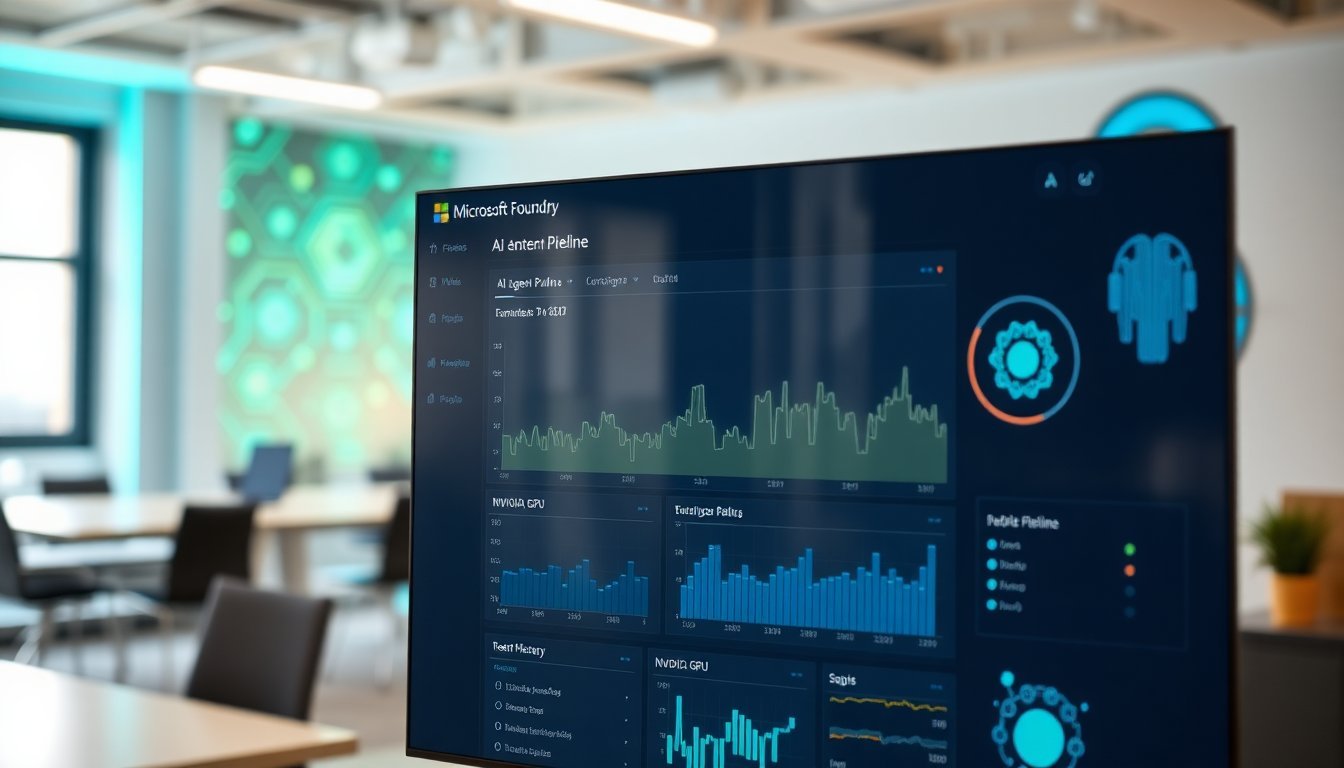
Can Foundry Really Replace LangChain and Custom Orchestration?
Technically, yes—but the migration cost is high. Microsoft Foundry offers pre-built agent templates for customer service, code generation, and data analysis, integrated with Azure AI Search and Copilot Studio. However, enterprises that built custom agent chains on LangChain or Semantic Kernel face a lock-in choice: re-platform to Foundry or lose access to Microsoft's latest optimizations (like the new NVIDIA Blackwell integration). Microsoft's blog claims "expanded capabilities" but doesn't mention pricing—a red flag that the real cost will come through compute consumption, not per-seat licensing.
What Does Physical AI Mean for Azure's Ambitions?
Microsoft's GTC announcement included "Physical AI"—a vague term that likely refers to robotics and digital twins. This is Microsoft's attempt to extend Foundry beyond software into industrial automation, competing with Siemens and Rockwell Automation. By integrating NVIDIA Omniverse with Azure, Microsoft can offer a unified platform for simulation, training, and deployment of AI in factories and warehouses. The challenge: Microsoft has no hardware play here—no robot controllers or edge devices—so it must rely on NVIDIA's ecosystem. This is a high-risk bet: if NVIDIA pivots to a direct industrial offering, Microsoft becomes a middleman with no unique value.
| Dimension | Microsoft Foundry | LangChain | AWS Bedrock |
|---|---|---|---|
| Agent orchestration | Native (pre-built + custom) | Open-source SDK | Via Step Functions |
| Model support | OpenAI, Meta, Mistral, NVIDIA NIM | 100+ models via API | Anthropic, Meta, AI21 |
| Hardware integration | NVIDIA Blackwell (exclusive) | None | AWS Trainium/Inferentia |
| Enterprise compliance | Azure AD, Purview, DLP | Self-managed | AWS IAM, Macie |
| Pricing model | Compute consumption + agent tokens | API calls + self-hosted cost | Per-inference + storage |
| Verdict | Winner for Azure-locked enterprises | Winner for multi-cloud flexibility | Loser for agent-native features |
My thesis is simple: Microsoft Foundry is a migration trap disguised as an innovation platform. The company is using NVIDIA's GTC stage to rebrand its Azure AI stack as an agent platform, but the underlying strategy is unchanged—lock enterprises into Azure's data plane, then charge compute premiums. In the short term, this will drive Azure AI revenue growth as enterprises migrate from LangChain to Foundry for compliance and simplicity. In the long term, Microsoft risks alienating developers who want multi-cloud flexibility, especially as NVIDIA itself pushes its own DGX Cloud and AI Enterprise platforms. I expect to see a direct LangChain-Microsoft partnership by Q3 2026, where LangChain becomes the open-source front-end for Foundry, neutralizing the competition while Microsoft controls the backend. The real loser is AWS Bedrock: it lacks the NVIDIA hardware exclusivity and the agent-native features that enterprises now expect.
- Microsoft will acquire or exclusively partner with LangChain by Q3 2026 to neutralize the agent orchestration threat.
- NVIDIA's Omniverse integration with Azure Physical AI will fail to gain enterprise traction by 2027, as Microsoft has no robotics hardware ecosystem.
- OpenAI will announce its own agent platform by June 2026, directly competing with Foundry and straining the Microsoft-OpenAI relationship.
- Microsoft Foundry's agent capabilities are a direct response to OpenAI's API slowdown and the rise of agent startups.
- The Physical AI announcement is a hedge: if software agents plateau, Microsoft wants a foothold in industrial automation.
- NVIDIA is the only unambiguous winner: every Foundry agent consumes H100/B200 compute hours.
- Enterprises should not migrate to Foundry until Microsoft clarifies pricing—current consumption models favor heavy users.
- The LangChain ecosystem will fragment: some partners will join Microsoft, others will resist and lose relevance.

Source and attribution
Microsoft Official Blog
Microsoft at NVIDIA GTC: New solutions for Microsoft Foundry, Azure AI infrastructure and Physical AI






Discussion
Add a comment