
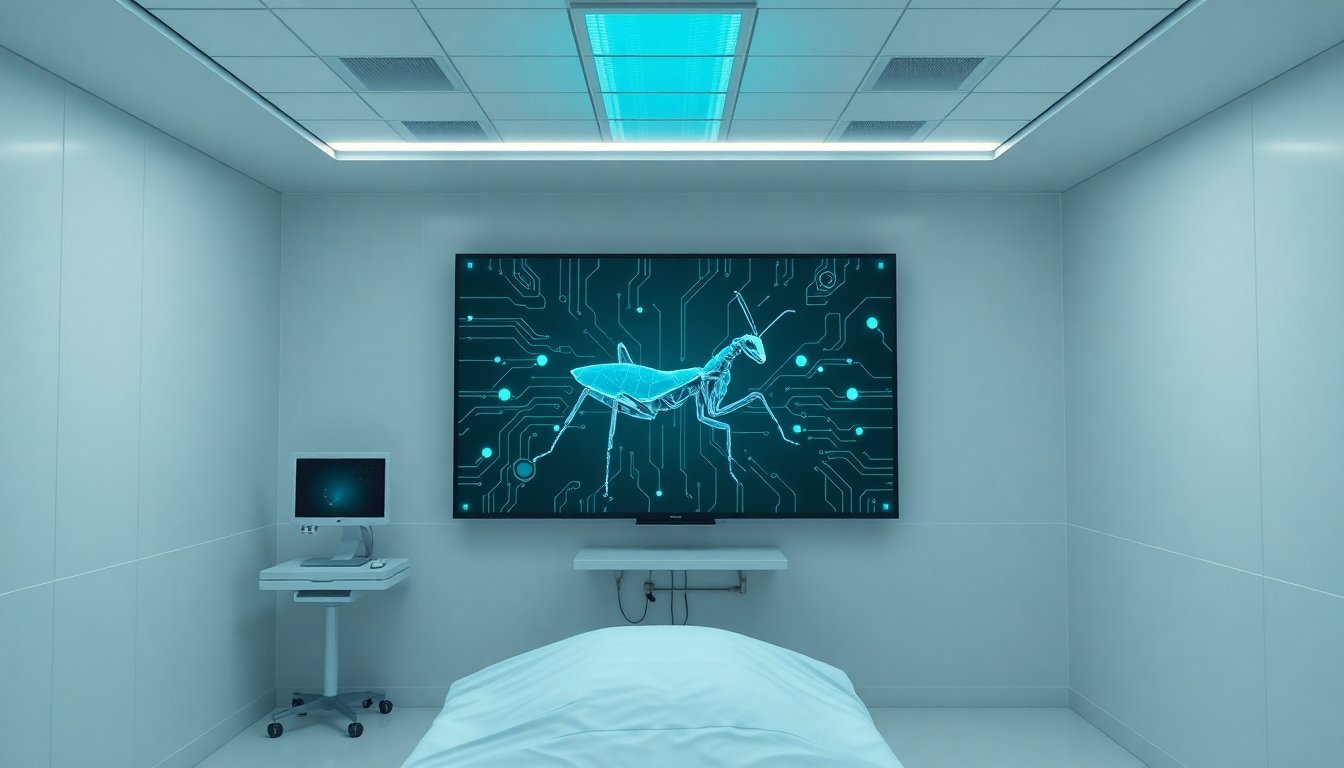
Mantis Digital Twins Will Kill Clinical Trials as We Know Them
Mantis Biotech is building digital twins of humans from disparate data sources, aiming to solve medicine's data availability crisis. This synthetic patient approach could accelerate drug development by years but raises fundamental questions about biological fidelity and regulatory acceptance.
Mantis Biotech claims it can synthesize entire human physiologies from fragmented data sources. If true, the pharma industry's $50 billion annual clinical trial budget just became a relic.
- Mantis Biotech uses machine learning to fuse fragmented medical data into synthetic datasets that model human anatomy, physiology, and behavior.
- This could eliminate the need for expensive, slow, and privacy-restricted real-world clinical trial data.
- Key tension: synthetic data fidelity vs. regulatory trust — will the FDA accept a digital twin as evidence?
Why Does Medicine Have a Data Availability Problem in 2026?
Despite decades of digitization, medical data remains locked in silos: hospital EMRs, insurance claims, genomic databases, wearable feeds, and clinical trial results rarely talk to each other. Privacy regulations like HIPAA and GDPR make sharing even anonymized data legally risky. The result? Most AI models in healthcare train on tiny, biased datasets — often from a single hospital system or a homogeneous patient population. Mantis Biotech's approach of synthesizing digital twins from disparate sources directly attacks this fragmentation. Instead of begging for data access, they generate it. But the source material doesn't specify how Mantis validates that its synthetic patients actually correspond to real biological outcomes — a gap that could become the company's Achilles' heel.
How Do Mantis's Digital Twins Actually Work?
Mantis takes what it calls 'disparate sources of data' — presumably a mix of public datasets, licensed clinical data, and synthetic generation techniques — to build computational models that represent not just anatomy but also physiology and behavior. This goes far beyond simple image generation or text-based patient records. A digital twin that models behavior means it could simulate how a patient might adhere to a medication schedule or respond to lifestyle interventions. The TechCrunch piece (March 30, 2026) provides no technical details on the underlying architecture, but the implication is clear: Mantis is creating a generative model of human biology, not just a static database. This is a fundamentally different bet than what competitors like Insilico Medicine or Recursion Pharmaceuticals are doing — they model biology at the molecular level; Mantis models the whole person.

Who Wins and Who Loses If Digital Twins Become Trusted?
The winners are clear: computational biology startups, AI-first CROs (contract research organizations), and any pharma company willing to bet on in silico trials. The losers are traditional CROs like IQVIA and LabCorp, whose business models depend on recruiting and managing real human subjects. Also losing: any regulatory framework built around the assumption that clinical evidence must come from physical bodies. The FDA's current guidance on digital health technologies (updated November 2025) still requires real-world validation for any model used in drug approval decisions. Mantis must either change this regulatory stance or accept that its digital twins will remain R&D tools, not evidence generators.
| Dimension | Mantis Biotech | Traditional Clinical Trials |
|---|---|---|
| Data source | Synthetic generation from disparate inputs | Real patient recruitment |
| Time to generate cohort | Days to weeks | Months to years |
| Privacy risk | Low (no real human data exposed) | High (HIPAA/GDPR compliance required) |
| Regulatory acceptance | Uncertain (no FDA precedent) | Well-established |
| Cost per patient equivalent | Estimated $50–500 | $5,000–50,000 |
| Verdict | Higher risk, higher reward | Lower risk, higher cost |
Mantis is building the most important infrastructure in medicine that nobody outside a small circle of computational biologists has heard of. My thesis is simple: synthetic patient data is the only path to truly personalized medicine at scale. Real-world data is too expensive, too slow, and too biased to ever solve the n=1 problem — every patient is their own statistical universe. Mantis's approach, if validated, collapses the data acquisition timeline from years to weeks. But here's the catch: validation itself is a data problem. How do you prove a digital twin behaves like a real human without running a real clinical trial? In the short term, Mantis will likely partner with academic medical centers to run parallel synthetic vs. real studies, generating validation data. The long-term consequence is that the FDA will eventually create a 'synthetic evidence' pathway, probably by 2028, driven by the sheer cost savings pharma companies will lobby for. The losers here are not just trial recruiters — they are every regulator who believes that biological truth requires a physical body. I predict that by Q4 2027, at least one major pharma company (my money is on Roche) will file a drug approval application citing Mantis-generated synthetic data as supporting evidence. The FDA will not reject it outright — they will ask for more validation, which is effectively an endorsement of the concept.
What Specific Predictions Can We Make About Mantis's Future?
- Mantis will raise a Series B of at least $150 million by Q1 2027, led by a crossover investor like Andreessen Horowitz or General Catalyst, specifically to fund regulatory validation studies.
- The FDA will issue a draft guidance on synthetic patient data for preclinical and early-phase clinical use by June 2028, citing Mantis's work in the preamble.
- By 2029, at least 20% of all early-phase clinical trials will use synthetic control arms generated by companies like Mantis, up from less than 1% today.
What Should the Reader Take Away From This Development?
- Mantis is not a drug discovery company — it's a data generation company that happens to work in biology.
- The real bottleneck is trust, not technology: the FDA has never approved a drug based on synthetic patient data, and changing that requires regulatory lobbying, not better algorithms.
- If Mantis succeeds, it will create a new asset class: synthetic patient datasets that can be licensed, traded, and used across multiple drug development programs.
- The biggest competitive threat to Mantis is not another startup — it's a hyperscaler like Google or Amazon buying their way into synthetic biology data.

Source and attribution
TechCrunch AI
Mantis Biotech is making ‘digital twins’ of humans to help solve medicine’s data availability problem






Discussion
Add a comment