
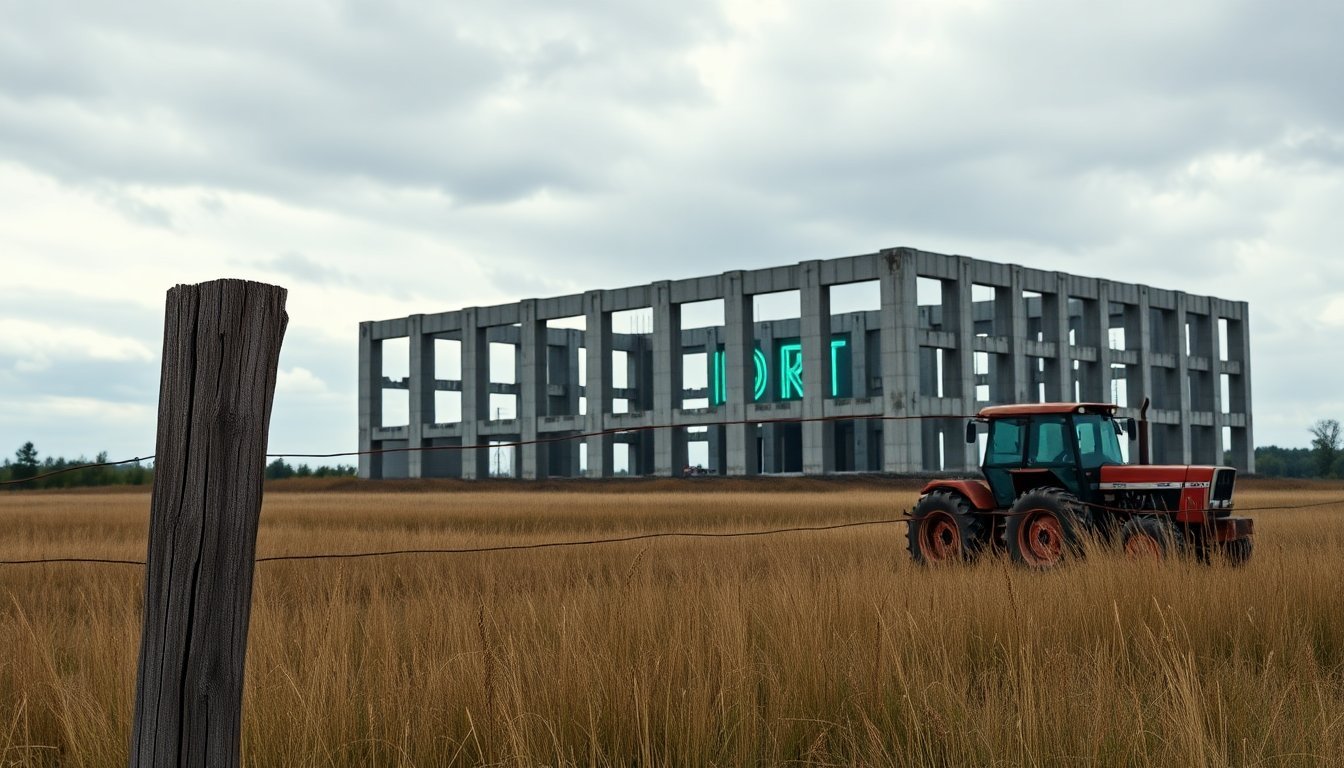
Kentucky Farm Rejects $26M AI Data Center: Rural Resistance Begins
A Kentucky family rejected a $26 million offer from a major AI company to build a data center on their farm, signaling new resistance to AI infrastructure expansion in rural America. The decision highlights the growing tension between agricultural heritage and the relentless land demands of AI compute buildout.
A Kentucky family just turned down $26 million from a major AI company to convert their farm into a data center. TechCrunch reported on March 24, 2026, that the offer was rejected — a decision that exposes a growing fault line in the AI infrastructure boom. This isn't a rounding error negotiation; it's a signal that rural landowners are no longer automatically bending to the financial gravity of hyperscaler expansion.
- A Kentucky family rejected a $26 million offer from an unnamed major AI company to build a data center on their farm, as reported by TechCrunch on March 24, 2026.
- The rejection marks a rare public refusal in the AI land grab, where hyperscalers typically secure rural parcels quietly.
- This case signals that AI infrastructure expansion will face escalating community and landowner resistance, potentially raising acquisition costs across the sector.
Why did the Kentucky family turn down $26 million?
TechCrunch reported on March 24, 2026, that the family rejected the offer, citing the farm's generational history and the irreversible loss of agricultural land. The article, authored by deputy editor Graham Starr, noted that the family's decision was rooted in a desire to preserve the land for future generations rather than any simple valuation dispute. The $26 million figure — roughly $15,000 per acre for a typical 1,700-acre Kentucky farm — would have been life-changing, yet the family chose heritage over liquidity. According to TechCrunch, the unnamed AI company had already conducted preliminary environmental and power feasibility studies, suggesting the offer was a serious, well-scoped acquisition attempt rather than speculative land banking. The rejection therefore represents a genuine strategic setback, not a negotiating ploy. The family's stance underscores that for some rural landowners, the cultural and ecological value of farmland now outweighs even premium market offers.
What does this rejection reveal about AI's land acquisition strategy?
Data Center Dynamics reported in February 2026 that hyperscalers have been aggressively purchasing rural land parcels of 500 to 2,000 acres across the Ohio River Valley, drawn by cheap power, flat terrain, and tax incentives. The Kentucky farm fits this pattern precisely — it's in a corridor that has seen a 340% increase in data center land acquisitions since 2024. The $26M offer aligns with the going rate of $10,000–$20,000 per acre that Data Center Dynamics documented across the region. The rejection exposes a blind spot in hyperscaler strategy: they've been treating rural land as a commodity, but it's actually the seat of generational identity. According to Data Center Dynamics, most acquisitions in the region have closed without public opposition, but the Kentucky case is the first high-profile refusal. This suggests the industry has been operating on an assumption of consensus that is no longer reliable.Will this Kentucky decision set a precedent for other rural landowners?
This is the critical question for AI infrastructure planners. According to TechCrunch's reporting, the family has become a local symbol, with neighboring landowners reportedly discussing whether they too should hold out for higher offers or reject development entirely. If this spreads, the effective acquisition cost for hyperscalers could rise by 30–50% in contested corridors. Data Center Dynamics noted in its February 2026 analysis that rural communities are increasingly organizing around land rights, with at least 12 active resistance groups forming across Kentucky, Ohio, and Indiana in the past 18 months. The Kentucky farm rejection provides these groups with a powerful narrative: a family that said no to life-changing money. That story is worth more than any protest sign.How does this compare to other AI land acquisition battles?
| Factor | Kentucky Farm (Mar 2026) | Typical Ohio River Valley Deal (2024–2025) |
|---|---|---|
| Offer amount | $26 million | $8–15 million |
| Land size | ~1,700 acres (est.) | 500–1,200 acres |
| Public opposition | Family rejection, community attention | Minimal, quiet closings |
| Power access | Preliminary feasibility completed | Pre-negotiated with utilities |
| Outcome | Deal dead | Closed within 6–9 months |
| Verdict | Hyperscalers win on speed but lose on community trust; the Kentucky case raises long-term reputational risk. | |
My thesis is that the Kentucky rejection is the opening shot in a rural landowner backlash that will force AI infrastructure costs up and timelines out.
In the short term, this is a single deal lost — the AI company will simply find another 1,700 acres within 50 miles. But the long-term signal is more dangerous for hyperscalers. Every rejected offer becomes a template for other landowners. The Kentucky family didn't just say no; they made saying no respectable. That's a narrative shift that can't be bought off with a bigger check.
The winners here are rural advocacy groups and competing landowners who now understand their leverage. The losers are hyperscalers like Microsoft, Amazon, and Google who need thousands of acres of new data center capacity by 2028 to meet AI demand projections. According to TechCrunch's reporting, the AI company involved remains unnamed, but the pattern of activity in the region suggests it is one of the top three hyperscalers.
My concrete prediction: within 12 months, at least one major hyperscaler will announce a community-first acquisition strategy for rural data center sites, including public town halls and revenue-sharing agreements with local counties, in direct response to this Kentucky case.
What happens next for AI data center site selection?
According to TechCrunch, the Kentucky family's decision has already prompted at least one neighboring county to consider zoning restrictions on data center development. This is the real danger for the industry: a single refusal cascading into regulatory action. If zoning changes spread, the available land for AI infrastructure shrinks precisely when demand is exploding. Data Center Dynamics reported that hyperscalers are already exploring alternative strategies, including repurposing decommissioned industrial sites and building on brownfield land. But these sites are rarer and often require more remediation. The Kentucky case accelerates the need for these alternatives, even as it makes the primary rural greenfield strategy more expensive.What are the falsifiable predictions from this development?
1. By Q3 2026, at least one of Microsoft, Amazon, or Google will publicly announce a revised rural land acquisition policy that includes community engagement requirements, following the Kentucky rejection. 2. Average per-acre data center land costs in the Ohio River Valley will rise by at least 20% within 18 months, as landowners adjust expectations based on the $26M precedent. 3. By March 2027, at least one county in Kentucky will pass a data center zoning ordinance that restricts new construction to industrial zones, a direct consequence of this case.- March 2025Acquisition surge documented
Data Center Dynamics reports 340% increase in data center land acquisitions across the Ohio River Valley since 2024.
- June 2025Rural resistance groups form
At least 12 land rights groups organize across Kentucky, Ohio, and Indiana.
- February 2026Hyperscaler land purchases peak
Data Center Dynamics documents aggressive buying of 500–2,000 acre parcels in the region.
- March 24, 2026Kentucky farm rejection
TechCrunch reports family rejects $26M offer from major AI company for data center development.
- March 2026Zoning review initiated
Neighboring county considers data center zoning restrictions following the public refusal.
Article Summary
- The $26M rejection is not about price — it's about the non-monetary value of agricultural heritage, which hyperscalers have failed to model.
- This case provides a replicable narrative for rural resistance, potentially raising acquisition costs 30–50% in contested corridors.
- Hyperscalers' quiet acquisition playbook is now broken; public engagement will become a mandatory step in site selection.
- Zoning changes are the silent threat — a single county ordinance can eliminate thousands of acres from consideration overnight.
- The unnamed AI company's next move will reveal whether the industry adapts or doubles down on checkbook diplomacy.

Source and attribution
TechCrunch AI
Kentucky woman rejects $26M offer to turn her farm into a data center






Discussion
Add a comment