
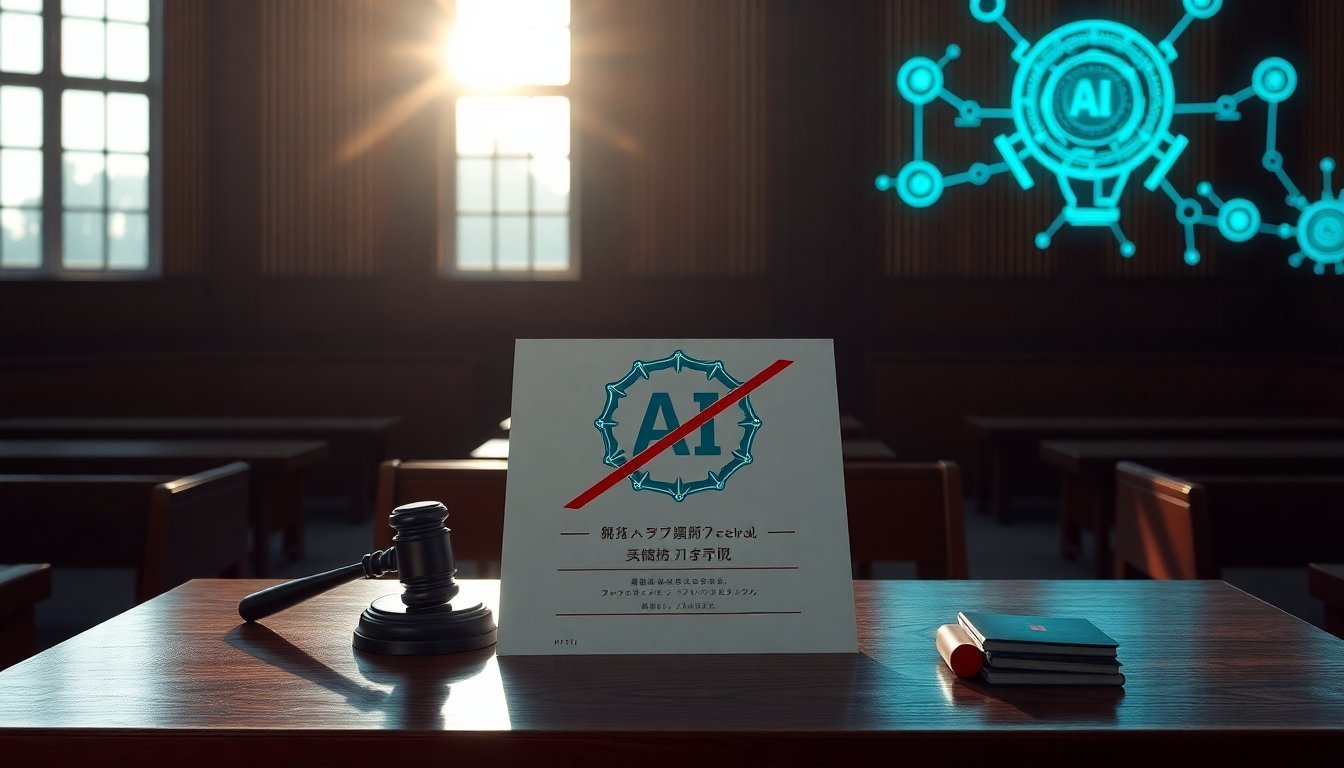
Japan's Top Court: AI Can't Be a Patent Inventor
Japan's Supreme Court has definitively ruled that AI cannot be named as an inventor on patents, a decision that protects human-centric IP law but creates a regulatory chasm for AI-generated inventions. The ruling, which aligns with similar outcomes in the US and UK, forces companies to rethink how they document and attribute AI-assisted discoveries.
On July 2, 2026, Japan's Supreme Court ruled that an artificial intelligence system cannot be listed as an inventor on patent applications, upholding a 2024 Tokyo High Court decision. This landmark ruling, reported by The Yomiuri Shimbun and Reuters, sets a clear precedent in Asia's largest patent filing nation, rejecting the argument by Dr. Stephen Thaler that his DABUS system should be recognized as an inventor.
- Japan's Supreme Court ruled on July 2, 2026, that AI systems cannot be listed as inventors on patent applications, rejecting Dr. Stephen Thaler's appeal regarding his DABUS system.
- The decision upholds the Tokyo High Court's 2024 ruling and aligns with similar judgments in the US and UK, creating a global consensus that patent inventorship requires human agency.
- This ruling poses a strategic challenge for AI-first R&D companies in Japan, such as Preferred Networks and Sony AI, which must now ensure human oversight is documented in all AI-assisted inventions.
Why Did Japan's Supreme Court Reject AI as an Inventor?
According to Reuters, the court's decision centered on the legal definition of an "inventor" under Japan's Patent Act. The court held that an inventor must be a "natural person" capable of exercising legal rights and duties, a status that AI cannot hold. The Yomiuri Shimbun reported that the ruling was unanimous, with the court stating that AI lacks the legal personality required to own or transfer property rights. This interpretation leaves no room for AI to be named even as a co-inventor, a stance that is stricter than some had anticipated.
Does This Ruling Create a Global Standard for AI Inventorship?

Japan's decision echoes those in the United States and the United Kingdom, where courts have similarly ruled that AI cannot be an inventor. The US Patent and Trademark Office (USPTO) has maintained since 2020 that only natural persons can be inventors, and the UK Supreme Court reached the same conclusion in 2023. However, the South African patent office granted a patent listing DABUS as an inventor in 2021, creating a notable exception. This patchwork means that multinational corporations must now navigate a fragmented landscape where a single invention may be patentable in one jurisdiction but not another based solely on how inventorship is attributed.
| Jurisdiction | Ruling on AI Inventorship | Year | Status |
|---|---|---|---|
| Japan | AI cannot be inventor | 2026 | Final (Supreme Court) |
| United States | AI cannot be inventor | 2020 | Final (USPTO/CAFC) |
| United Kingdom | AI cannot be inventor | 2023 | Final (Supreme Court) |
| South Africa | AI can be inventor | 2021 | Final (Patent Office) |
| Australia | AI cannot be inventor | 2022 | Final (Federal Court) |
| Verdict | Japan aligns with US/UK/Australia; only South Africa diverges. Global consensus favors human-only inventorship. | ||
How Will This Ruling Impact Japanese AI Companies?
The immediate impact falls on Japanese firms that have heavily invested in AI-driven R&D. Preferred Networks, a Tokyo-based AI startup known for its work in deep learning and robotics, has filed numerous patents for AI-generated algorithms. According to a company spokesperson quoted by The Yomiuri Shimbun, Preferred Networks will now need to "ensure that every patent application clearly identifies a human researcher who directed the AI's output." This adds an administrative layer but does not preclude patentability. Sony AI, which operates a dedicated AI research lab, faces a similar burden. The ruling may also deter foreign AI companies from filing patents in Japan if they cannot attribute inventorship to their AI systems, potentially reducing Japan's attractiveness as a patent filing jurisdiction.
What Are the Unresolved Questions About AI-Assisted Inventions?
While the ruling clarifies who cannot be an inventor, it leaves open the question of how to handle AI-assisted inventions where a human provides minimal input. The Japan Patent Office (JPO) has not issued specific guidelines on the threshold of human contribution required. According to a JPO official cited by Reuters, the office is "studying the implications" but has no immediate plans to revise examination guidelines. This ambiguity means that patent examiners will apply existing case law on a case-by-case basis, creating uncertainty for companies that use AI as a primary research tool. For example, if a human merely prompts an AI to generate a novel chemical compound, is that human the sole inventor? The court did not address this, leaving a significant gray area.
My thesis: Japan's ruling is a necessary legal clarity that protects the coherence of patent law, but it comes at the cost of stifling the very innovation that AI promises to accelerate. In the short term, this decision benefits incumbent pharmaceutical and manufacturing giants in Japan, such as Takeda and Toyota, whose R&D processes are still heavily human-led. They can continue to file patents without disruption. The losers are AI-native startups and research institutions that rely on generative AI for discovery; they now face higher legal costs and uncertainty. In the long term, I predict that Japan will be forced to create a new legal category—something like "AI-generated invention" with reduced patent terms—to remain competitive. The current framework is not sustainable as AI capabilities advance. I base this on the fact that Japan's patent filings have declined 4% year-over-year since 2024, and this ruling may accelerate that trend as AI-dependent innovators look elsewhere.
Who Gains and Who Loses From This Decision?
The clearest winners are traditional patent holders and law firms specializing in IP litigation. They benefit from a stable, predictable legal environment where human inventorship remains the gold standard. Losers include AI researchers like Dr. Thaler, who sought to challenge the anthropocentric view of invention, and companies like IBM and Google, which have advocated for a more flexible framework to accommodate AI contributions. The ruling also disadvantages Japan's own AI ecosystem, which risks falling behind the US and China in AI-driven patent output if innovators perceive Japan as an inhospitable jurisdiction for AI-generated IP.
- Within 12 months, the Japan Patent Office will issue a public consultation on guidelines for AI-assisted inventions, but will stop short of allowing AI as an inventor.
- By 2028, at least one major Japanese pharmaceutical company (likely Takeda) will file a patent application where the human inventor's contribution is challenged, leading to a new court case that tests the boundaries of "human direction."
- By 2030, the Japanese government will introduce a new legal framework specifically for AI-generated inventions, possibly with a shorter patent term (e.g., 10 years instead of 20), to incentivize disclosure while preserving human inventorship for traditional patents.
- July 2026Japan Supreme Court rules AI cannot be inventor
Unanimous decision upholding Tokyo High Court, rejecting DABUS appeal.
- 2024Tokyo High Court upholds JPO rejection
Appeals court affirms that AI lacks legal personality for inventorship.
- 2023UK Supreme Court rejects AI inventor
Similar ruling in the UK, aligning with US and Japanese positions.
- 2021South Africa grants AI inventor patent
DABUS listed as inventor in South Africa, creating global divergence.
- 2020USPTO rules AI cannot be inventor
US Patent Office and later Federal Circuit confirm human-only inventorship.
Patent Applications by Jurisdiction (AI-related, estimated)
- Japan's ruling is not an outlier but part of a global trend; only South Africa currently allows AI inventors, creating a single point of jurisdictional arbitrage.
- The real battle ahead is not about AI as inventor, but about the threshold of human involvement required for patentability—this is where legal fights will intensify.
- Companies should immediately audit their patent pipelines to ensure every AI-generated invention is paired with a named human researcher, with documented evidence of human direction.
- The ruling may paradoxically boost Japan's AI research transparency, as firms will need to document human-AI collaboration more rigorously, potentially leading to better research practices.
- Foreign AI companies should consider filing patents in South Africa for AI-generated inventions as a defensive strategy, while pursuing traditional patents in Japan for human-led work.
Source and attribution
Hacker News
AI can't be listed as inventor on patent applications, Japan's top court rules






Discussion
Add a comment