
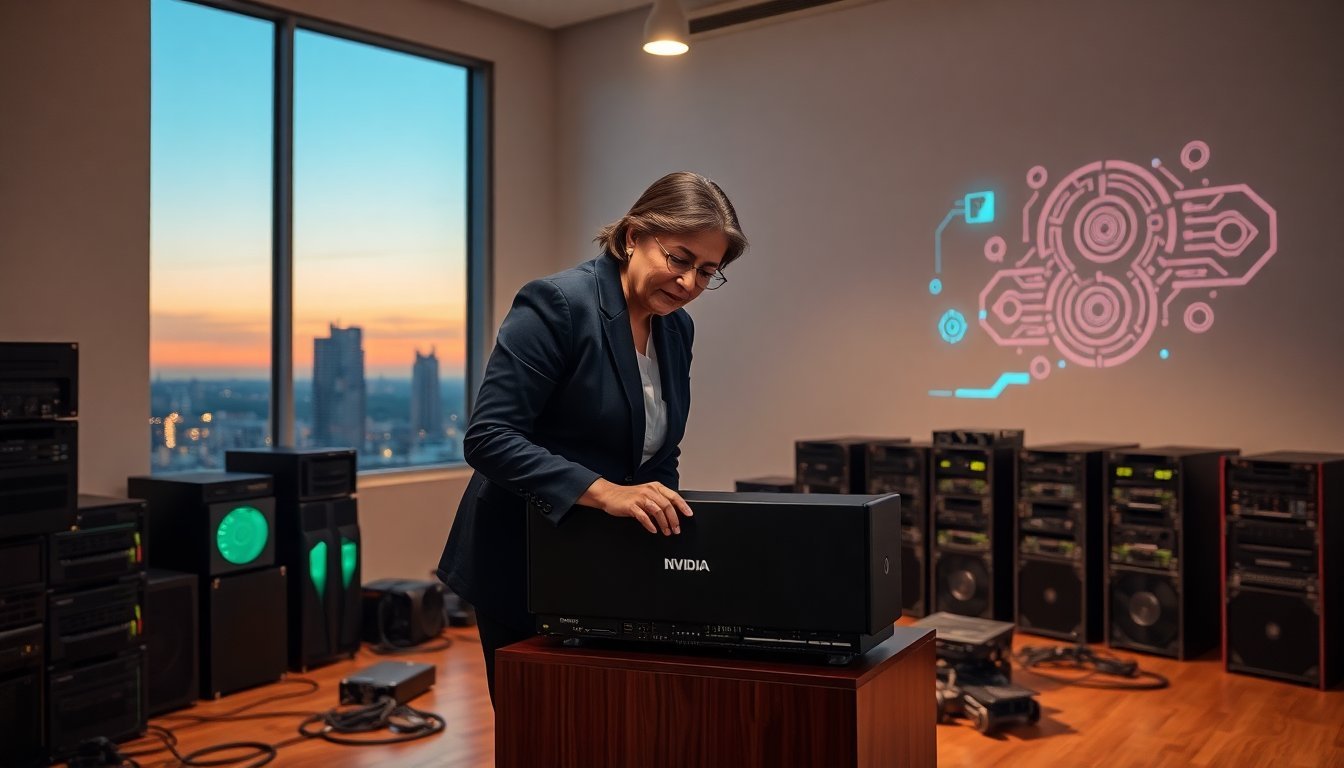
India's AM Intelligence Bets $9B on Nvidia Vera Rubin
AM Intelligence's order for 9,000 Nvidia Vera Rubin units marks the largest single AI infrastructure commitment in India's history. This analysis examines what the deal means for India's AI ambitions, Nvidia's market strategy, and the competitive landscape against China and the US.
AM Intelligence, an Indian AI infrastructure firm, has placed a landmark order for 9,000 Nvidia Vera Rubin systems, aiming to be among the first in Asia to deploy the next-generation AI computing platform. The Bloomberg report, published August 25, 2026, signals a bold move that could redefine India's position in the global AI infrastructure race—or expose the risks of overcommitting to unproven hardware.
- AM Intelligence has ordered 9,000 Nvidia Vera Rubin systems, positioning itself as a first-mover in Asia for Nvidia's next-gen AI platform.
- The deal, reported by Bloomberg on August 25, 2026, underscores India's accelerating push into AI infrastructure amid a global compute race.
- Key tensions: financing the estimated $9B deployment, India's power grid capacity, and whether early adoption of unproven hardware creates advantage or risk.
Why did AM Intelligence commit to 9,000 Vera Rubin systems now?
According to Bloomberg Technology's August 25, 2026 report, AM Intelligence's order is a deliberate bet on being first. The company is seeking to become one of the earliest adopters of the Vera Rubin platform in Asia, a move that would give it a competitive edge in securing enterprise AI contracts before rivals catch up. Nvidia has positioned Vera Rubin as its flagship AI data center platform, with a focus on energy efficiency and massive parallel processing capabilities.
The timing is strategic. India's AI market is projected to grow rapidly, and AM Intelligence appears to be betting that early access to cutting-edge hardware will translate into long-term customer lock-in. However, this is a high-stakes gamble—the Vera Rubin platform is still in its early deployment phase, and any technical issues could delay revenue generation.
How does this order reshape India's AI infrastructure landscape?
The scale of this order is unprecedented for an Indian AI infrastructure company. According to Nvidia's official product documentation, the Vera Rubin platform is designed for extreme-scale AI training and inference workloads, making it a direct competitor to systems being deployed by US hyperscalers and Chinese cloud providers. AM Intelligence's move positions India as a serious contender in the global AI compute market, challenging the dominance of US and Chinese players.
Yet, the infrastructure challenge is immense. India's power grid has historically struggled with reliability, and a deployment of this scale would require dedicated power generation capacity. AM Intelligence has not disclosed its power strategy, but the company will need to secure long-term power purchase agreements or build captive generation to ensure uptime. This is a critical operational risk that could undermine the entire project.
Who are the winners and losers in this deal?
| Stakeholder | Position | Key Factor |
|---|---|---|
| Nvidia | Winner | Secures a major Asian anchor customer for Vera Rubin, boosting production confidence |
| AM Intelligence | High Risk | First-mover advantage vs. execution risk on unproven hardware |
| Indian AI ecosystem | Potential Winner | Access to world-class compute could spur domestic AI innovation |
| Chinese cloud providers | Threatened | India's compute capacity could undercut China's regional AI services |
| US hyperscalers | Indirect Winner | India becomes an alternative hub, reducing concentration risk |
| Verdict | Nvidia Wins Short-Term | AM Intelligence's success depends on execution, not just hardware |
This comparison table highlights the asymmetric risk profile. Nvidia gains a marquee customer that validates Vera Rubin's market traction, while AM Intelligence carries the operational burden. The Indian AI ecosystem could benefit enormously if the deployment succeeds, but the failure mode is equally dramatic—a massive stranded asset investment.
What are the financing and operational challenges AM Intelligence faces?
Bloomberg's report did not disclose the financial terms, but industry estimates suggest a deployment of this scale could cost between $8–12 billion, including infrastructure and power. AM Intelligence will likely need to secure debt financing, potentially through Indian state-backed infrastructure funds or international private equity. The company's ability to secure favorable financing terms will be a key determinant of project viability.
Operationally, the company faces a chicken-and-egg problem. To justify the investment, it needs customers; to attract customers, it needs to demonstrate reliability. This is a classic infrastructure dilemma, and AM Intelligence will need to aggressively court enterprise and government clients to reach utilization rates above 70%—the typical breakeven threshold for AI data centers.
What does this mean for the global AI compute race?
This order is a clear signal that India is no longer content to be a back-office for global tech. According to industry analysts tracking AI infrastructure investments, India's total AI compute capacity could increase by 300% within 18 months if this deployment goes live. That would make India the third-largest AI compute market after the US and China, fundamentally altering the geopolitical balance in AI development.
However, the US export controls on advanced AI chips remain a wildcard. If the regulatory environment shifts, AM Intelligence could face supply chain disruptions that delay the entire project. The company is betting that Nvidia's production capacity and political stability will hold, but this is far from guaranteed.
My thesis: AM Intelligence's order is a bold but risky bet that could either make India a global AI powerhouse or become a cautionary tale of overcommitment.
Short-term, Nvidia is the clear winner—it secures a massive order that validates Vera Rubin's market position. Long-term, the outcome hinges on AM Intelligence's execution. If the company can overcome India's power infrastructure challenges and secure anchor tenants, it will have created a strategic asset that rivals anything in Asia outside China. If not, the financial fallout could set back India's AI ambitions by years.
The biggest winner is Nvidia, which gains a powerful proof point for Vera Rubin's adoption beyond the US and Europe. The biggest loser, if execution fails, is AM Intelligence itself—and by extension, the Indian AI ecosystem that would have bet on this infrastructure.
My prediction: AM Intelligence will announce a partnership with a major Indian conglomerate or state-owned enterprise within 12 months to secure financing and power commitments, a move that will be critical to project viability.
Predictions
- AM Intelligence will secure a $3–4 billion debt financing package from a consortium of Indian state banks and international infrastructure funds by Q2 2027.
- Nvidia will use this order to secure at least two additional Asian anchor customers for Vera Rubin by mid-2027, citing AM Intelligence as a reference deployment.
- India's Ministry of Electronics and IT will announce a dedicated AI infrastructure policy by Q1 2027, specifically addressing power allocation for AI data centers.
Timeline
- August 2026Order Announced
Bloomberg reports AM Intelligence's 9,000-unit Vera Rubin order.
- Q4 2026Financing Round
Expected debt financing discussions begin with Indian and international lenders.
- Q2 2027First Deployment
Initial phase of Vera Rubin systems expected to go live in a major Indian metro.
- 2028Full Operational Status
Target for full 9,000-system deployment and commercial operations.
Chart
Estimated AI Compute Capacity by Region (2027)
Article Summary
- AM Intelligence's order is a strategic bet on first-mover advantage, but execution risk is the dominant factor.
- India's power infrastructure is the single biggest operational risk to the deployment's success.
- Nvidia benefits disproportionately from this deal, gaining a marquee Asian customer for Vera Rubin.
- The order shifts India from AI consumer to AI producer, with geopolitical implications for the US-China-India triangle.
- Financing structure and anchor tenant acquisition will determine whether this becomes a landmark or a cautionary tale.
Source and attribution
Bloomberg Technology
India AI Data Center Firm Orders 9,000 Nvidia Vera Rubin Systems






Discussion
Add a comment