
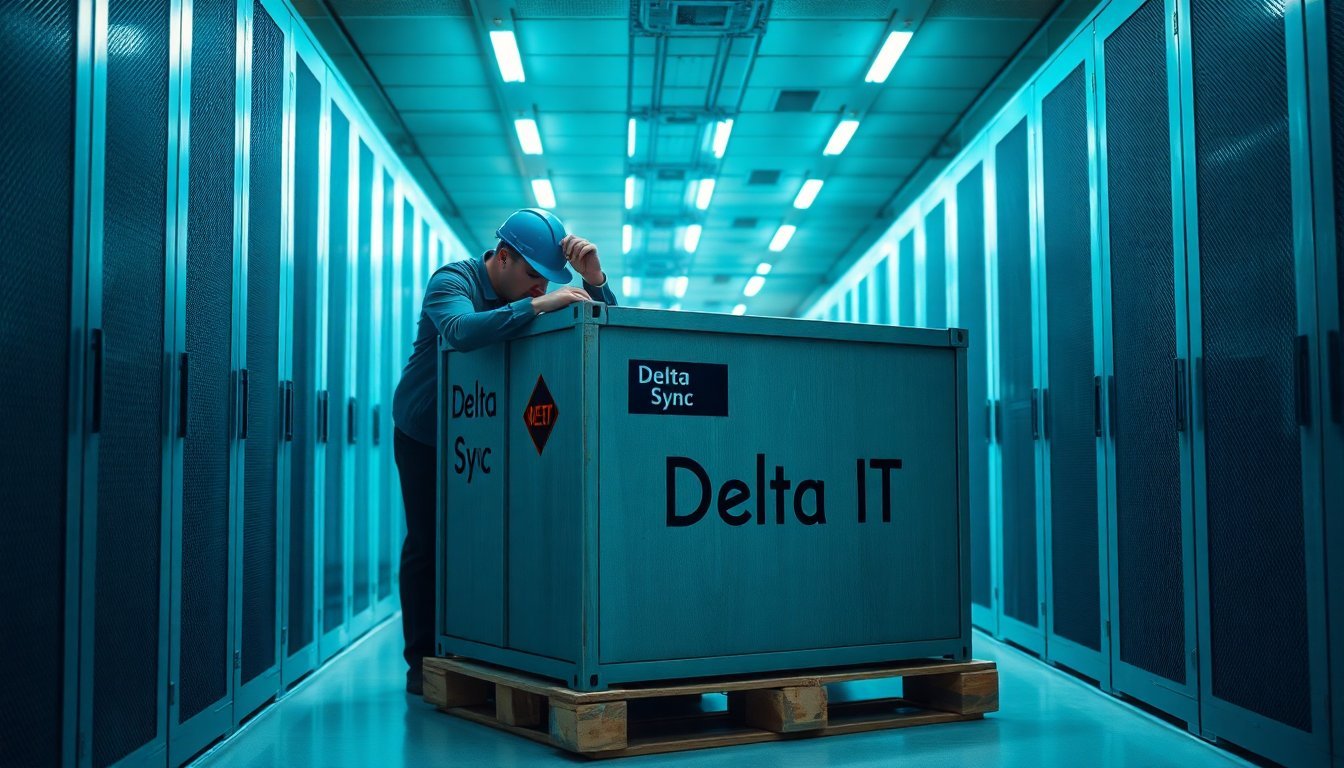
Hugging Face's Delta Sync Ships Trillion-Parameter Models
Hugging Face's Delta Weight Sync in TRL reduces the cost of shipping trillion-parameter models by syncing only the fine-tuning deltas, not the full weights. This makes large-scale fine-tuning practical for teams without massive bandwidth.
Hugging Face released Delta Weight Sync for its TRL library on May 27, 2026, enabling developers to sync only the fine-tuning deltas instead of full model weights. This cuts the bandwidth needed to ship a trillion-parameter model from terabytes to megabytes, fundamentally changing how large-scale fine-tuning is deployed.
- Hugging Face released Delta Weight Sync for TRL on May 27, 2026, enabling syncing of only fine-tuning deltas instead of full model weights.
- This reduces the bandwidth needed to ship a trillion-parameter model from terabytes to megabytes, making large-scale fine-tuning practical.
- The key tension: does this solve the distribution bottleneck or just shift it to compute and storage of base models?
What Is Delta Weight Sync and Why Does It Matter for Trillion-Parameter Models?
According to Hugging Face's blog post, Delta Weight Sync is a new feature in the TRL (Transformer Reinforcement Learning) library that allows users to synchronize only the weight deltas—the changes made during fine-tuning—rather than the entire model. For a trillion-parameter model like a hypothetical GPT-5 scale system, full weights might occupy 2 TB of storage. The deltas, depending on the fine-tuning method (e.g., LoRA or full fine-tuning with sparse updates), could be as small as a few megabytes. This is a radical reduction in transfer cost.
Hugging Face reported that the feature works by storing the base model in a Hub bucket and syncing only the delta weights. This means that when a developer fine-tunes a model on a specific dataset, they can push the deltas to the Hub, and any consumer can pull the deltas and apply them to their local copy of the base model. The base model itself is never transferred—only the changes. This is conceptually similar to how git stores only diffs, but applied to neural network weights.
How Does Delta Weight Sync Compare to Existing Fine-Tuning Distribution Methods?

| Feature | Delta Weight Sync (TRL) | Full Weight Snapshot | LoRA Adapter Weights |
|---|---|---|---|
| Transfer size for 1T model | ~10 MB (deltas) | ~2 TB | ~100 MB (LoRA adapters) |
| Base model required on target | Yes | No | Yes |
| Fine-tuning method support | Any (full FT, LoRA, etc.) | Any | LoRA only |
| Versioning and rollback | Automatic via Hub | Manual | Manual |
| Latency to first inference | Seconds (download deltas, apply) | Hours (download full weights) | Minutes (download adapters) |
| Verdict | Winner for bandwidth-constrained teams | Only viable with dedicated fiber | Good but limited to LoRA |
Who Benefits Most From This Feature: Developers or Platform Providers?
Hugging Face said that the primary beneficiaries are developers working on large-scale fine-tuning projects, especially those in regions with limited bandwidth or those using cloud instances with expensive egress costs. For example, a team in Southeast Asia fine-tuning a 500B parameter model would previously need to download 1 TB of weights; now they can download 5 MB of deltas. This democratizes access to large model fine-tuning.
However, the platform provider—Hugging Face—also benefits significantly. By making the Hub the canonical storage for base models, they lock in users to their infrastructure. Competitors like Weights & Biases or MLflow would need to implement similar delta syncing to remain competitive for large-scale fine-tuning workflows. The feature also increases the value of the Hub as a distribution platform, potentially driving more paid storage and compute usage.
What Are the Technical Limitations of Delta Weight Sync?
According to the Hugging Face blog, Delta Weight Sync requires that the base model be accessible on the target machine. This means that the target must either have the base model cached locally or be able to pull it from a fast local network. For organizations with distributed teams, this could be a challenge if the base model is not already mirrored in each region. Additionally, the deltas are specific to the base model version; if the base model is updated, the deltas may become incompatible.
Another limitation is that the delta weights are computed as the difference between the fine-tuned and base model weights. For models fine-tuned with methods that modify the architecture (e.g., adding new layers), the delta may not be a simple subtraction. Hugging Face acknowledged that this feature works best with parameter-efficient fine-tuning methods like LoRA, where the deltas are small and well-defined. For full fine-tuning, the deltas can still be large, though still much smaller than the full model.
My thesis: Delta Weight Sync is a pragmatic solution to a real infrastructure bottleneck, but it shifts the problem rather than eliminating it. In the short term, this feature will reduce bandwidth costs for teams fine-tuning large models, especially those using LoRA. In the long term, it increases dependency on the Hugging Face Hub as the single source of truth for base models, which could become a single point of failure. The winners are Hugging Face (platform lock-in) and developers with limited bandwidth. The losers are competitors like Weights & Biases, who will need to build similar features or risk losing mindshare. I predict that within 12 months, at least two major MLOps platforms will announce their own delta-syncing capabilities, but Hugging Face's first-mover advantage will be significant.
- Weights & Biases will announce a delta-syncing feature for their W&B Artifacts by Q2 2027. The competitive pressure from Hugging Face's Hub will force them to match the capability.
- By Q1 2027, at least 30% of large-scale fine-tuning projects (models >100B parameters) will use delta syncing. The cost savings are too large to ignore.
- Hugging Face will introduce a paid tier for delta storage and bandwidth by Q4 2026. The feature is too valuable to remain free indefinitely.
- May 2026Delta Weight Sync released in TRL
Hugging Face ships delta weight syncing for large model fine-tuning.
- Q2 2027Competitors announce delta syncing
Predicted: Weights & Biases and MLflow launch similar features.
- Q4 2026Paid delta storage tier
Predicted: Hugging Face monetizes delta storage and bandwidth.
Transfer Size Comparison for 1T Parameter Model Fine-Tuning (estimated)
- Delta Weight Sync is not a new training method—it's a distribution optimization that makes fine-tuning large models practical for teams without dedicated fiber.
- The feature creates a subtle lock-in to Hugging Face's Hub, as base models must be stored there for delta compatibility.
- For parameter-efficient fine-tuning (LoRA, AdaLoRA), the deltas are tiny, making this a no-brainer for most teams.
- The biggest risk is dependency on a single platform for base model versioning; a Hub outage could halt delta-based workflows.
- This feature will accelerate the trend toward centralized model hubs and away from local model storage.

Source and attribution
Hugging Face Blog
Shipping a Trillion Parameters With a Hub Bucket: Delta Weight Sync in TRL






Discussion
Add a comment