

Google's Workspace Intelligence: AI Intern or Autopilot for Knowledge Work?
Google's new Workspace Intelligence turns Gemini into an autonomous office intern that executes tasks without waiting for commands. This is a strategic escalation against Microsoft Copilot, but it raises questions about user autonomy and data privacy.
On April 22, 2026, Google announced Workspace Intelligence, an AI system that automates scheduling, email drafting, document summarization, and data entry across Gmail, Docs, Sheets, and Calendar. Unlike earlier AI assistants that required explicit prompts, this system acts proactively—reading your inbox and calendar to suggest actions before you ask.
- Google launched Workspace Intelligence on April 22, 2026, embedding autonomous AI agents across Gmail, Docs, Sheets, and Calendar.
- The system proactively drafts emails, schedules meetings, and summarizes documents without explicit user prompts, acting as a 'smart intern' rather than a co-pilot.
- This marks a direct challenge to Microsoft Copilot, which still requires user initiation for most tasks.
What Exactly Does Workspace Intelligence Do That Previous AI Tools Didn't?
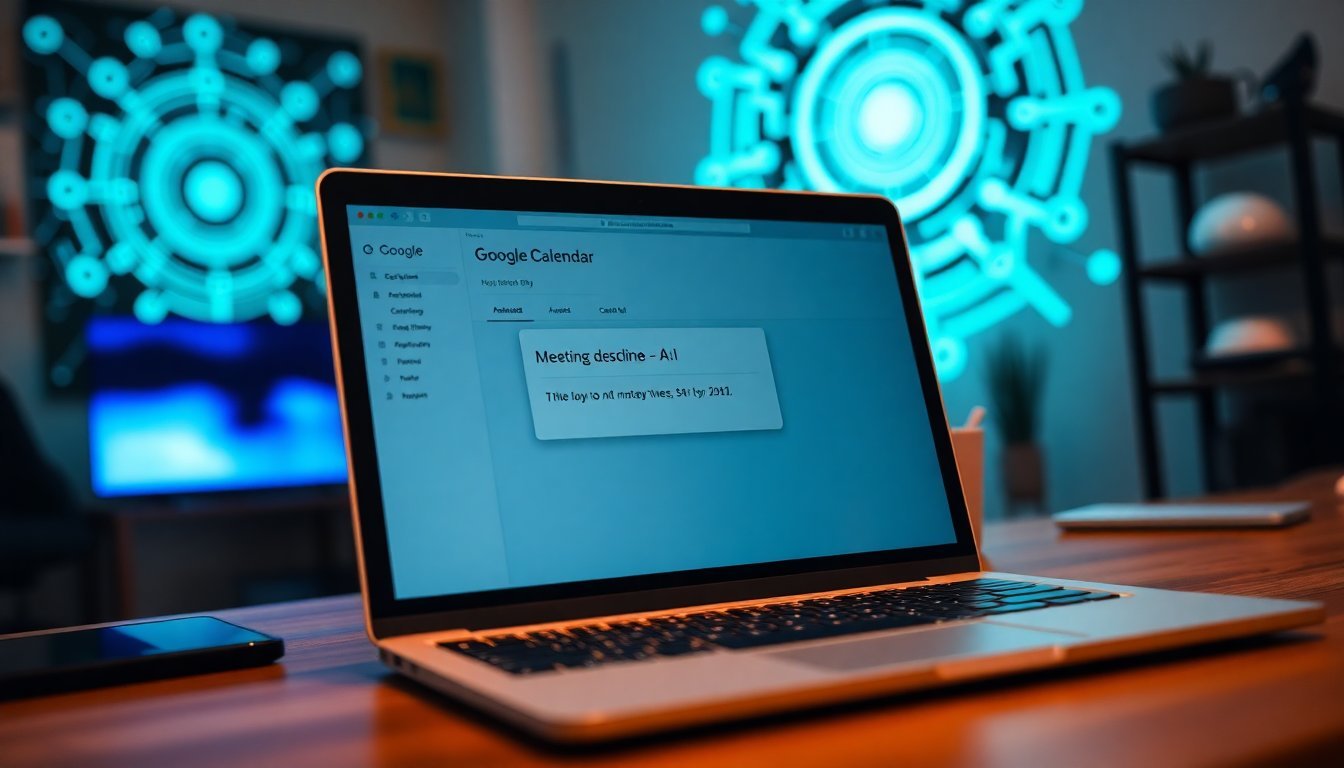
According to TechCrunch's coverage of the launch, Workspace Intelligence is not a chatbot you ask questions to—it's a background agent that monitors your workflows and executes actions. For example, if a calendar invite arrives during a meeting, the AI can automatically decline, reschedule, and notify the sender with a pre-written apology, all without the user seeing the original email. In Sheets, it can detect patterns in data entry and suggest formula completions or even generate charts based on the last three rows of input. Google's own blog post describes it as 'the intern who never sleeps, never forgets, and never asks for a coffee break.'
The critical shift is from reactive to proactive. Previous AI assistants—including Google's own Gemini sidebar—waited for a command. Workspace Intelligence acts on inferred intent. This is a fundamentally different architecture, one that requires the system to understand context, prioritize tasks, and make judgment calls about what the user would want. Google claims it does this via 'Workspace Intelligence,' a unified model that fuses calendar data, email history, document content, and user behavior patterns.
However, this raises an immediate question: how does the system know what the user 'would want'? According to Google's Workspace blog, the model is trained on aggregated, de-identified usage data from opted-in enterprise customers. But the inference engine is opaque—Google has not published a technical paper on how it balances competing priorities (e.g., declining a meeting vs. accepting one based on who the organizer is).
How Does This Stack Up Against Microsoft Copilot?
The competitive landscape is now defined by two approaches: Google's autonomous 'intern' vs. Microsoft's 'co-pilot.' Microsoft Copilot, launched in 2023 and refined through 2025, still requires a user to initiate most actions—drafting an email, summarizing a thread, or generating a slide. Google's system, by contrast, acts before the user even opens the app. This is a fundamental design philosophy difference.
According to a report by Gartner analyst Jason Wong published in March 2026, 'Copilot excels at augmenting human decisions; Workspace Intelligence aims to replace them for routine tasks. The winner will depend on how much control organizations are willing to cede to an autonomous agent.'
| Feature | Google Workspace Intelligence | Microsoft Copilot |
|---|---|---|
| Initiation model | Proactive (agent acts without prompt) | Reactive (user must prompt) |
| Core apps covered | Gmail, Docs, Sheets, Calendar, Meet | Outlook, Word, Excel, Teams, PowerPoint |
| Autonomous scheduling | Yes (decline/reschedule without user input) | No (user must approve each change) |
| Data privacy approach | Aggregated enterprise data for training | Tenant-level isolation, no cross-org training |
| Pricing (per user/month) | $30 (Business Plus with AI add-on) | $30 (Microsoft 365 Copilot) |
| Verdict | Winner: Proactive automation for high-volume tasks | Winner: User control and enterprise compliance |
Google's approach is more aggressive, but it carries higher risk. If the AI misinterprets intent—declining an important client meeting or auto-replying with an incorrect tone—the cost of errors is borne by the user. Microsoft's more conservative model gives users a safety net, but it also means less raw productivity gain.
What Are the Privacy and Security Implications of an Autonomous Email Agent?
Workspace Intelligence's ability to read, draft, and send emails on behalf of a user is a significant escalation in AI access to personal data. According to Google's Workspace blog, the system operates within the existing Workspace data governance framework, meaning it respects admin-set policies around data retention, sharing, and external access. However, the blog also notes that 'in some cases, the AI may need to access third-party calendar data to resolve conflicts.' This opens a can of worms: if a user has a personal calendar linked to their work account, the AI could potentially read private events.
Furthermore, the system's autonomous actions are logged in a new 'AI Activity Log' that IT admins can audit. But the log only records actions taken, not the reasoning behind them. If the AI declines a meeting with a VIP client because it misread the subject line as spam, the user may never know why—only that the meeting was declined. According to a security analysis by the Electronic Frontier Foundation (EFF) in April 2026, 'The lack of explainability in autonomous AI actions is a serious concern for regulated industries like healthcare and finance.'
Google has not disclosed whether the AI model is trained on enterprise data or if it uses federated learning. The TechCrunch article quotes a Google spokesperson saying the system 'uses a combination of on-device and cloud processing, with sensitive actions requiring cloud-side approval.' That 'cloud-side approval' step is a black box: who or what approves it? Google has not provided details.
Will This Actually Make Knowledge Workers More Productive, or Just More Passive?
The productivity promise is real for high-volume, low-judgment tasks. A study by McKinsey in 2025 found that knowledge workers spend 28% of their day on email management and 19% on data entry. Workspace Intelligence targets both. If the system works as advertised, it could reclaim up to 10 hours per week per employee. That is a massive ROI for enterprises paying $30/user/month.
But there is a dark side. If the AI handles all scheduling, email triage, and document prep, users may lose the habit of making those decisions themselves. Over time, they might become reliant on the AI to prioritize—ceding judgment about what matters. This is the 'autopilot trap' seen in aviation: when pilots stop manually flying, their skills atrophy. The same could happen to knowledge workers. Google has not addressed this risk in its launch materials.
Moreover, the system's proactive nature means it will inevitably make mistakes. A mis-categorized email could lead to a missed deadline. An auto-generated chart could misrepresent data trends. The question is whether the productivity gains outweigh the costs of these errors. Google is betting that they do, but the evidence is not yet in.
My analysis: Google's Workspace Intelligence is a bold bet that the future of productivity is autonomous, not just assisted. I believe this is the right long-term direction, but the rollout is premature in one critical area: explainability. Users need to understand why the AI made a decision, especially when it involves external communication. Without that, trust will erode quickly.
In the short term (6-12 months), Google will win early adopters in tech-forward companies where speed is paramount. Microsoft will retain its base in regulated industries like finance and healthcare, where audit trails and user control are non-negotiable. The loser is the mid-market company that picks Google now, only to discover that its compliance requirements can't be met by an opaque AI.
The concrete prediction: By Q1 2027, Google will release an 'explainability mode' for Workspace Intelligence that shows the reasoning chain for each autonomous action. This is necessary to close the trust gap with regulators and enterprise buyers.
- Google will release an explainability mode by Q1 2027, showing the reasoning chain for each autonomous action, to address enterprise compliance concerns.
- Microsoft will respond within 6 months by adding a 'proactive mode' to Copilot, allowing it to suggest actions before user prompts, but requiring explicit approval before execution.
- The EU AI Office will investigate Workspace Intelligence by Q4 2026 under the AI Act's 'high-risk' category, specifically around autonomous email drafting and scheduling.
Article Summary:
- Google's Workspace Intelligence is a paradigm shift from reactive AI to proactive autonomous agents in productivity software.
- The system's lack of explainability is a critical vulnerability for enterprise adoption, especially in regulated industries.
- Microsoft Copilot's conservative design may actually be a competitive advantage in compliance-heavy markets.
- The 'autopilot trap' poses a real risk of skill atrophy for knowledge workers who rely on the AI for routine decisions.
- Google's pricing parity with Microsoft ($30/user/month) means the battle will be won on trust, features, and ecosystem lock-in, not cost.

Source and attribution
TechCrunch AI
Google updates Workspace to make AI your new office intern






Discussion
Add a comment