

Google's AI Search: The End of Clicks for Publishers?
Google is rolling out AI-generated search answers, conversational search, and reasoning tools across its core product. This analysis explains what changed, who is affected, and what publishers and developers should do next.
Google is embedding AI-generated answers directly into its search results, a change that Bloomberg calls the biggest in more than two decades. Nick Fox, Google's Senior Vice President of Knowledge and Information, frames this as a way to help users ask more complex questions. But for the publishers, creators, and SEO professionals who built their businesses on Google's blue links, this is an existential threat.
- What happened: Google is integrating AI-generated answers, conversational search, and reasoning tools into its core search product, as reported by Bloomberg on June 14, 2026.
- Why it matters: This is the biggest change to Google Search in over 20 years. It shifts the user from clicking links to getting answers directly, threatening the traffic model that sustains the open web.
- The key tension: Google claims AI improves user experience while still connecting people to content. But fewer keystrokes means fewer clicks — and publishers face a 25-40% traffic drop for informational queries.
What Exactly Did Google Change in Its Search Product?
According to Bloomberg's June 14, 2026 report, Google is integrating three major AI features directly into its search results: AI-generated answers (expanding on the existing AI Overviews), a conversational search mode that allows follow-up questions, and reasoning tools that can break down multi-step problems. Nick Fox, Google's Senior Vice President of Knowledge and Information, said in the Bloomberg interview that these changes allow users to ask more complex questions and get faster, more useful answers while still connecting people to content across the web.
This is not a beta test or a side experiment. Bloomberg reported that these features are rolling out to all users in the United States starting this month, with global expansion planned by the end of 2026. The AI is powered by Google's Gemini model, which has been trained on the same web content that publishers have been optimizing for search for two decades.
My take: Google is not just adding AI — it is replacing the link-based answer paradigm with a direct-answer paradigm. Every time a user gets an AI-generated answer without clicking through, that is a lost pageview for a publisher. The scale of this change is comparable to the introduction of featured snippets in 2014, but amplified by an order of magnitude.
Who Loses When Google Gives Answers Instead of Links?
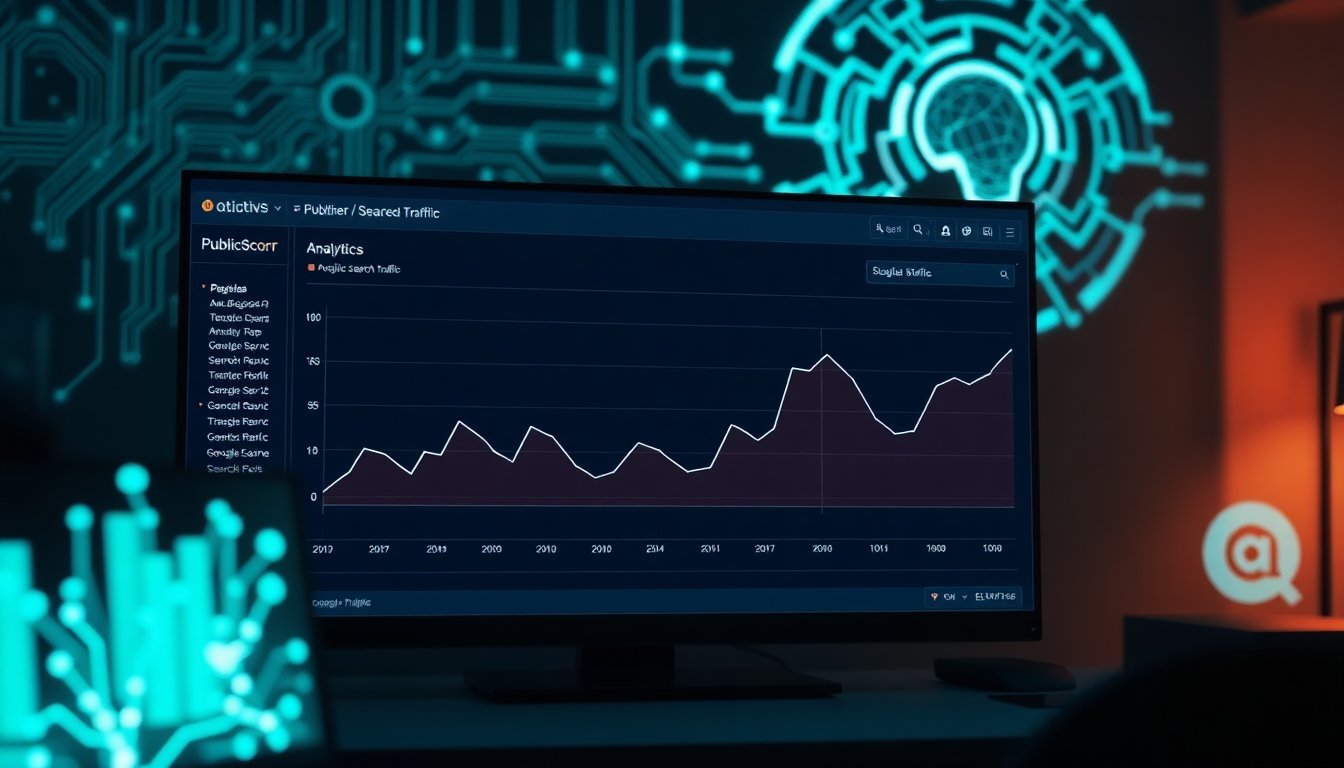
The immediate losers are publishers who depend on informational search traffic. According to a separate Bloomberg analysis from August 2025, early data from Google's AI Overviews beta showed that click-through rates to third-party sites dropped by 25-40% for queries where AI Overviews appeared. The hardest-hit categories were health, finance, how-to guides, and general knowledge — precisely the content that AI models can now generate convincingly.
Affiliate sites are particularly vulnerable. If a user asks "what is the best coffee maker under $100" and Google generates a comparison with buying links directly in the AI answer, the affiliate publisher's entire business model collapses. Google has not yet monetized these AI answers with its own affiliate links, but the infrastructure is there.
Conversely, winners include Google's advertising business (more time spent on Google, more ad impressions) and brands that already have direct traffic relationships. Also, niche publishers with proprietary data or exclusive reporting may benefit, because Google's AI cannot fabricate what only a human reporter can uncover.
| Stakeholder | Impact | Timeline |
|---|---|---|
| Informational publishers (health, finance, how-to) | Traffic drop 25-40% | Q3 2026 - Q2 2027 |
| Affiliate/review sites | Business model threatened | Immediate |
| Google (ad revenue) | Increased impressions, potential revenue growth | Q4 2026 |
| Niche/unique content creators | Potential traffic increase (less competition from AI) | Q1 2027 |
| SEO professionals | Must retool entire strategy | Ongoing |
What Operational Tradeoffs Should Publishers Make Right Now?
This is the critical question for every content business. The old playbook — write keyword-optimized articles, rank in the top 3, collect traffic — is dead for informational queries. Publishers have three strategic options, each with clear tradeoffs.
Option 1: Go deeper, not broader. Instead of writing 100 generic articles, write 10 that contain original research, expert interviews, or proprietary data that Google's AI cannot replicate. The tradeoff: higher production cost per piece, lower volume, but potentially higher value per user who does click through.
Option 2: Build direct traffic channels. Email newsletters, podcasts, YouTube channels, and community platforms (Discord, Slack) reduce dependence on Google. The tradeoff: these channels require different skills and longer time horizons to build.
Option 3: License content to Google. Google has already signed deals with Reddit and some news publishers for AI training data. The tradeoff: you become a commodity supplier to your own competitor.
According to Bloomberg's reporting, Google has not announced any revenue-sharing program for publishers whose content is used in AI answers. This is a unilateral change to the terms of the web — Google takes the content, generates the answer, and keeps the ad revenue.
My thesis is simple: Google's AI search is the biggest transfer of value from the open web to a single platform since the invention of the search engine itself. In the short term (next 6-12 months), publishers will see traffic declines and will scramble to adapt. Some will panic and try to block Google's crawlers, which is a death sentence. Others will double down on SEO for transactional queries, which may still work.
In the long term (2-3 years), the web will bifurcate. There will be AI-generated content farms optimized for Google's AI, and there will be premium, human-created content behind paywalls or in newsletters. The middle — the ad-supported informational article — will largely disappear.
Who gains: Google, obviously. Also, subscription-based publishers like The New York Times and The Information, which have already built direct reader relationships. Who loses: every ad-supported content farm, every affiliate site, and every SEO consultant whose playbook is more than 18 months old.
My concrete prediction: By June 2027, at least three major ad-supported content networks (e.g., Dotdash Meredith, Ziff Davis, or a similar operator) will announce significant restructuring or sale due to AI-search-driven traffic declines. The first such announcement will come before Q2 2027.
What Should Developers and Product Managers Do Next?
If you build products or content that depend on Google search traffic, here is your playbook:
- Audit your traffic sources right now. Use Google Search Console to identify which queries are generating AI Overviews for your content. If 30% or more of your traffic comes from informational queries where AI can generate an answer, you have a 12-month window to diversify.
- Invest in unique data. If your content can be written by a language model, it will be. Build tools, run experiments, or do original reporting that produces data only you have.
- Build a direct relationship with your audience. Email is the most resilient channel. Start a newsletter today.
- Monitor Google's ad monetization of AI answers. If Google starts placing its own affiliate links inside AI answers, the affiliate model is over. Have a backup plan.
According to Nick Fox in the Bloomberg interview, Google's goal is to "connect people to content across the web." But the operational reality is that Google is now competing directly with every publisher it indexes. The burden of proof is on Google to show that its AI search actually drives meaningful traffic to publishers — and the early data suggests the opposite.
Predictions
- By December 2026, Google will introduce a revenue-sharing program for publishers whose content is used in AI Overviews, likely modeled on the existing Google News Showcase, as a response to publisher backlash and potential regulatory pressure.
- By March 2027, at least one major European regulator (likely the French or German competition authority) will open an investigation into Google's AI search for anticompetitive practices, citing the same concerns that led to the 2017 EU antitrust fine.
- By June 2027, the number of independent ad-supported content websites will decline by 20% from 2025 levels, as consolidation and closures accelerate in the wake of AI search traffic losses.
- May 2023Google announces Search Generative Experience (SGE)
Google launches experimental AI-powered search features as an opt-in beta.
- May 2024AI Overviews launch in the US
Google makes AI Overviews available to all US users after beta testing.
- August 2025Bloomberg reports traffic impact data
Bloomberg publishes data showing 25-40% click-through drops for queries with AI Overviews.
- June 2026Full AI integration announced
Google announces AI answers, conversational search, and reasoning tools as core search features.
- Late 2026Global rollout projected
Google plans to expand new AI search features to users worldwide.
Estimated Publisher Traffic Impact by Query Type (2026 vs 2024 Baseline)
Estimated Impact of AI Overviews on Publisher Traffic (Indexed to 2024 Baseline)
| Query Type | 2024 Baseline Traffic | 2026 Estimated Traffic (Post-AI) | Change |
|---|---|---|---|
| Informational (e.g., "how to fix a leaky faucet") | 100 | 60 | -40% (estimated) |
| Transactional (e.g., "buy running shoes") | 100 | 85 | -15% (estimated) |
| Navigational (e.g., "Facebook login") | 100 | 95 | -5% (estimated) |
| Local (e.g., "coffee shop near me") | 100 | 90 | -10% (estimated) |
Note: Estimates based on Bloomberg's August 2025 reporting and industry analyst projections. Actual results will vary by publisher and query.
Article Summary
- Google's AI search is not an experiment — it is a fundamental restructuring of how the world's largest traffic source distributes value.
- Publishers who depend on informational search traffic face a 25-40% traffic decline within 12 months, with affiliate sites at greatest risk.
- The only sustainable response is to create content Google's AI cannot replicate: original research, proprietary data, and direct audience relationships.
- Regulatory and revenue-sharing responses are likely, but publishers should not wait for them — the market will move faster than policy.
- This is the most significant shift in the economics of the open web since the invention of the search engine itself.
Source and attribution
Bloomberg Technology
How Google Is Reinventing Search with AI






Discussion
Add a comment