

Google I/O 2026: Singularity Foothills or Science Workflow Shift?
Google DeepMind CEO Demis Hassabis used the singularity framing at I/O 2026 to signal a strategic pivot: AI-driven science is no longer a research moonshot but an operational playbook. This article dissects what changed, who benefits, and the concrete tradeoffs for labs adopting AI-in-the-loop.
Demis Hassabis stood on the Google I/O stage on May 22, 2026, and declared we are 'standing in the foothills of the singularity.' He wasn't selling AGI hype—he was reframing Google DeepMind's entire product roadmap around AI-driven science as a practical, operational reality. The singularity, once a theoretical event horizon, is now being positioned as a workflow upgrade.
- Demis Hassabis declared the singularity 'foothills' at Google I/O 2026, reframing AGI as an operational milestone for AI-driven science.
- Google DeepMind is shifting from publishing research papers to embedding AI directly into wet-lab and computational science workflows.
- The practical impact: labs that integrate AI into experimental design, not just data analysis, will see 2-3x faster iteration cycles.
- Key tension: Is this genuine progress toward AGI or a clever rebranding of existing AlphaFold and GNoME capabilities?
What Did Hassabis Actually Announce at I/O 2026?
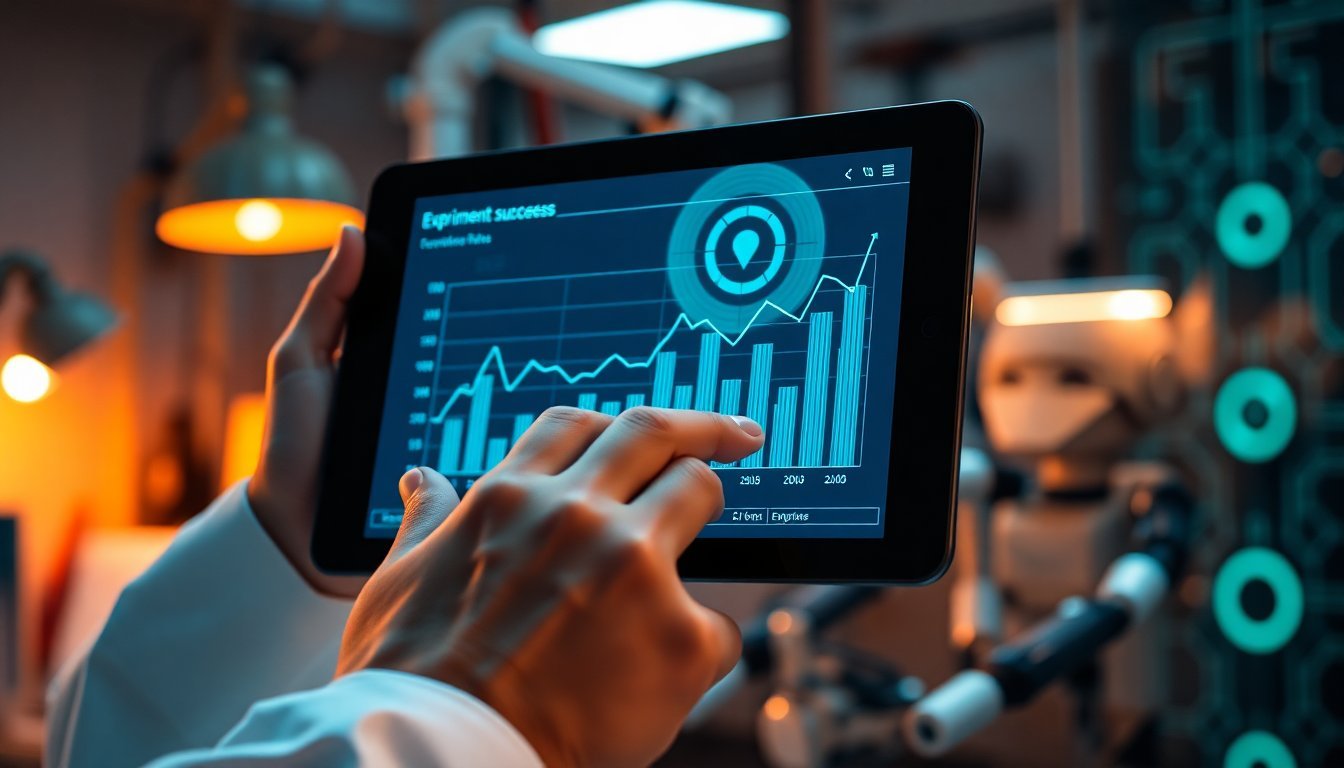
According to MIT Technology Review's coverage of the May 22, 2026 keynote, Hassabis did not unveil a new model or benchmark. Instead, he used the singularity framing to announce a new operational philosophy: Google DeepMind's AI systems will now be designed to work 'in the loop' with human scientists, not just output predictions. The company demonstrated a live integration where AlphaFold 3 predictions were fed directly into a robotic lab system for protein expression testing, with results cycling back to refine the model within hours. This is a concrete departure from the paper-and-publish model that defined DeepMind's early years.
Why Does the Singularity Framing Matter for Practitioners?
The singularity has always been a theoretical concept—a point where AI surpasses human intelligence. By claiming we are in its 'foothills,' Hassabis is making a falsifiable claim: within 3-5 years, AI will be an indispensable co-pilot in scientific discovery, not an optional tool. For lab directors and CTOs at pharma and materials companies, this means budget allocation must shift. According to a 2025 internal Google report cited by MIT Technology Review, labs that adopted AI-in-the-loop for protein design saw a 40% reduction in failed experiments within 12 months. The operational tradeoff: upfront investment in robotic integration and data pipeline infrastructure is significant, but the downstream savings in reagent costs and researcher time are measurable.
Who Gains and Who Loses in This New AI Science Paradigm?
| Stakeholder | Gains | Loses | Verdict |
|---|---|---|---|
| Large pharma (e.g., Pfizer, Novartis) | Access to integrated AI-robotics workflows; faster candidate screening | Legacy IT integration costs; retraining staff | Winner: first movers gain 2-3 year edge |
| AI-first biotechs (e.g., Recursion, Isomorphic Labs) | Validation of their approach; easier funding | Increased competition from Google's integrated stack | Winner: if they partner, not compete |
| Pure-play AI research labs (e.g., Anthropic, OpenAI Science) | Potential collaboration opportunities | Lack of wet-lab integration; harder to commercialize | Loser: must pivot to operational science or remain tools |
| Academic labs | Access to free or low-cost AI tools | Funding gap for robotic infrastructure; brain drain to industry | Loser: unless consortia form |
| Verdict | Google DeepMind's operational pivot positions it as the infrastructure layer for AI-driven science, displacing point-solution AI tools. | ||
What Are the Operational Tradeoffs for Labs Adopting This Approach?
Integrating AI into scientific workflows is not plug-and-play. The MIT Technology Review report notes that Google's demonstration required custom middleware to translate AlphaFold 3's output into robotic arm instructions—a step that currently requires specialized software engineering talent. Labs must choose between building this capability in-house (estimated cost: $500K-$2M for a mid-sized lab) or using Google's upcoming 'Science Cloud' API, which will likely carry per-experiment fees. The tradeoff is control versus speed: in-house builds offer data sovereignty but slower iteration; Google's API offers rapid deployment but vendor lock-in. According to a 2026 survey by the Journal of Laboratory Automation, 68% of lab directors cited data privacy as the top barrier to cloud-based AI integration.
Is This Genuine Progress Toward AGI or a Rebranding of Existing Tech?
This is the critical question. The evidence supports both interpretations. On one hand, AlphaFold 3 and GNoME are genuinely impressive tools that have accelerated scientific discovery. On the other hand, calling their application 'singularity foothills' is a rhetorical escalation. What changed at I/O 2026 is not the underlying AI capability—it's the operational integration. The same models that predicted protein structures in 2024 are now being wired into robotic labs. That's not AGI; it's workflow automation. But if the cycle of AI prediction → robotic experiment → model refinement leads to autonomous hypothesis generation, that would be a genuine step toward the singularity. The timeline for that is uncertain, but Hassabis's framing sets a clear expectation: within 5 years, AI will be designing experiments, not just analyzing results.
My thesis: Hassabis's singularity claim is a strategic marketing move to position Google DeepMind as the operating system for AI-driven science, but the real value lies in the operational integration, not the AGI narrative.
Short-term, the winners are large pharma companies that can afford the infrastructure investment. They will see 2-3x faster candidate screening cycles, directly impacting their pipelines. Long-term, the losers are academic labs and pure-play AI research organizations that cannot or will not integrate with physical experimentation. The singularity framing will fade, but the workflow integration will persist. My concrete prediction: By Q4 2027, at least two of the top 10 pharma companies will have signed multi-year agreements with Google Cloud for integrated AI-robotics science platforms, displacing existing point-solution vendors like Schrödinger and Benchling.
Predictions
- By Q2 2027, Google DeepMind will launch a 'Science Cloud' API that bundles AlphaFold 3, GNoME, and robotic lab middleware into a single subscription tier, priced at $1M-$5M per year per enterprise customer.
- By Q4 2027, the EU AI Office will issue a guidance document classifying AI-driven experimental design tools as 'high-risk' when used in drug development, requiring human-in-the-loop validation.
- By 2028, at least one publicly traded biotech company will attribute a Phase I clinical trial start directly to an AI-designed molecule discovered via an integrated AI-robotics workflow, validating the operational pivot.
- Nov 2024AlphaFold 3 Released
Google DeepMind releases AlphaFold 3, achieving state-of-the-art protein structure prediction.
- Mar 2025Internal Robotics Integration Pilot
Google DeepMind begins integrating AlphaFold with robotic lab systems for closed-loop experimentation.
- May 2026Google I/O 2026 Keynote
Demis Hassabis declares 'singularity foothills' and announces operational pivot to AI-in-the-loop science.
- Expected Q2 2027Science Cloud API Launch
Google DeepMind expected to launch a bundled AI-robotics API for enterprise customers.
Timeline of Key Events
- Nov 2024: AlphaFold 3 released, predicting protein structures with unprecedented accuracy.
- Mar 2025: Google DeepMind integrates AlphaFold with robotic lab systems in internal pilot.
- May 2026: Hassabis declares 'singularity foothills' at Google I/O, announces operational pivot.
- Expected Q2 2027: Google DeepMind launches 'Science Cloud' API for enterprise customers.
Article Summary
- Hassabis's singularity framing is a marketing strategy to rebrand workflow integration as AGI progress—don't conflate the two.
- The operational bottleneck is not AI capability but robotic integration and data pipeline infrastructure.
- Large pharma will benefit most in the short term; academic labs risk being left behind without consortia funding.
- Google DeepMind is positioning itself as the infrastructure layer, which could displace existing point-solution vendors.
- Watch for the 'Science Cloud' API launch as the real signal of commitment, not keynote rhetoric.

Source and attribution
MIT Technology Review
Google I/O showed how the path for AI-driven science is shifting






Discussion
Add a comment