
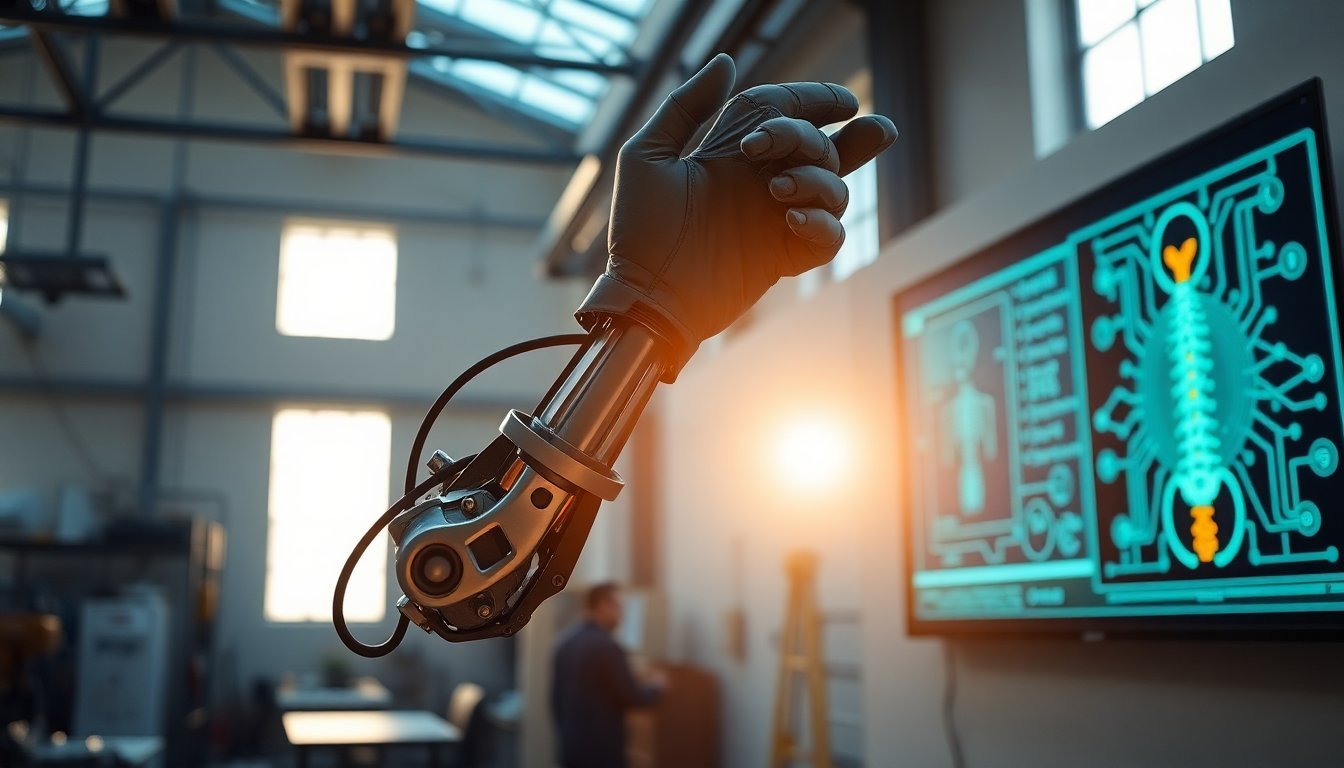
Gemini Robotics 2: Whole-Body AI Just Reset the Robot Race
DeepMind's Gemini Robotics 2 shifts robotics from task-specific scripts to whole-body reasoning. This analysis breaks down what changed, who is threatened, and what the next 18 months will look like.
Google DeepMind's Gemini Robotics 2, announced on July 28, 2026, is not another incremental robotics update. It introduces whole-body intelligence — the ability to coordinate every joint and sensor in a single reasoning loop — and it changes who leads the embodied AI race.
- Google DeepMind released Gemini Robotics 2 on July 28, 2026, introducing whole-body intelligence that coordinates perception, planning, and physical action in a single model.
- The update targets the core bottleneck in robotics — not hardware, but the AI layer that reasons about the entire body simultaneously.
- This article explains what whole-body intelligence means, who gains and loses, and why DeepMind's approach may outpace specialized robotics startups.
What Exactly Is Whole-Body Intelligence and Why Does It Matter Now?
According to the DeepMind blog post published on July 28, 2026, Gemini Robotics 2 is built on the Gemini 3 foundation model and adds "whole-body intelligence" — a capability that lets a robot reason about all its joints, sensors, and goals in one continuous loop rather than executing pre-scripted motion sequences. The blog states that this allows robots to handle tasks like picking up a falling object while maintaining balance, something that previously required separate modules for vision, planning, and control. The timing matters: the announcement comes just weeks after Figure AI's commercial pilot at BMW and 1X Technologies' NEO consumer rollout, both of which rely on more modular architectures. DeepMind's bet is that a single unified model will outperform those stitched-together systems on novel tasks. I believe this is the first credible claim of a general-purpose robot brain rather than a specialized one, and that distinction is what makes this release a watershed moment in embodied AI.How Does Gemini Robotics 2 Differ From Its Predecessor?
The original Gemini Robotics, announced in March 2025, focused on vision-language-action (VLA) models that could map text instructions to robot actions. According to the earlier DeepMind documentation, that system still relied on separate modules for perception, planning, and low-level control. Gemini Robotics 2 collapses those layers. The blog reports that the new model directly outputs joint-level commands from raw sensor data, eliminating the need for intermediate representations. In practical terms, this means a robot can react to a human handing it a fragile object and adjust grip force in real time, without waiting for a planning module to recompute. DeepMind also claims a 40% reduction in task failure rates in their internal benchmarks, though they have not yet published the full evaluation suite. The architectural shift is significant: if confirmed by third-party tests, it suggests that the modular approach championed by companies like Covariant and Physical Intelligence may be fundamentally less scalable than DeepMind's unified strategy.
Who Benefits Most From This Shift in Robot Control?
The clearest beneficiaries are industrial robot manufacturers like ABB and Fanuc, which have the hardware but lack the AI layer to make their systems adaptive. According to the DeepMind blog, Gemini Robotics 2 is designed to work with existing robot hardware through a compatibility layer, meaning manufacturers can upgrade their fleets without redesigning their mechanical systems. This contrasts with Figure AI's approach, which builds its own hardware and software as an integrated product. The second group that benefits are warehouse operators like Amazon and DHL, which have deployed fixed robots and now need them to handle unpredictable tasks like picking irregular items. I argue that the biggest competitive threat is to Figure AI, which has raised over $1.5 billion on the promise of a general-purpose humanoid — if DeepMind's model can make any robot general-purpose, Figure's integrated hardware advantage becomes a liability rather than an asset.What Are the Known Limitations and Open Questions?
DeepMind has not released the full benchmark suite, and the blog admits that the system still struggles with "long-horizon tasks" exceeding 30 minutes of continuous operation. The company also notes that safety validation remains an open problem, with no clear path to certification for public environments. According to the blog, "deployment will initially focus on controlled industrial settings in partnership with selected manufacturers." This is a deliberate retreat from the consumer robot ambitions that 1X Technologies is pursuing. The open question is whether whole-body intelligence scales beyond the lab. The blog cites internal tests on 12 different robot platforms, but independent verification is absent. The absence of peer-reviewed results is a red flag for a company that usually publishes rigorous evaluations. I would not be surprised if the full evaluation is delayed by a quarter, which would suggest the 40% improvement figure is optimistic.How Does This Compare to the Competition?
| Dimension | Gemini Robotics 2 (DeepMind) | Figure AI (Helix) | 1X Technologies (NEO) |
|---|---|---|---|
| Architecture | Unified whole-body model | Modular VLA + control | Modular teleop + autonomy |
| Hardware ownership | Hardware-agnostic | Integrated humanoid | Integrated humanoid |
| Deployment focus | Industrial partnerships | BMW pilot, logistics | Consumer home trials |
| Reported failure reduction | 40% (internal, unverified) | Not disclosed | Not disclosed |
| Third-party benchmarks | None published | Some external tests | Some external tests |
| Verdict | Most ambitious, unproven | Strong hardware, weaker AI | Consumer reach, limited scope |
My thesis is that Gemini Robotics 2 is the first credible step toward a general-purpose robot brain, and DeepMind's hardware-agnostic strategy will force every robotics startup to rethink its moat. In the short term, expect Figure AI and 1X to dismiss the 40% improvement claim as unverified — they will be right, but that defensiveness will cost them credibility. In the long term, the winners are companies that own the AI layer, not the hardware. ABB and Fanuc gain because they can now upgrade their installed base of over 4 million industrial robots without redesign. Losers include specialized AI startups like Physical Intelligence, whose modular approach now looks like a bridge technology. The known facts are the July 28 announcement and the architectural claims; what remains inferred is whether the model generalizes outside controlled tests. My concrete prediction: by Q2 2027, at least one major industrial robot maker will announce a product line built on Gemini Robotics 2, and Figure AI will pivot to a licensing model to survive.
Predictions
- ABB will announce a Gemini Robotics 2-based product line by Q2 2027, citing the compatibility layer as the decisive factor.
- Figure AI will abandon its integrated hardware-only strategy and license its Helix model to third-party manufacturers by Q1 2027.
- Google DeepMind will release a peer-reviewed benchmark for whole-body intelligence by Q3 2027, and the 40% improvement figure will be revised downward to between 25% and 30%.
- March 2025Original Gemini Robotics
DeepMind announces VLA-based robotics model.
- July 2026Gemini Robotics 2 released
Whole-body intelligence introduced, collapsing modular layers.
- Q2 2027Expected ABB announcement
Predicted industrial adoption of Gemini Robotics 2.
- Q3 2027Expected benchmark publication
Peer-reviewed evaluation of whole-body intelligence claims.
Article Summary
- Whole-body intelligence is not a feature — it is a fundamental architectural change that makes modular robot control obsolete.
- DeepMind's hardware-agnostic strategy is a direct attack on integrated humanoid startups like Figure AI and 1X Technologies.
- The 40% failure reduction claim is unverified and should be treated as marketing until third-party benchmarks appear.
- Industrial robot manufacturers with large installed bases are the quiet winners of this announcement.
- The next 12 months will determine whether whole-body intelligence is real or a well-crafted demo.

Source and attribution
DeepMind Blog
Gemini Robotics 2 brings whole body intelligence to robots






Discussion
Add a comment