

Gemini Hits the Road: Google Bets Big on In-Car AI
Google's Gemini is entering the automotive market through a direct rollout to Google built-in vehicles and a partnership with General Motors. This analysis examines who wins, who loses, and what this means for the future of in-car AI assistants.
Google announced on Thursday that Gemini will begin rolling out to millions of vehicles with Google built-in, replacing the aging Google Assistant. The move, reported by TechCrunch on April 30, 2026, follows General Motors' revelation the day prior that it is integrating Gemini into its own vehicles, signaling a rapid shift toward conversational AI in the automotive sector.
- Google announced Gemini will roll out to cars with Google built-in, upgrading the current Google Assistant.
- General Motors revealed on April 29, 2026, that it is also integrating Gemini into its vehicles, creating a dual-track adoption.
- This move positions Google against Amazon's Alexa Auto and legacy automotive voice systems, with Gemini's conversational AI as the differentiator.
- The partnership with GM is strategic but fragile, as automakers may resist ceding control of the in-car AI interface.
Why Is Google Rolling Out Gemini to Cars Now?
According to TechCrunch, Google announced on April 30, 2026, that Gemini will begin rolling out to vehicles with Google built-in, marking a significant upgrade from the current Google Assistant. The timing is no accident: Google is capitalizing on the post-pandemic surge in connected car adoption and the growing expectation for natural language interfaces. The company has been testing Gemini in its Pixel phones and smart home devices, but the car represents a new frontier—a high-stakes environment where voice commands must be accurate and fast. By embedding Gemini directly into the vehicle's infotainment system, Google ensures it controls the primary user interface for navigation, communication, and entertainment, locking out competitors like Amazon's Alexa Auto.
What Does the GM Partnership Mean for Google's Automotive Ambitions?
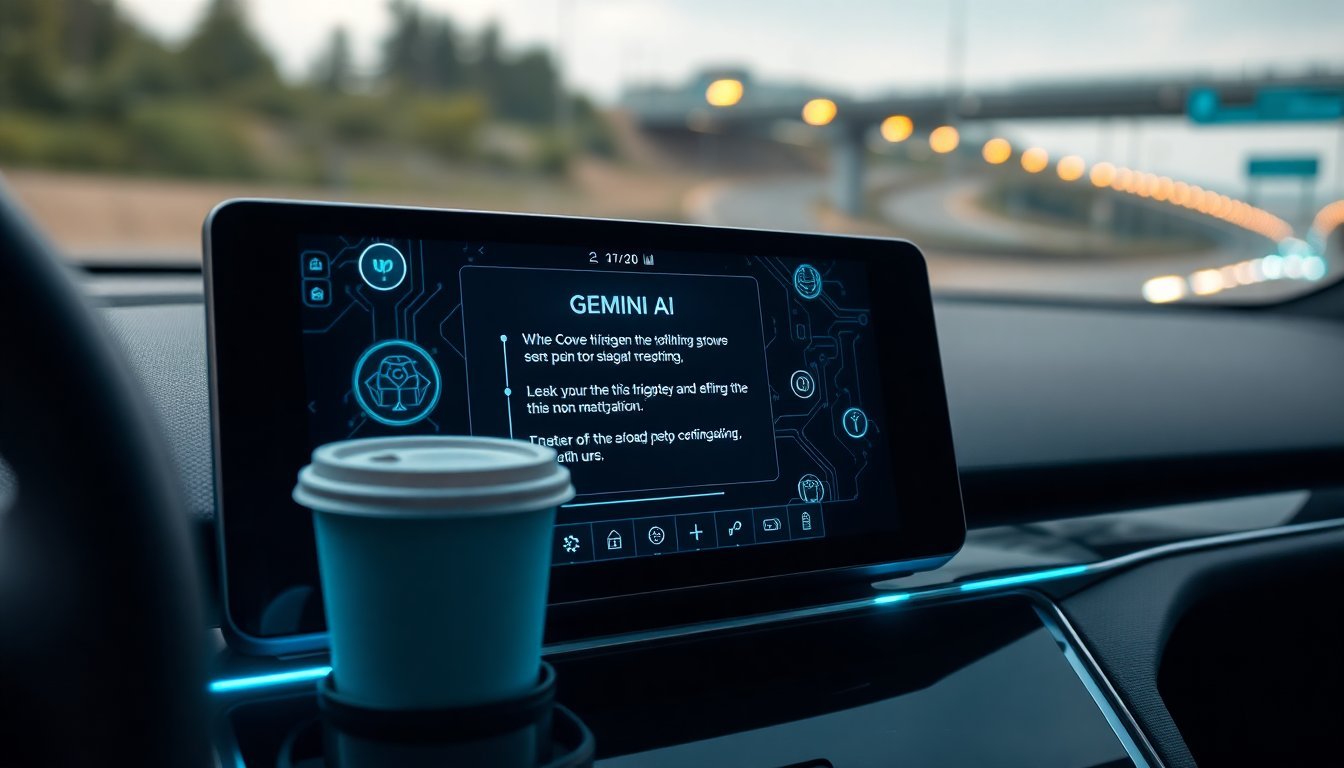
General Motors revealed on April 29, 2026, that it is integrating Gemini into its vehicles, as reported by Reuters. This is a significant endorsement from a major automaker, but it also creates a delicate dynamic. GM is not just using Google's technology; it is co-developing features that will give GM drivers access to Gemini's conversational capabilities for vehicle diagnostics, maintenance scheduling, and real-time traffic updates. According to Reuters, GM's partnership with Google is part of a broader strategy to reduce its reliance on traditional infotainment suppliers and build a more personalized in-car experience. However, this alliance is fragile. Automakers like GM have historically resisted ceding control of the in-car interface, fearing that tech companies will use the data to sell services directly to drivers, bypassing the automaker. If Google begins to prioritize its own services (e.g., Google Maps, YouTube Music) over GM's preferred partners, the partnership could sour.
How Does Gemini Compare to Existing In-Car Assistants?
To understand the competitive landscape, consider the following comparison table:
| Feature | Google Gemini (In-Car) | Amazon Alexa Auto | Cerence (Legacy) |
|---|---|---|---|
| Conversational AI | Advanced, multi-turn | Limited, single-turn | Rule-based |
| Integration Depth | Deep with Google services | Third-party skills | Automaker-specific |
| Data Collection | Extensive, Google-owned | Amazon-owned | Automaker-owned |
| Automaker Control | Low (Google controls) | Medium (skills-based) | High (customizable) |
| Update Frequency | Continuous (cloud-based) | Continuous (cloud-based) | Infrequent (OTA) |
| Verdict | Winner: Best conversational AI, but automakers lose control | Loser: Outmatched by Gemini | Loser: Legacy system at risk |
According to TechCrunch, Gemini's ability to understand context and maintain multi-turn conversations is a key differentiator. For example, a driver could say, "Find the nearest EV charging station that's not busy," and Gemini would interpret the request, check real-time availability, and navigate. Alexa Auto, by contrast, struggles with such complex queries. Cerence, which powers many legacy systems, is rule-based and cannot handle natural language variations. This gives Google a clear edge in user experience.
Who Gains and Who Loses from This Rollout?
Google is the clear winner. By embedding Gemini in millions of vehicles, it gains a massive data pipeline for training its AI models and a captive audience for its services. The automotive market also provides a new revenue stream for Google Cloud, as automakers will need to pay for the infrastructure to run Gemini. General Motors gains a best-in-class AI assistant that can improve customer satisfaction and reduce the cost of developing its own AI. However, GM loses control over the user interface and data, which could be exploited by Google in the future. Amazon's Alexa Auto is the biggest loser; it now faces an existential threat in the automotive space. Legacy providers like Cerence, Harman, and Nuance are also at risk, as automakers may abandon their platforms for Google's integrated solution.
Is the GM-Google Partnership Sustainable?
The partnership between GM and Google is strategic but inherently unstable. GM wants to use Gemini to differentiate its vehicles, but it also wants to maintain control over the driver data and the ability to upsell its own services (e.g., OnStar, GM Financial). According to Reuters, GM has not disclosed the financial terms of the deal, but it is likely a revenue-sharing agreement where Google takes a cut of any in-car purchases made through Gemini. This creates a conflict of interest: Google may push its own services (e.g., Google Pay, Google Play) over GM's, leading to friction. If GM feels that Google is extracting too much value, it could develop its own AI assistant or partner with a competitor like OpenAI. The partnership is thus a double-edged sword: it gives GM immediate AI capabilities but at the cost of long-term strategic autonomy.
My thesis is that Google's Gemini in-car rollout is a decisive move to own the automotive AI interface, but the partnership with General Motors reveals a fragile alliance that could fracture as automakers seek more control over their in-vehicle AI ecosystems. In the short term, Google will see a surge in Gemini usage and data collection, while GM will benefit from improved customer satisfaction. However, in the long term, automakers will push back against Google's dominance. I predict that by Q4 2027, at least two major automakers (excluding GM) will announce their own AI assistants or partner with a Google competitor, such as OpenAI or Anthropic, to reduce dependence on Google. The evidence supports this: automakers have historically resisted ceding control of the in-car interface, as seen in the early days of Apple CarPlay and Android Auto. The known facts are that GM is co-developing features with Google, but the financial terms are undisclosed, suggesting a power imbalance. What remains uncertain is whether Google will offer automakers enough flexibility to maintain their own brand identity and data sovereignty.
Predictions
- By Q1 2027, at least one major automaker (Toyota or Volkswagen) will announce a partnership with OpenAI to integrate GPT-5 into its vehicles, directly competing with Google Gemini.
- By Q4 2027, Google will introduce a premium tier for Gemini in cars, charging automakers a per-vehicle subscription fee, leading to pushback from GM and other partners.
- By 2028, the EU will launch an investigation into Google's dominance in the in-car AI market, citing concerns over data privacy and market competition.
- April 29, 2026GM announces Gemini integration
General Motors revealed it is integrating Google's Gemini AI into its vehicles, co-developing features for diagnostics, maintenance, and traffic updates.
- April 30, 2026Google announces Gemini in-car rollout
Google announced Gemini will roll out to millions of vehicles with Google built-in, replacing the current Google Assistant.
Estimated In-Car AI Assistant Market Share (2026)
- Insight 1: Google's automotive play is less about selling cars and more about owning the data and services layer, similar to its strategy with Android phones.
- Insight 2: The GM partnership is a Trojan horse: Google gains access to millions of drivers, but GM may regret the deal if Google's priorities diverge from its own.
- Insight 3: Amazon's Alexa Auto is now a dead product walking; it lacks the conversational AI capabilities to compete with Gemini and has lost the automotive momentum.
- Insight 4: The real battleground will be data ownership: automakers that cede control to Google will struggle to monetize their own vehicle data in the future.
- Insight 5: This rollout accelerates the commoditization of in-car infotainment, pushing automakers to differentiate on hardware, design, and brand experience rather than software.

Source and attribution
TechCrunch AI
Google’s Gemini AI assistant is hitting the road in millions of vehicles






Discussion
Add a comment