
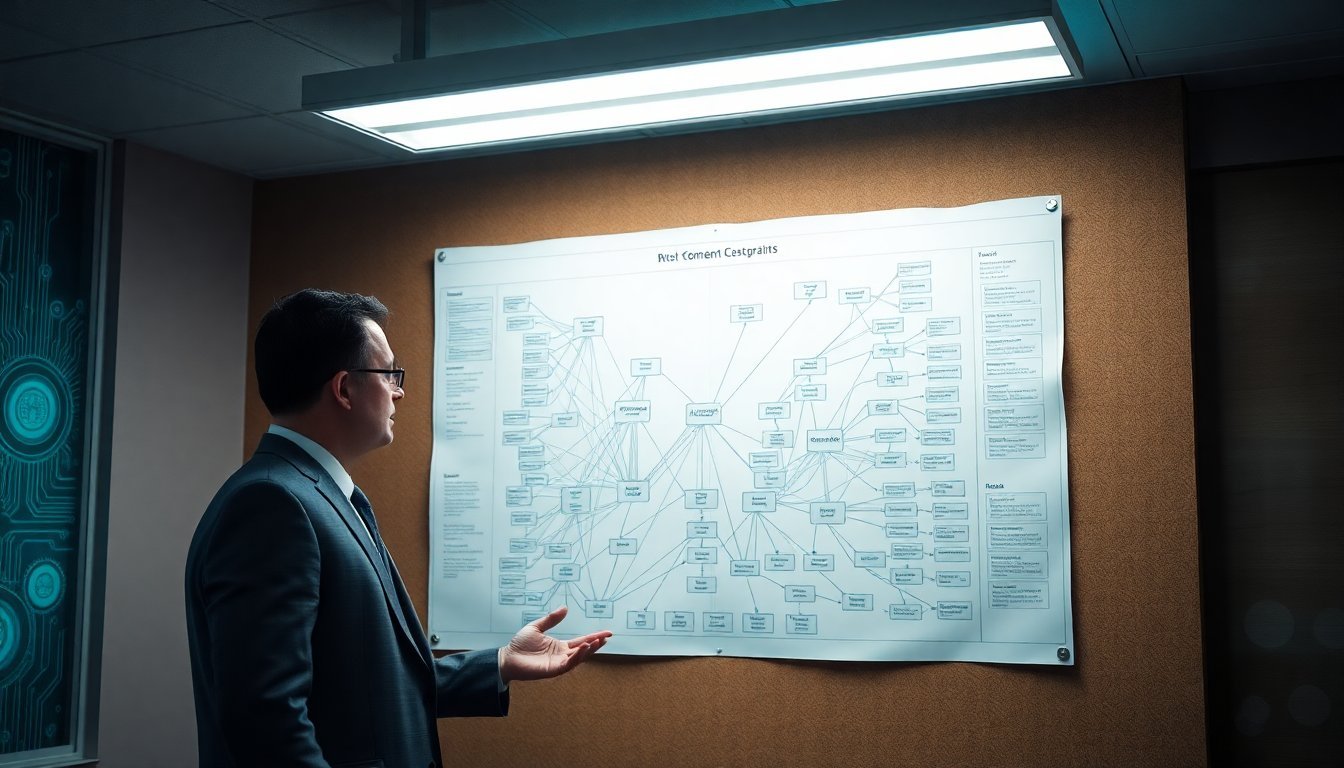
Enterprise AI's Real Prize: The Operating Layer, Not the Model
The public conversation obsesses over GPT vs. Gemini benchmarks, but the real competitive edge lies in the operating layer that controls how AI is applied, governed, and audited in enterprises. This article explains why cloud platforms and integration-layer vendors will win, while pure-play model providers risk commoditization.
April 16, 2026. MIT Technology Review publishes a piece that should terrify every AI startup CEO who thinks their latest GPT-5 wrapper is a moat. The article argues that enterprise AI's durable advantage isn't the foundation model — it's the operating layer that governs, routes, and audits intelligence in production. This is the moment the industry stops obsessing over benchmarks and starts fighting over middleware.
- MIT Technology Review argues the enterprise AI battle is shifting from foundation models to the 'operating layer' — the middleware for governance, routing, and audit.
- Cloud platforms (AWS, Azure, GCP) and integration-layer specialists (Databricks, Snowflake) are best positioned to own this layer, not pure-play model providers.
- Enterprises face a critical choice: pick the right operating layer partner now or risk lock-in and compliance failures by 2028.
- The article resolves the tension between model performance hype and real enterprise deployment needs — governance beats capability.
Why Is the Operating Layer More Valuable Than the Foundation Model?
The article, published on April 16, 2026, by MIT Technology Review, makes a structural argument: foundation models are becoming commodities. GPT-5, Gemini Ultra, Claude 4 — they all score within a few percentage points on standard benchmarks. The real value capture happens at the layer where decisions are made: which model to call for which task, how to enforce compliance, how to audit outputs, and how to integrate with existing enterprise systems. This operating layer is sticky because it embeds into workflows, not just APIs. The source explicitly states that the 'durable advantage is structural: who owns the operating layer where intelligence is applied, governed, and audited.' This is a direct challenge to the narrative that model quality is the primary differentiator. I believe this is correct: enterprises don't care which model answers a query — they care that the answer is compliant with GDPR, doesn't leak IP, and can be traced back to a source.
Who Wins and Who Loses in This Operating Layer Shift?
The winners are clear: AWS with its Bedrock and SageMaker governance features, Azure with AI Studio and Purview integration, and GCP with Vertex AI Agent Builder. Databricks and Snowflake win because they already own the data layer and can extend upward into governance. The losers are OpenAI, Anthropic, and Mistral — pure-play model providers that lack the enterprise middleware stack. They risk being relegated to 'model vendors' with thin margins, similar to what happened to database engine providers versus cloud DBaaS. A concrete example: AWS Bedrock's 'Guardrails' feature, launched in preview in 2024 and generally available by 2025, already lets enterprises enforce content policies across multiple models. This is operating layer control. OpenAI's ChatGPT Enterprise, by contrast, is a single-model interface — powerful but narrow.
Why Should Enterprises Care About This Now?
Because the window for choosing an operating layer is closing. The article implies that by 2028, most large enterprises will have committed to one or two platforms for AI governance. Switching costs will be high — retraining models, migrating audit trails, reconfiguring compliance rules. The source notes that the public conversation still tracks 'GPT versus Gemini, reasoning scores, and marginal capability gains,' but that focus is a distraction. Enterprises that pick a model-agnostic operating layer (e.g., Databricks' Unity Catalog for AI) retain flexibility. Those that pick a model-specific platform (e.g., OpenAI's GPT-5 exclusive stack) face lock-in. I see this as a replay of the cloud database wars: Amazon Redshift versus Snowflake versus Google BigQuery. The winner wasn't the best database engine — it was the platform with the best governance, integration, and ecosystem.
How Does This Change the AI Vendor Landscape?
It creates a two-tier market. Tier 1: platform vendors offering operating layers (AWS, Azure, GCP, Databricks, Snowflake, ServiceNow). Tier 2: model providers (OpenAI, Anthropic, Mistral, Cohere) who compete on benchmarks and pricing. The article suggests that Tier 2 companies will need to either build operating layers (expensive, distracting) or partner deeply with Tier 1 players (ceding control). Microsoft's deep investment in OpenAI is a hedge — Azure AI becomes the operating layer, OpenAI becomes the model. But Anthropic and Mistral lack such a platform home. The source doesn't name names, but the implication is clear: Anthropic's enterprise push is hollow without a governance layer. Mistral's open-source models are great, but who audits them in a regulated bank?
| Dimension | Platform Vendors (AWS, Azure, GCP, Databricks) | Pure-Play Model Providers (OpenAI, Anthropic, Mistral) |
|---|---|---|
| Core offering | Operating layer + multiple models | Foundation models + API |
| Governance & audit | Built-in (Guardrails, Purview, Unity Catalog) | Thin or partner-dependent |
| Model flexibility | Multi-model, switchable | Single-model, proprietary |
| Enterprise integration | Deep (ERP, CRM, data lakes) | Shallow (API calls) |
| Switching costs | Moderate (data stays in platform) | High (model-specific fine-tuning) |
| Verdict | Winner: owns the durable value | At risk of commoditization by 2028 |
My thesis: The operating layer is the new middleware, and middleware always wins in enterprise software. In the short term (2026-2027), we'll see a flurry of partnerships as model providers scramble to embed themselves into platforms. Expect OpenAI to deepen its Azure exclusivity not just for compute but for governance — Azure Purview integrations announced by Q3 2026. Anthropic will likely partner with Databricks or Snowflake to get an operating layer without building one. In the medium term (2028-2030), the operating layer becomes the primary profit pool, and model margins compress to near zero, just like database engines in the cloud. The losers are startups building 'AI middleware' that doesn't own the data or the cloud — they'll be squeezed out by platform defaults. My concrete prediction: by Q2 2027, AWS Bedrock will surpass OpenAI's total API revenue (including ChatGPT Enterprise) because enterprises will pay more for governance than for model quality. The source material supports this: the 'durable advantage is structural.' I agree completely.
- By Q4 2026, AWS will announce a multi-model governance standard that becomes the de facto enterprise AI operating layer, forcing OpenAI and Anthropic to either conform or lose enterprise deals. The basis: AWS's existing Bedrock Guardrails and SageMaker governance features are already ahead of any model provider's offerings.
- By Q2 2027, Microsoft will acquire or build a dedicated AI governance startup (e.g., a company like Credo AI or Monitaur) to strengthen Azure AI's operating layer against AWS. The basis: Microsoft's current Purview integration is good but not best-in-class; they need to catch up to AWS Bedrock's governance depth.
- By 2028, at least one pure-play model provider (likely Mistral) will pivot to being an operating-layer company, offering governance and routing tools atop open-source models. The basis: Mistral's open-source strategy gives it a unique position to build a multi-model operating layer without the proprietary lock-in of OpenAI.
- April 2026MIT Technology Review publishes operating layer thesis
Article argues enterprise AI's durable advantage is structural, not model-based, shifting focus to governance and integration layers.
- Late 2024AWS Bedrock Guardrails enters preview
AWS launches multi-model governance features, signaling platform play for operating layer.
- 2025Azure AI Studio and Purview integration deepens
Microsoft strengthens governance capabilities, positioning Azure as an operating layer.
- 2028 (predicted)Enterprise AI operating layer commitments solidify
Most large enterprises will have committed to one or two platforms, making switching costly.
- The real competitive moat in enterprise AI is governance and integration, not model intelligence. Enterprises will pay more for auditability than for a 2% improvement in reasoning scores.
- Pure-play model providers (OpenAI, Anthropic, Mistral) face a choice: build an operating layer (expensive) or partner with a platform vendor (cede control). Those that do neither will be commoditized by 2028.
- The operating layer shift mirrors the cloud database wars: the winner was the platform with the best integration and governance, not the best engine. Enterprises should bet on platform-agnostic operating layers now to avoid lock-in.
- AWS, Azure, and GCP are the likely winners, but Databricks and Snowflake are dark horses because they already own the data layer. Their AI governance features will be critical differentiators.
- Regulatory pressure (EU AI Act, US Executive Order) will accelerate the shift to operating layers, since compliance requires governance, not just model performance. Enterprises that ignore this now will face costly retrofits.

Source and attribution
MIT Technology Review
Treating enterprise AI as an operating layer






Discussion
Add a comment