

Developers Are Quietly Deleting Their Data—Here's Why Everyone's Following 🗑️
Ever feel like you’re just renting your eyeballs to the internet? Like you logged on for a cute cat video and somehow ended on a three-hour deep dive into the geopolitical history of concrete? You’...
You logged on for a cat video, but the algorithm decided you needed a dissertation on concrete instead. This isn't just an odd Tuesday; it's proof you're not browsing the web—it's browsing you. A quiet revolution is brewing as developers, the very architects of this system, are now systematically deleting their own digital footprints.
They’re rejecting the "consensual internet" as a complete myth. So why is everyone from coders to casual users suddenly hitting delete, and what does that mean for the future of our online lives?
They’re rejecting the "consensual internet" as a complete myth. So why is everyone from coders to casual users suddenly hitting delete, and what does that mean for the future of our online lives?
Ever feel like you’re just renting your eyeballs to the internet? Like you logged on for a cute cat video and somehow ended on a three-hour deep dive into the geopolitical history of concrete? You’re not alone. A Reddit thread is blowing up with over 1,700 upvotes, all agreeing on one thing: the “consensual internet” is a complete myth.
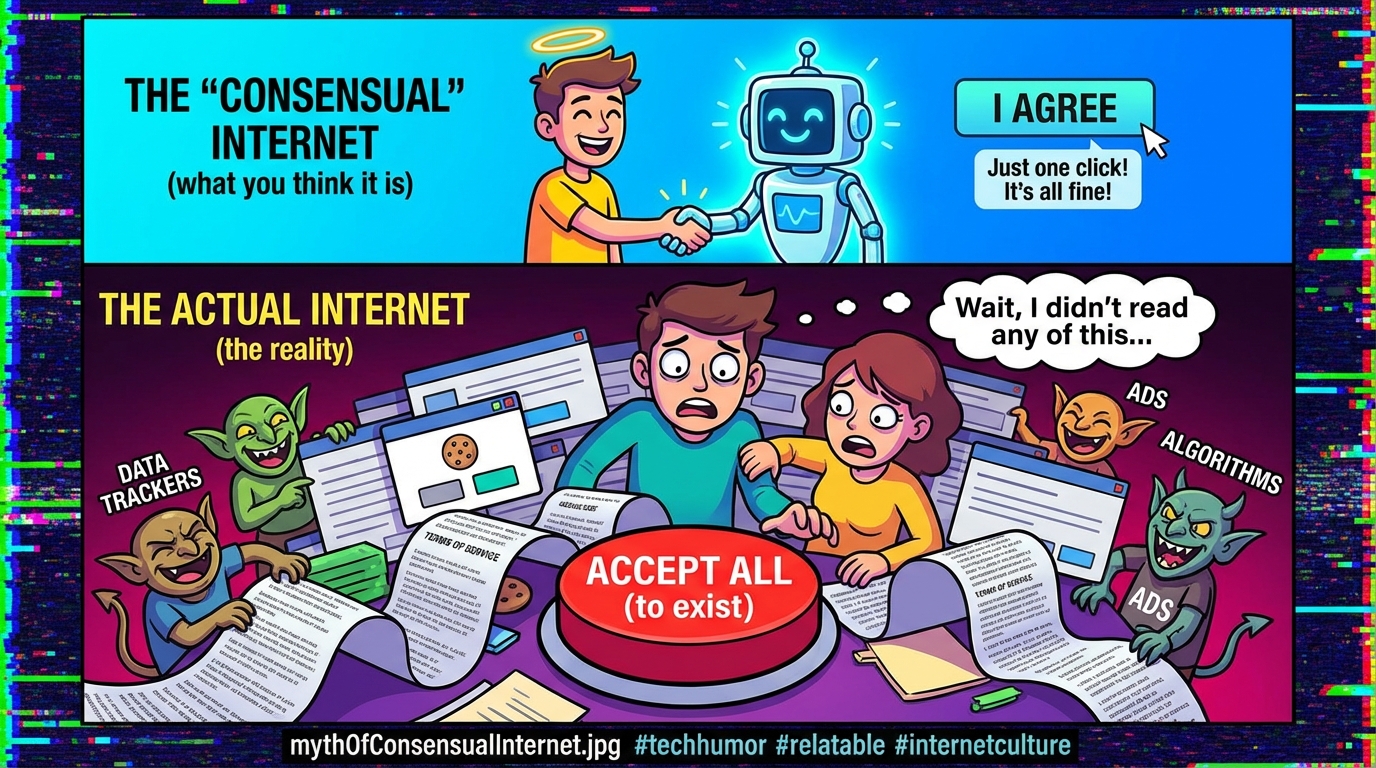
The discussion points out that we never really agree to the online journey we’re about to take. You click one innocent link, and suddenly the algorithm has you pegged as someone who desperately needs to see videos of pimple-popping or a 45-minute documentary about industrial laundry folding machines. There was no consent form. There was no, “Hey, do you consent to having your entire afternoon derailed?” It just happens.
It’s funny because it’s so true. We’ve all been there, yelling “I DIDN’T ASK FOR THIS” at our screens as we watch a stranger restore a rusty shovel for the tenth time. The internet doesn’t ask for our permission; it assumes it. It’s like a friend who insists on showing you their entire camera roll from a vacation you never asked about, except this friend lives in your pocket and knows your deepest, weirdest curiosities.
Think about it. You go online for a recipe. Two hours later, you’re in a heated forum debate about whether a hot dog is a sandwich, and you’ve somehow purchased a specialized spatula. The path makes zero sense in hindsight. The internet operates on a find-out phase, not a consent phase. You don’t choose the rabbit hole; the rabbit hole chooses you.
So the next time you surface from an internet trance wondering how you got from looking up movie times to watching a live feed of a Norwegian train journey, just remember: you didn’t fail. The system was designed to be a non-consensual field trip from the start. Your only job is to enjoy the weird, winding ride and try not to buy the specialized spatula.






Discussion
Add a comment