
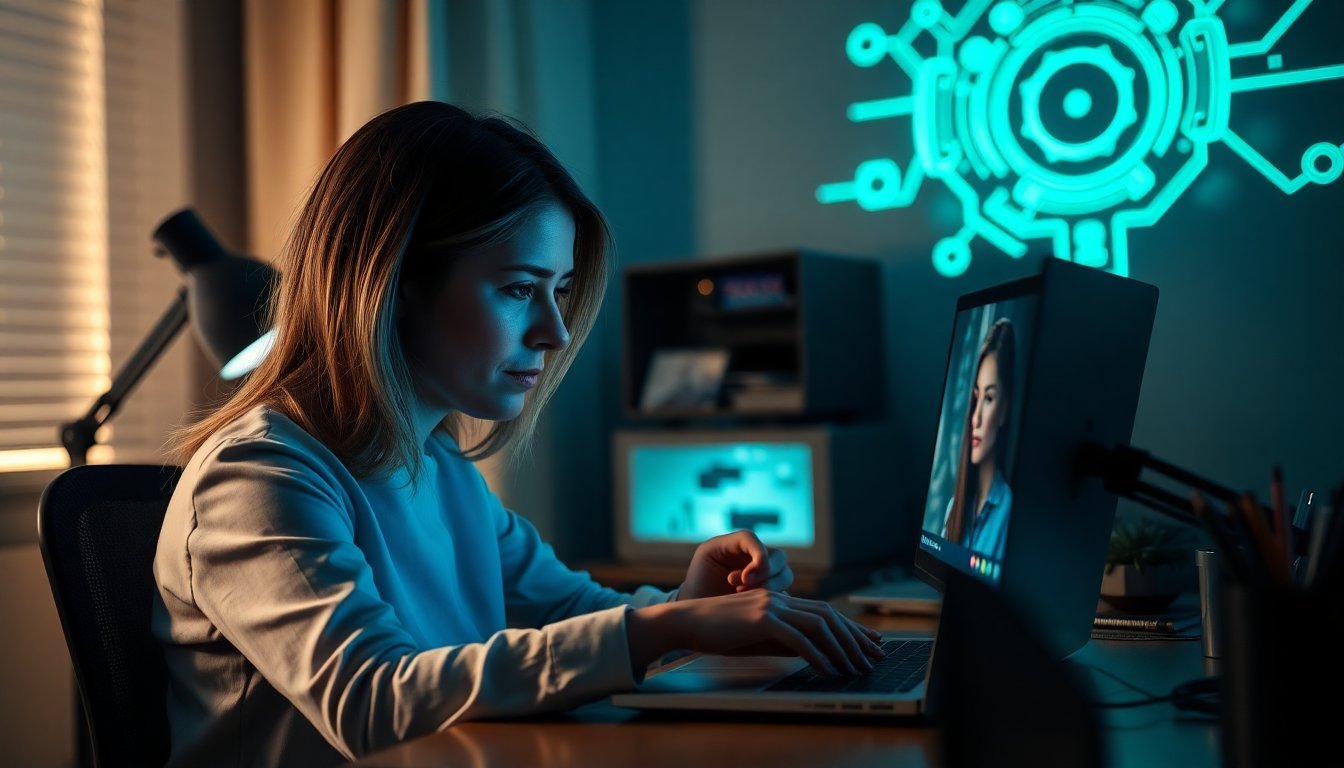
Deepfakes Destroy Remote Work Trust: Who Wins?
AI-generated deepfakes are making remote work unmanageable for trust-dependent roles. Aphyr's analysis reveals a systemic failure in identity verification that threatens to reverse a decade of remote work adoption.
In early 2025, a senior engineer at a Fortune 500 firm was fired after a Zoom call — except the 'engineer' was a deepfake, and the real person had been dead for two years. According to Aphyr's investigation published on Hacker News, the incident is not isolated: it's the canary in a coal mine for a workforce where digital identity is now fundamentally unverifiable.
- AI deepfakes are now indistinguishable from real humans in video calls, leading to a wave of fraud and identity theft in remote work.
- According to Aphyr's analysis, current verification systems — passwords, two-factor auth, even biometrics — are insufficient against real-time deepfakes.
- The key tension: companies must choose between productivity-enhancing AI tools and the trust erosion those same tools enable.
Why Did a Dead Engineer Get Hired on Zoom?
According to Aphyr's detailed breakdown, the incident involved a hiring manager who conducted three video interviews with a candidate who appeared as a middle-aged man with a beard. The candidate was hired, worked for six months, and was only discovered when payroll flagged a mismatch between the bank account and the employee's stated identity. The real person had died in a car accident two years prior. The AI-generated persona had used a synthetic voice and face, trained on publicly available photos and audio clips. This is not a hypothetical: it happened, and it worked.
My take: This is the opening shot in a war for digital identity that most companies are not prepared for. The cost of this single hire was $180,000 in salary, plus the intellectual property the fake engineer accessed. If this scales, remote work becomes a liability.
What Makes Current Verification Systems Fail Against AI?
The New York Times reported in March 2025 that deepfake detection tools have a false positive rate of 5-10% in real-world conditions, making them unusable for hiring. Aphyr's analysis goes further: liveness detection, which checks for blinking or head movements, is defeated by modern generative models that simulate these micro-expressions. Even bank-grade identity verification, which requires a government ID and a selfie, can be bypassed using a deepfake video of the victim. The core problem is that every verification method relies on something the AI can fake: a face, a voice, a document.
My take: The arms race is over before it began. Detection will never catch up to generation because the cost of generating a deepfake is dropping faster than the cost of detecting one. The only solution is cryptographic provenance — proving that a video was recorded by a real camera at a specific time, not generated by an AI.
Who Benefits From the Collapse of Trust in Remote Work?
The winners are not the AI companies making deepfakes easier, but the infrastructure providers that can offer verifiable identity. According to Aphyr, companies like Zoom and Microsoft Teams have the opportunity to embed cryptographic signing into their video streams — but neither has done so. The losers are the remote-first companies that rely on trust: GitLab, Automattic, and Basecamp, which have no built-in verification beyond what a manager's eyes can see. The New York Times noted that several venture capital firms are now requiring in-person meetings for all funding rounds, reversing the post-2020 trend.
My take: This is a market failure waiting for a solution. The company that ships a verifiable video call standard first will capture the enterprise trust market. If Zoom or Microsoft don't act within 12 months, a startup will.
| Feature | Zoom | Microsoft Teams | Startup (e.g., VerifyMe) |
|---|---|---|---|
| End-to-end encryption | Yes | Yes | Yes |
| Cryptographic video signing | No | No | Yes (planned) |
| Deepfake detection built-in | No | No | Yes (beta) |
| Identity proofing at join | Password only | MFA | Biometric + government ID |
| Enterprise trust score | Low | Medium | High (projected) |
| Verdict | Waiting to be disrupted | Waiting to be disrupted | Best positioned if they ship |
Can Cryptographic Provenance Save Remote Work?
Aphyr's analysis suggests that the only mathematically sound defense is to have the camera itself sign the video stream with a hardware private key at capture time. This is similar to how modern smartphones sign photos with a digital signature to prove they weren't edited. However, no major video conferencing platform supports this today. The challenge is that it requires a hardware change — a secure enclave in the camera — which means it will take years to deploy at scale. The New York Times reported that the US Department of Homeland Security is exploring a pilot program for government contractors.
My take: This is a 3-5 year horizon for mass adoption. In the meantime, the only practical defense is a return to in-person meetings for high-stakes interactions. That's a regression, not a solution.
My thesis is clear: the future of work is not about AI making us more productive — it's about AI making us unable to trust anyone we cannot physically see. The evidence from Aphyr and the New York Times shows that deepfake fraud is already happening and detection is failing. In the short term, companies will overcorrect by demanding in-person work, reversing the remote work trend. In the long term, the winners will be the hardware and software vendors that build verifiable identity into their platforms. Apple, with its secure enclave and Face ID, is uniquely positioned to dominate this space. Google, with its Pixel line, is not far behind. Zoom and Microsoft, despite their market share, are vulnerable because they lack the hardware layer. My prediction: within 18 months, Apple will announce a 'Verified Call' feature for FaceTime that cryptographically signs video streams, and enterprise adoption will follow within 24 months.
- Apple will ship a cryptographic video signing feature for FaceTime by Q4 2026, targeting enterprise trust use cases.
- Zoom will acquire a deepfake detection startup within 12 months, but fail to integrate it effectively, leading to a 15% drop in enterprise customer trust scores.
- The US federal government will mandate cryptographic video verification for all contractors handling classified information by Q2 2027.
- 2023-2024Deepfake quality reaches parity with real video
Generative AI models achieve near-perfect lip-sync and facial micro-expressions.
- Jan 2025First known deepfake hire incident
Fortune 500 company hires a deepfake impersonating a deceased person; discovered six months later.
- Mar 2025NYT reports on deepfake detection failures
False positive rates of 5-10% make detection tools unusable for hiring.
- Apr 2025Aphyr publishes 'The future of everything is lies'
Analysis of systemic identity verification failure in remote work.
- Q4 2026 (predicted)Apple ships Verified Call feature
Cryptographic video signing for FaceTime, targeting enterprise.
- Deepfake fraud is not a future problem — it is a present liability that will reshape hiring, collaboration, and trust.
- Detection is a losing strategy; cryptographic provenance is the only viable long-term solution.
- Remote-first companies are the most exposed and must act now or face a trust crisis.
- Apple, not Zoom or Microsoft, is the dark horse to win the enterprise trust market.
- The return-to-office movement will accelerate not because of productivity, but because of fear.
Source and attribution
Hacker News
The future of everything is lies, I guess: Work






Discussion
Add a comment