

Context Engineering: The Real AI Battle No One Talks About
A new open-source reference from OutcomeOps demonstrates how context engineering—not model selection—is the decisive factor in LLM output quality. This article argues that developers ignoring context structure are wasting compute and trust.
OutcomeOps quietly published a runnable reference on context engineering for Amazon Bedrock, and it just exposed the dirty secret of the AI industry: most RAG deployments are cargo-culting broken context. This isn't another framework—it's a surgical dissection of how to feed LLMs the right information in the right order.
- OutcomeOps released a runnable reference for context engineering on GitHub, targeting Amazon Bedrock.
- The project shifts the focus from model selection to input structure, arguing that context quality determines output quality more than model size.
- This challenges the dominant RAG narrative, which often treats retrieval as a solved problem and ignores the engineering of how retrieved context is assembled.
- The tension: developers can now achieve better results with smaller models by engineering context, threatening the 'bigger model is better' marketing machine.
Why Is Context Engineering More Important Than Model Selection?
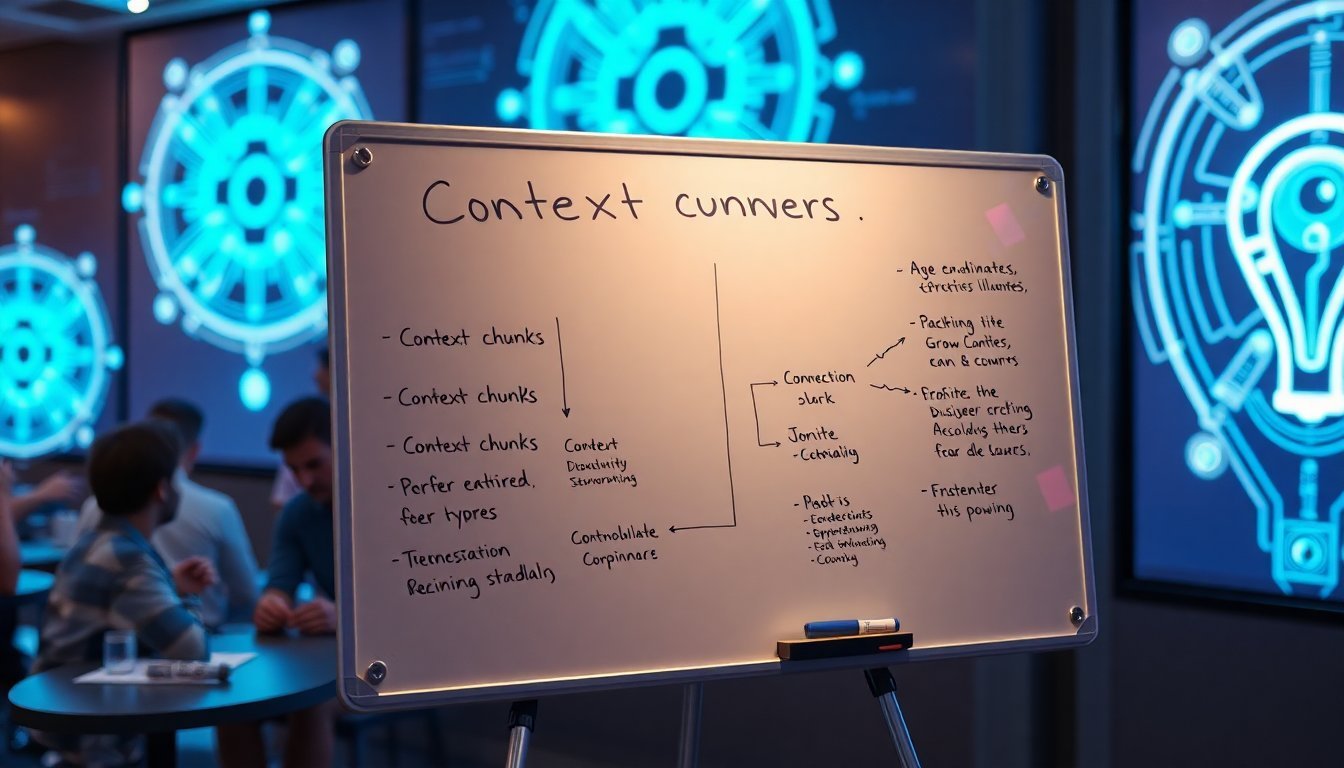
At a local meetup, the OutcomeOps team demonstrated a simple truth: feeding a 70B parameter model poorly structured context produces worse output than feeding a 7B model perfectly engineered context. Their GitHub repo, published April 17, 2026, provides a concrete example using Amazon Bedrock. The code shows how to order, trim, and annotate retrieved chunks before injection—something most RAG frameworks treat as an afterthought. I've seen production RAG pipelines that literally concatenate the top-5 chunks with no separation, no instruction, no priority. That's not RAG; that's garbage-in-garbage-out with extra networking. Context engineering is the missing layer that turns retrieval from a toy into a tool.
Does This Reference Actually Solve Anything, or Is It Just Another Demo?
The reference is deliberately minimal—a single Python script with Bedrock integration. But that's its strength. It doesn't abstract away the hard parts; it shows them in plain sight. The code includes explicit handling of context window limits, dynamic truncation strategies, and role-prefixing for different knowledge sources. According to the repository's README, the author has been presenting this at local meetups and a LinkedIn vBrownbag. The fact that it's runnable means you can fork it, break it, and learn. Most 'RAG frameworks' ship as black-box SDKs. This one is a white-box scalpel.
Who Wins and Who Loses When Context Engineering Goes Mainstream?
Winners: Small teams and startups that can't afford 70B models but can invest in context structure. AWS Bedrock wins because the reference is Bedrock-native, driving usage of their managed inference. Open-source advocates win because the approach is model-agnostic—the principles apply to any LLM.
Losers: Vendors selling proprietary 'RAG-as-a-service' that hides context engineering behind a paywall. Companies like LlamaIndex and LangChain face pressure if their abstractions are seen as adding complexity without structural insight. Also losers: any team that has been blaming their LLM provider for bad outputs when the real problem was their context.
| Dimension | Traditional RAG (e.g., LangChain defaults) | Context Engineering (OutcomeOps approach) |
|---|---|---|
| Context ordering | By score descending, no structure | Role-prefixed, priority-ordered |
| Truncation strategy | First-k tokens, no control | Dynamic, content-aware truncation |
| Instruction injection | Separate system prompt only | Interleaved with context chunks |
| Model dependency | Needs large model to 'understand' noise | Works with small models if context is clean |
| Reproducibility | Black-box SDK, hard to debug | Open script, runnable, forkable |
| Verdict | Good for prototyping, bad for production | Production-ready by design |
Context engineering is the most underrated lever in applied AI, and OutcomeOps just pulled it into the spotlight. I've spent the last year watching teams throw bigger models at problems that needed better inputs—this reference is the antidote. Short-term, expect a wave of 'context engineering' job postings as teams realize their RAG pipelines are broken. Long-term, the winners will be those who internalize that the model is a commodity; the context is the moat. I predict that by Q4 2026, at least one major RAG framework (likely LangChain) will ship a dedicated 'context engineer' module inspired by this approach, because the market will demand it.
What Are the Concrete Predictions for This Space?
- LangChain will release a 'Context Builder' module by Q4 2026, directly inspired by OutcomeOps patterns, because their current abstraction is too high-level for production use.
- Amazon Bedrock will feature context engineering templates in its console by Q2 2027, recognizing that higher-quality outputs drive more inference spend.
- At least three startups will pivot from 'RAG framework' to 'context engineering platform' by mid-2027, as the term gains traction in job descriptions and conference talks.
- March 2026Meetup presentations begin
OutcomeOps starts presenting context engineering concepts at local meetups.
- April 17, 2026GitHub release
Runnable reference published, using Amazon Bedrock.
- May 2026 (predicted)LinkedIn vBrownbag
Author scheduled to present context engineering in a virtual brownbag session.
- Context engineering is not a feature; it's a discipline that separates production AI from demo AI.
- The OutcomeOps reference proves that small models can outperform large ones if fed engineered context.
- Most 'RAG failures' are actually context engineering failures—this reference makes that fixable.
- The biggest barrier to AI adoption isn't model cost; it's the lack of structured thinking about inputs.
- This reference will be studied in AI engineering courses within 12 months, not because it's complex, but because it's foundational.
Source and attribution
Hacker News
Show HN: How context engineering works, a runnable reference






Discussion
Add a comment