
Claude Platform on AWS: Anthropic’s Cloud Lock-In Masterstroke
Anthropic has launched Claude Platform on AWS, offering enterprises a seamless, native experience within their existing AWS accounts. The move positions AWS as the exclusive cloud home for Anthropic’s platform, challenging rivals and redefining enterprise AI deployment.
Published June 11, 20265 min readBy SynapsFlow.com
On May 11, 2026, Anthropic and AWS announced the general availability of Claude Platform on AWS—a service that gives AWS customers direct access to Anthropic’s native platform without separate accounts or billing. This integration transforms Anthropic from a mere API provider into a platform deeply embedded in the world’s largest cloud ecosystem, raising the competitive heat on OpenAI and Google.
Anthropic and AWS launched Claude Platform on AWS on May 11, 2026, enabling direct access to Anthropic's native platform through AWS accounts with no separate credentials or billing.
AWS is the first cloud provider to offer the full Claude Platform experience, giving it a competitive edge over Google Cloud and Azure in enterprise AI.
This integration eliminates friction for AWS customers, but raises questions about vendor lock-in and the future of multi-cloud AI strategies.
## Why Did Anthropic Choose AWS as Its Exclusive Cloud Partner?
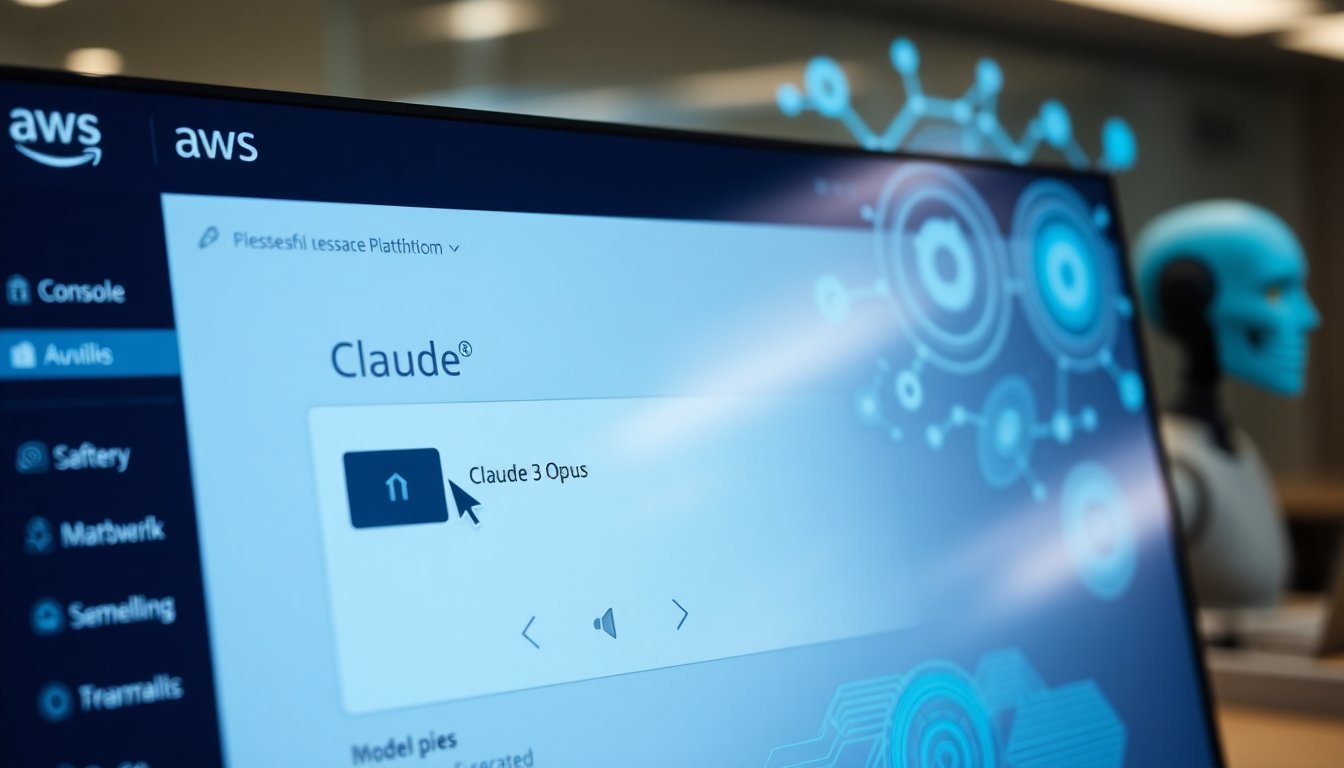
According to the AWS Machine Learning Blog, Claude Platform on AWS is a “new service that gives customers direct access to Anthropic's native Claude Platform experience through their AWS account, with no separate credentials, contracts, or billing relationships required.” This is not a simple API integration—it’s a deep embedding of Anthropic’s entire platform into AWS’s infrastructure. Anthropic reported that this partnership allows enterprises to leverage existing AWS security, compliance, and billing frameworks, reducing adoption barriers. The exclusivity is striking: AWS is the first cloud provider to offer this native experience, suggesting Anthropic sees strategic advantage in aligning with Amazon’s market dominance rather than spreading across multiple clouds.
## What Does This Mean for Enterprise AI Adoption?
Enterprises already on AWS can now access Claude’s advanced capabilities—including Claude 3 Opus, Sonnet, and Haiku models—without leaving the AWS console. According to Anthropic, this integration “gives customers direct access to Anthropic's native Claude Platform experience,” meaning features like prompt caching, batch processing, and custom model fine-tuning are available natively. For IT teams, this eliminates the need to manage separate API keys or negotiate independent contracts. The result is a streamlined path to deploying AI at scale, which could accelerate enterprise adoption of generative AI. However, this convenience comes at a cost: organizations that invest deeply in Claude Platform on AWS may find it harder to switch to competing AI platforms later.
## Who Loses from This AWS-Anthropic Deal?
Google Cloud and Microsoft Azure are the immediate losers. Google, which has invested heavily in its own AI models (Gemini) and partnerships (e.g., with Hugging Face), now faces a scenario where Anthropic—a key AI innovator—is exclusively tied to AWS. Microsoft Azure, which has bet on OpenAI, also loses: enterprises evaluating AI platforms may now see Anthropic as a more integrated choice on AWS, especially for organizations already committed to Amazon’s cloud. Smaller AI startups that rely on multi-cloud flexibility may also be disadvantaged, as this deal reinforces the trend of AI platform lock-in.
| Feature | Claude Platform on AWS | OpenAI on Azure | Google Vertex AI (Gemini) |
|---------|----------------------|----------------|--------------------------|
| Native cloud integration | Full, no separate accounts | Separate API key required | Native, but requires Google Cloud account |
| Billing consolidation | Through AWS | Separate billing | Through Google Cloud |
| Model access | Claude 3 Opus, Sonnet, Haiku | GPT-4, GPT-4 Turbo | Gemini Ultra, Pro, Nano |
| Fine-tuning | Supported natively | Available via API | Supported natively |
| Security/compliance | Inherits AWS IAM, VPC | Azure AD, private endpoints | Google Cloud IAM, VPC |
| Verdict | **Winner** for AWS-native enterprises | Strong but requires separate setup | Strong but limited to Google ecosystem |
## How Does This Change the Competitive Landscape for AI Platforms?
This announcement reshapes the AI platform war. Anthropic is no longer just a model provider—it is now a platform that competes directly with OpenAI’s API and Google’s Vertex AI. By embedding itself in AWS, Anthropic gains access to AWS’s enterprise sales force, compliance certifications, and global infrastructure. According to the AWS blog, “AWS is the first cloud provider to offer access to the native Claude Platform experience,” a move that pressures Google and Microsoft to offer similar deep integrations with their own AI partners. The market is now polarizing: AWS + Anthropic vs. Azure + OpenAI vs. Google Cloud + Gemini. Enterprises that want multi-cloud AI flexibility may find themselves squeezed.
## What Are the Risks of This Deep Integration?
Vendor lock-in is the most obvious risk. Enterprises that build AI workflows around Claude Platform on AWS may find it difficult to migrate to other clouds or switch to competing AI models. Additionally, Anthropic’s fate is now tied to AWS’s strategic priorities—if Amazon decides to shift focus or change pricing, Anthropic’s enterprise customers could be affected. There is also a regulatory risk: antitrust authorities in the US and EU may scrutinize this exclusive partnership, especially given AWS’s dominant market share in cloud computing. According to industry analysts, such deep integrations could be seen as anti-competitive if they create barriers for smaller AI providers.
My thesis is straightforward: Anthropic’s decision to go exclusive with AWS is a brilliant short-term growth play but a long-term risk. In the short term, Anthropic gains immediate enterprise credibility and distribution via AWS’s massive customer base. AWS wins by offering a differentiated AI platform that its competitors cannot match. However, over the long term, Anthropic may regret ceding strategic independence. If AWS changes its terms or prioritizes its own AI models (e.g., Amazon Titan), Anthropic could be marginalized. The biggest winner today is AWS, which has locked in a leading AI platform. The biggest loser is Google Cloud, which now lacks a comparable exclusive AI partner. My prediction: by Q4 2027, at least one major enterprise will publicly cite vendor lock-in concerns as a reason for not adopting Claude Platform on AWS, prompting Anthropic to offer a multi-cloud version.
## Predictions
1. By Q3 2027, Google Cloud will announce a similar exclusive partnership with a leading AI startup (possibly Cohere or Mistral) to counter AWS-Anthropic.
2. Within 18 months, the EU Commission will open a preliminary investigation into the AWS-Anthropic exclusive deal for potential anti-competitive effects.
3. By Q2 2028, Anthropic will release a multi-cloud version of its platform, but with reduced features compared to the AWS-native experience.
May 2026
Claude Platform on AWS GA
Anthropic and AWS announce general availability of the native Claude Platform experience within AWS accounts.
Q4 2027
Expected enterprise lock-in complaints
Predicted: first major enterprise publicly cites vendor lock-in concerns.
Q3 2027
Google Cloud countermove
Predicted: Google Cloud announces exclusive partnership with a leading AI startup.
## Article Summary
Claude Platform on AWS eliminates separate account and billing for enterprises, but creates a new lock-in risk for customers.
AWS gains a unique competitive advantage over Azure and Google Cloud by offering the only native Anthropic platform integration.
Anthropic trades long-term strategic flexibility for immediate enterprise distribution, a gamble that may backfire if AWS shifts priorities.
Regulators are likely to scrutinize this exclusive deal, potentially forcing changes within two years.
We use cookies to enhance your browsing experience, analyze site traffic, and personalize content. By clicking "Accept All", you consent to our use of cookies. You can manage your preferences or learn more in our Cookie Policy.
Discussion
Add a comment





