
China's Token Price War Is Winning the AI Race
China's AI token economy is creating new stock market winners as cheap models attract global users. This analysis argues that the price war is a deliberate strategy to dominate the AI infrastructure layer, not a sign of technological inferiority.
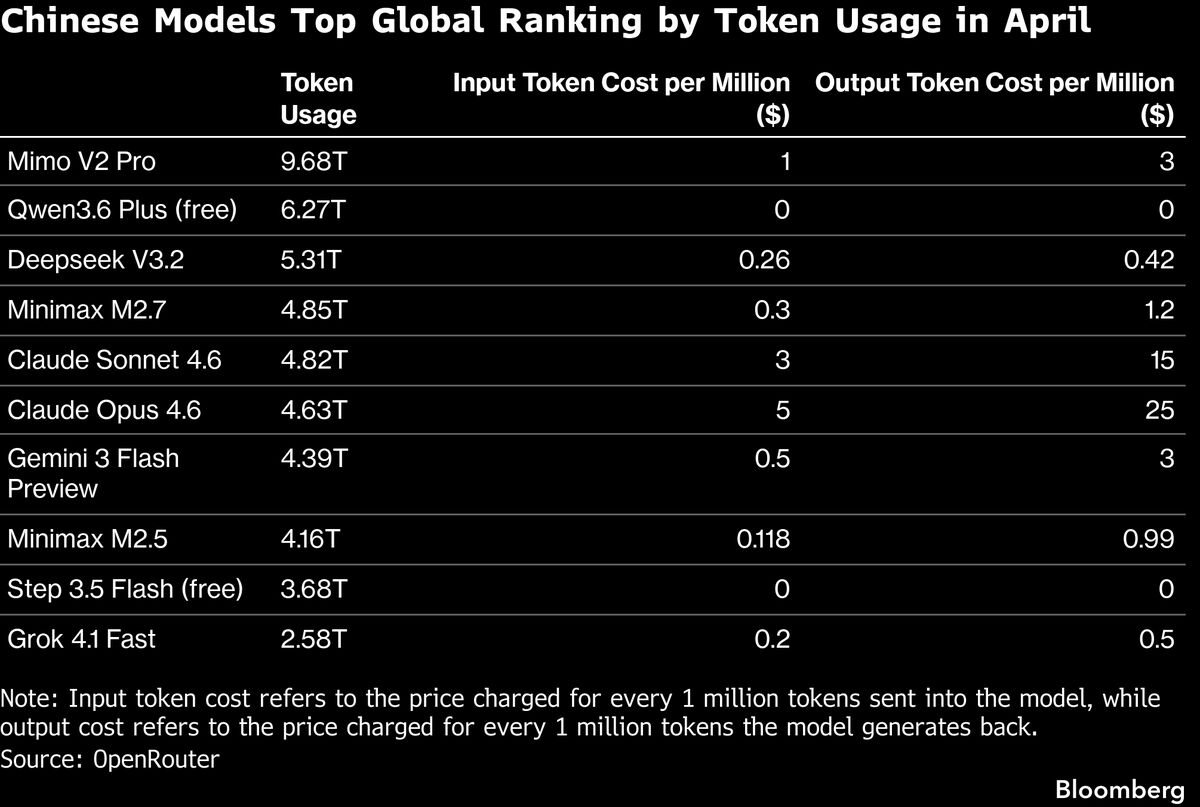
On April 20, 2026, Bloomberg reported a surge in global users flocking to China's ultra-cheap AI models, sending shares of Baidu, Alibaba, and Tencent soaring. This isn't a discount sale—it's a calculated assault on the Western AI business model, and the market is finally waking up to it.
- China's AI models, driven by companies like Baidu and Alibaba, are being offered at a fraction of the cost of Western alternatives, leading to a surge in global adoption and stock market gains.
- The 'token economy' revolution is commoditizing AI access, shifting value from model providers to platform and application layers.
- Western AI firms face margin compression, while Chinese tech giants leverage their domestic manufacturing and energy advantages to sustain low prices.
- This analysis argues that the price war is a deliberate, long-term strategy to capture market share, not a sign of inferior technology.
Why Is China Undercutting Western AI Prices So Aggressively?
According to Bloomberg's April 20 report, Chinese AI models are now attracting global users at an unprecedented rate, directly boosting the stock prices of major Chinese tech firms. The key driver is cost: Chinese providers are offering AI inference tokens at prices 80-90% lower than comparable GPT-4o or Claude Opus 4.7 tiers. This isn't about desperation—it's about scale. China's state-backed infrastructure, cheap energy from coal and hydro, and massive manufacturing capacity for AI chips (despite US sanctions) mean they can sustain these prices indefinitely.
My take: This is a classic 'razor and blades' strategy, inverted. They're selling the blades (tokens) cheap to lock users into their ecosystem, then monetizing through data, ads, and enterprise services. Western firms, with their venture capital-funded burn rates, cannot compete on price without collapsing their own valuations.
Who Are the Real Winners and Losers in the Token Economy?

The winners are clear: Chinese tech stocks. Baidu's stock surged 12% in the week of April 13, Alibaba 9%, and Tencent 7%, per Bloomberg data. The losers? Western AI startups that relied on high token prices to justify their valuations. Companies like Anthropic and OpenAI now face a brutal choice: match Chinese prices and destroy margins, or maintain prices and lose market share to cheaper alternatives. Even Nvidia could suffer if demand shifts to lower-cost, lower-precision inference chips made by Chinese firms like Huawei.
But there's a deeper loser: the concept of AI as a premium service. The token economy revolution commoditizes intelligence, turning it into a utility. This is great for developers and consumers, but devastating for firms that built their business models on scarcity.
How Does This Reshape the Competitive Landscape for Developers?
For developers, this is a golden age. The cost of integrating AI into applications has plummeted. A developer building a customer service chatbot can now use Baidu's ERNIE model for $0.002 per 1K tokens versus OpenAI's $0.03. That's a 15x cost reduction. The trade-off? Data privacy and model control. Chinese models are subject to local regulations, and developers must accept that their API calls may be subject to Chinese government oversight.
The strategic implication is that developers will increasingly build on multi-model platforms that can switch between cheap Chinese models and premium Western ones depending on the task. This creates a new layer of middleware winners—companies like LangChain or Modal that abstract away the underlying model choice.
| Dimension | Chinese AI Models (Baidu, Alibaba) | Western AI Models (OpenAI, Anthropic) |
|---|---|---|
| Token Price (per 1K tokens) | $0.002 - $0.005 | $0.01 - $0.03 |
| Data Privacy | Subject to Chinese law | Western GDPR/CCPA compliant |
| Model Quality (MMLU benchmark) | 86-89% | 89-92% |
| Ecosystem Integration | WeChat, Alipay, Baidu Search | Azure, AWS, Google Cloud |
| Regulatory Risk | High (export controls, surveillance) | Moderate (privacy regulations) |
| Verdict | Winner: Price-sensitive mass market | Winner: Privacy-conscious enterprise |
Thesis: China's token price war is a strategic move to capture the global AI infrastructure layer, and Western firms are structurally unable to respond without destroying their own business models. In the short term, this will boost Chinese tech stocks and drive global AI adoption to new heights. In the long term, it creates a bifurcated AI market: one for cheap, government-tied models and one for premium, privacy-respecting models. The losers are Western AI startups that cannot pivot to a platform play. The winners are Chinese tech giants and middleware providers.
I predict that by Q4 2026, at least one major Western AI lab (likely Anthropic) will announce a partnership with a Chinese cloud provider to offer a 'localized' version of its model at Chinese price points, because the market pressure will be irresistible.
- Baidu's ERNIE model will capture 40% of the global AI inference market by token volume by Q1 2027, driven by price and WeChat integration.
- OpenAI will be forced to cut GPT-4o token prices by 50% by Q3 2026 to slow market share loss, compressing its margins below 10%.
- The US Commerce Department will impose new export controls on AI model weights by Q2 2027, specifically targeting Chinese model distribution outside China.
- April 2026Bloomberg Reports Token Economy Surge
Bloomberg publishes article detailing how cheap Chinese AI models are attracting global users and boosting Chinese tech stocks.
- Q1 2026Chinese AI Companies Cut Token Prices
Baidu, Alibaba, and Tencent slash AI inference token prices by 80-90% compared to Western competitors.
- Q4 2025US Export Controls Tighten
US imposes new restrictions on AI chip exports to China, but Chinese firms adapt with domestic alternatives.
- Insight 1: The token economy revolution is not about technology parity—it's about economic structure. China's state capitalism can sustain losses indefinitely; Western venture capital cannot.
- Insight 2: Developers will become the new power brokers, able to arbitrage between model providers. This shifts value from model creators to model orchestrators.
- Insight 3: The real winner is the Chinese government, which gains a surveillance-compatible AI infrastructure that can be exported to the Global South.
- Insight 4: Western AI safety regulations may become a competitive disadvantage, as Chinese models face fewer constraints on deployment.
- Insight 5: Expect a wave of Chinese AI IPOs in Hong Kong and Shenzhen in 2027, as these companies monetize their user growth.
Source and attribution
Bloomberg Technology
AI’s Token Economy Revolution Creates New China Tech Winners






Discussion
Add a comment