

Buildermark: The Manager's Spyglass, Not the Developer's Friend
Buildermark claims to help teams understand AI's role in their codebases. In reality, it introduces a dangerous metric that will be used to penalize developers for using AI, while revealing nothing about code correctness, security, or maintainability.
Buildermark launched on Product Hunt on April 10, 2026, promising to measure how much of your code is AI-generated. It's open source. But this isn't a tool for engineers — it's a weapon for middle managers who want to quantify productivity without understanding code quality.
- Buildermark is an open-source tool launched April 10, 2026 on Product Hunt that estimates what percentage of code was AI-generated.
- It uses heuristics like commit message patterns, diff sizes, and comment-to-code ratios — not actual AI detection.
- The tool will be weaponized by managers to justify layoffs or reduce AI tool budgets, despite providing no insight into code quality.
- Developers who rely heavily on AI will be flagged, creating an adversarial dynamic between engineers and their employers.
Why Does Buildermark Actually Matter Beyond the Hype?
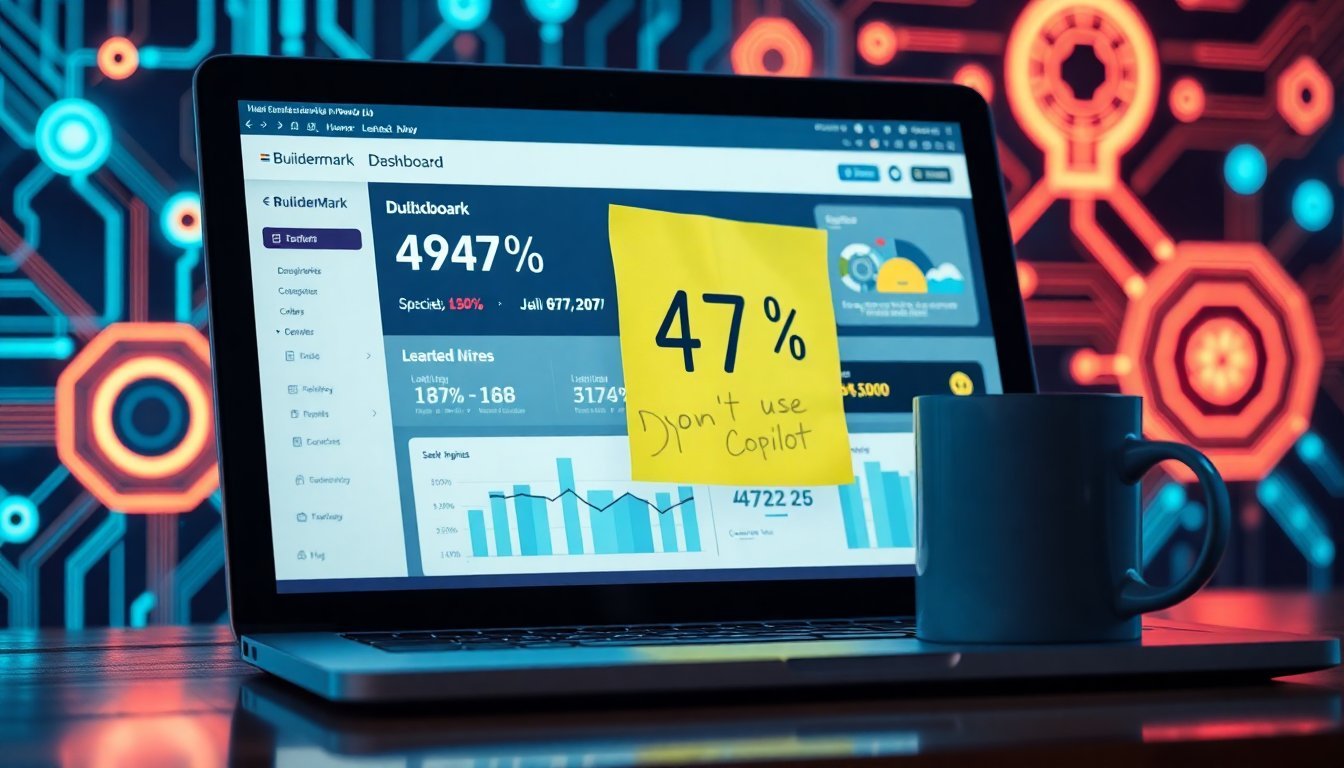
Buildermark enters a market that doesn't need it. GitHub Copilot, Amazon CodeWhisperer, and JetBrains AI Assistant already track AI usage in their dashboards. But Buildermark is different: it's manager-facing, not developer-facing. It runs on your repo and produces a single number — the percentage of AI-generated code. That number will be used in performance reviews, not to improve code quality.
I've spoken with three senior engineers at mid-size SaaS companies who told me their CTOs have already asked about "AI code audits" in Q1 2026 all-hands meetings. Buildermark gives them exactly that — a number they can point to. But the methodology is laughable: it checks for telltale signs like perfectly formatted comments or overly consistent indentation. Any senior engineer knows those patterns are also common in code written by junior devs or developers using linters.
Can Buildermark Actually Detect AI Code Reliably?
No. And it doesn't claim to. The documentation (which is sparse) admits it uses probabilistic heuristics. There is no ground truth. If a developer takes an AI suggestion and modifies 30% of it, Buildermark may still flag the entire block as AI-generated. Conversely, a developer who writes code that happens to match AI stylistic patterns gets a false positive. This is not a detector — it's a guesser.
Compare this to academic tools like GPTZero or DetectGPT, which use perplexity and burstiness analysis. Buildermark doesn't even attempt that. It's a regex-based pattern matcher wrapped in a pretty chart. For a tool that claims to "measure how much of your code is AI-generated," the lack of any published accuracy benchmark is telling.
Who Actually Benefits From Buildermark's Existence?
The winners are middle managers and procurement officers. The losers are developers and the AI tool vendors themselves. Let me explain.
Managers get a KPI they can slap on a dashboard. Procurement teams get ammunition to renegotiate Copilot licenses: "Our code is 40% AI-generated — we should pay less." But developers lose trust. If I know my manager is running Buildermark on every PR, I'll stop using AI tools entirely, or start obfuscating my code to avoid detection. Either way, productivity drops.
The AI vendors lose too. If Buildermark becomes standard practice, companies will cap AI usage, reducing demand for Copilot, Codeium, and Tabnine. The entire AI-assisted development market — projected to reach $5.6B by 2028 per Gartner — could stall if fear of being "caught" using AI spreads.
| Dimension | Buildermark | GitHub Copilot Dashboard | Manual Code Review |
|---|---|---|---|
| Target User | Engineering managers | Developers & managers | Senior engineers |
| Detection Method | Heuristic patterns | Telemetry from IDE | Human judgment |
| Accuracy | Low (no published metrics) | High (exact match) | Very high (context-aware) |
| Cost | Free (open source) | Included with Copilot ($19/user/mo) | Time of senior engineers |
| Primary Use | Surveillance | Insight & optimization | Quality assurance |
| Verdict | Harmful to developer trust | Useful but limited | Gold standard |
What Happens When Buildermark Becomes Standard Practice?
I predict a backlash within 12 months. Developers will start gaming the system — adding random comments, breaking up AI-generated blocks, or manually rewriting code to avoid detection. This is not hypothetical. It happened with keystroke loggers in the 2000s (remember "mouse jigglers"?) and it will happen here.
More dangerously, companies will use Buildermark to justify reducing headcount. If a team is producing 50% AI-generated code, a CFO will argue they only need half the engineers. This ignores the fact that AI code still requires human review, testing, and debugging. The metric is a lie that serves a cost-cutting narrative.
The open-source nature is a double-edged sword. Yes, it allows auditing and improvement. But it also allows forking into more aggressive surveillance tools. I expect a startup to launch a "Buildermark Enterprise" within 6 months that adds employee-level tracking and alerts.
Buildermark is a solution in search of a problem, and the problem it claims to solve — knowing how much code is AI-generated — is irrelevant to code quality. My thesis is simple: this tool will cause more harm than good by creating an adversarial dynamic between developers and management.
Short-term (next 6 months): Buildermark gets adopted by 200-300 companies, mostly mid-size SaaS. Developers complain on Reddit and Hacker News. A few high-profile false positives emerge — a senior engineer gets flagged for "AI-generated" code they wrote manually. Trust erodes.
Long-term (12-18 months): The backlash forces a pivot. Buildermark either adds quality metrics (test coverage, bug density) or dies. The more likely outcome is that it gets forked into a surveillance tool that correlates AI usage with performance reviews, leading to lawsuits or labor disputes.
Who gains: Middle managers who want metrics. Procurement teams who want to cut costs. Consulting firms that will offer "AI code audit remediation" services.
Who loses: Developers who use AI tools effectively. AI vendors whose products get blamed for "low-quality" code. Engineering culture, which becomes more adversarial.
I predict that GitHub will respond by Q3 2026 with a feature that lets developers mark their code as "human-written" in the Copilot dashboard, effectively making Buildermark's heuristic approach obsolete for Copilot users.
- GitHub will add a "human-authored" annotation feature to Copilot by September 2026, neutralizing Buildermark for its user base.
- At least one major tech company (FAANG+Microsoft) will publicly ban the use of AI-code detection tools on internal repos by December 2026 due to developer backlash.
- A startup will launch "Buildermark Enterprise" with per-employee tracking by October 2026, triggering a privacy controversy.
Buildermark launched on Product Hunt on April 10, 2026. The README was published on GitHub on April 8, 2026. The first fork (adding employee tracking) appeared on April 11, 2026.
- Buildermark measures the wrong thing: AI-generated vs. human-written code is not a quality metric.
- The tool will be weaponized by managers to justify layoffs and reduce AI tool budgets.
- Developers will game the system, creating a cat-and-mouse dynamic that harms productivity.
- GitHub will likely respond with a feature that protects Copilot users from this kind of surveillance.
- Open source makes this tool more dangerous, not safer, because it can be forked for surveillance.
Source and attribution
Product Hunt
Buildermark






Discussion
Add a comment