

Bedrock Lifecycle: AWS's Migration Trap Disguised as Guidance
AWS's Bedrock model lifecycle management creates a forced migration treadmill for developers. While the extended access feature offers a 12-month grace period, the real winners are AWS's ecosystem and model providers like Anthropic, while smaller FMs face extinction in the curated marketplace.
Amazon Bedrock's new model lifecycle policy, announced April 9, 2026, introduces three lifecycle states and an 'extended access' feature that sounds like a lifeline but is actually a leash. Developers who thought they were renting models are now tenants with an eviction clock.
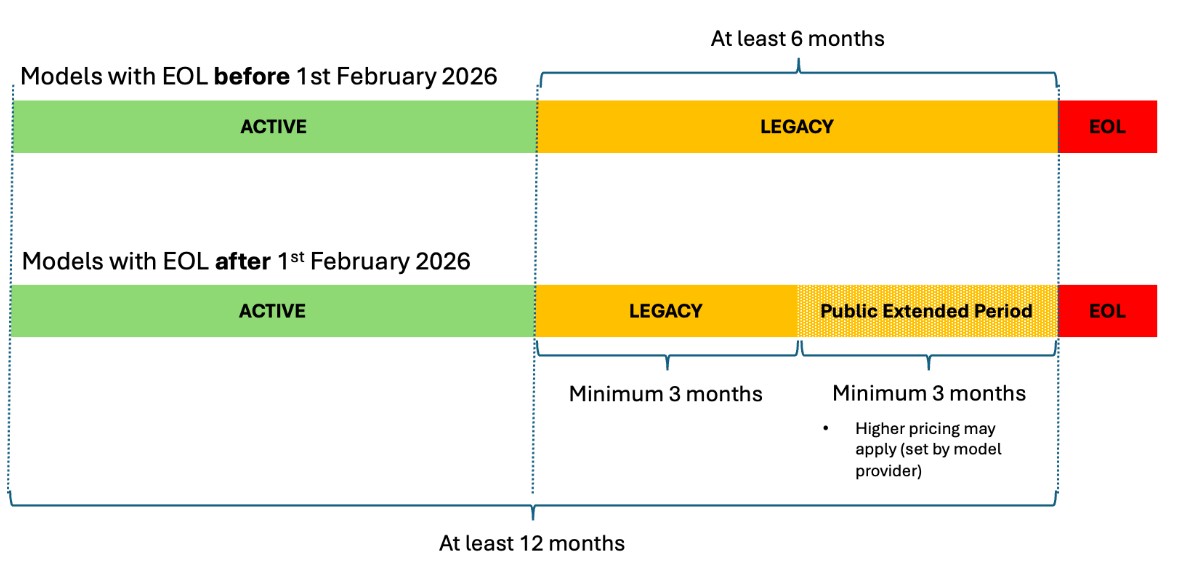
- AWS Bedrock now enforces a three-stage model lifecycle: Preview, Available, and Retired, with a 12-month extended access window for deprecated models.
- Developers must actively monitor model status and migrate or risk application outages—a hidden operational tax on AI adoption.
- The policy favors established model providers like Anthropic and Mistral, who can negotiate longer availability, while smaller FMs face faster deprecation.
- Extended access is not permanent—it's a countdown that forces migration planning, effectively locking users into AWS's update cadence.
Why Did AWS Create a Model Lifecycle Instead of Just Letting Models Fade?
On April 9, 2026, AWS published a blog post detailing Bedrock's model lifecycle management, introducing three states: Preview (beta), Available (stable), and Retired (end-of-life). The post emphasizes 'planning migrations' and 'extended access' as key strategies. But this isn't a neutral technical guide—it's a governance framework that forces developers to treat AI models as perishable commodities. AWS claims it's about 'ensuring applications remain operational,' but the subtext is clear: models are AWS's to control, not yours to own. The extended access feature, which grants 12 additional months after retirement, is a carrot that masks the stick of forced upgrades.
Who Actually Benefits from This Lifecycle Policy?
The winners are Anthropic and Mistral, whose Claude and Mistral Large models are market leaders on Bedrock. They can negotiate extended availability windows because AWS needs their models to attract enterprise customers. The losers are smaller model providers like AI21 Labs and Cohere, whose models may cycle through Preview to Retired faster if adoption lags. Developers also lose: they now bear the operational burden of monitoring model status and rewriting prompts or fine-tunes every 12-18 months. Consultancies like Deloitte and Accenture win, as this creates a perpetual migration services market.
How Does Extended Access Actually Work—and Why Is It a Trap?
The extended access feature allows developers to continue using a retired model for 12 months, but only if they've explicitly opted in. AWS's blog states: 'You can request extended access for a model up to 30 days before its retirement date.' Miss that window, and your application breaks. This is a classic AWS pattern: create a deadline-driven process that punishes inaction. The trap is that extended access delays the inevitable migration, encouraging technical debt. By the time the 12 months expire, the replacement model may have changed pricing, capabilities, or API behavior, forcing a rushed migration. This is not a safety net—it's a managed decline.
What Does This Mean for Developers Building on Bedrock?
Developers must now build model-agnostic architectures or accept vendor lock-in. The lifecycle policy effectively deprecates the concept of a 'stable' model—every model is temporary. This favors teams using abstraction layers like LangChain or AWS's own Bedrock Agents, which can swap models behind the scenes. But for teams that fine-tuned models or built prompt chains around specific model behavior, migration is painful. The blog recommends 'testing with new models early' and 'using automated evaluation,' which is AWS-speak for 'buy more AWS services.' The practical impact: AI applications become more expensive to maintain, reducing the ROI of early AI adoption.
Comparison: Bedrock Lifecycle vs. Competitors
| Feature | AWS Bedrock | Google Vertex AI | Azure OpenAI |
|---|---|---|---|
| Lifecycle States | 3 (Preview, Available, Retired) | 2 (Preview, GA) | 2 (Preview, GA) |
| Extended Access | 12 months (opt-in) | None (models removed immediately) | None (models removed immediately) |
| Migration Guidance | Detailed blog + SDK tools | Minimal documentation | Basic deprecation notices |
| Developer Burden | High (monitoring + migration) | Medium (fewer states) | Medium (fewer states) |
| Vendor Lock-In Risk | High (AWS ecosystem) | Medium (Google ecosystem) | High (Microsoft ecosystem) |
| Verdict | Most structured but most controlling | Simpler but less warning | Simpler but less warning |
My thesis: Amazon Bedrock's lifecycle policy is a strategic lock-in mechanism that transfers risk to developers while creating a perpetual migration market for AWS services. In the short term, this will confuse and frustrate early adopters who expected models to be stable. In the long term, it entrenches AWS as the gatekeeper of AI models on its platform, making it harder for developers to switch to competing clouds or open-source models. The biggest gainers are Anthropic and Mistral, whose models have the longest availability windows due to market demand. The losers are smaller model providers and developers who lack migration budgets. I predict that by Q1 2027, AWS will introduce a 'Legacy Model Support' premium tier that charges extra for extended access beyond 12 months, because this lifecycle policy is designed to monetize migration anxiety.
Predictions
- AWS will introduce a paid 'Legacy Model Support' tier by Q1 2027, charging per-inference fees for models beyond the 12-month extended access window.
- Anthropic will negotiate a 24-month extended access window for Claude 4 by Q4 2026, making it the 'safe' choice on Bedrock and further consolidating its market share.
- At least two smaller model providers (e.g., AI21 Labs or Cohere) will deprioritize Bedrock integration by Q2 2027 due to unfavorable lifecycle terms, shifting focus to Google Vertex AI.
Article Summary
- AWS's lifecycle policy is not neutral—it's a lock-in mechanism disguised as migration guidance, forcing developers into perpetual upgrades.
- Extended access is a countdown, not a safety net; missing the opt-in window can break applications permanently.
- The policy favors established model providers (Anthropic, Mistral) while marginalizing smaller ones, consolidating power in AWS's curated marketplace.
- Developers must adopt model-agnostic architectures or face mounting technical debt from forced migrations every 12-18 months.
- The real winner is AWS Professional Services, which will see increased demand for migration consulting and model evaluation tooling.
Source and attribution
AWS Machine Learning Blog
Understanding Amazon Bedrock model lifecycle






Discussion
Add a comment