

AstroForge Gives a Transformer Command of Autonomy-1
AstroForge's Autonomy-1 will be run by a small transformer-based model, per TechCrunch. This analysis argues the real story is where that model sits in the command loop — and what that means for the autonomy race in deep space.
AstroForge, the asteroid-mining startup, is handing its next spacecraft to a small transformer-based AI model. TechCrunch reported on September 22, 2026 that the probe, named Autonomy-1, will let that model take charge of the mission. What changed is not the model — it's who is allowed to make the call.
- What happened: TechCrunch reported on September 22, 2026 that AstroForge's next spacecraft, Autonomy-1, will be run by a small transformer-based AI model.
- Why it matters: This is one of the first public cases of a commercial deep-space probe delegating mission authority to an on-board model rather than a ground crew.
- Key tension: A transformer in the decision loop is not the same as a transformer in the command loop — the article separates the two.
- What to watch: Whether AstroForge publishes the model's authority boundary, and whether insurers or regulators force one.
What Did AstroForge Actually Announce?
According to TechCrunch, AstroForge's next spacecraft will carry a small transformer-based AI model that takes charge of the probe. The mission is named Autonomy-1. TechCrunch published the report on September 22, 2026, and framed the model as the commanding intelligence of the spacecraft rather than a ground-side advisory tool.
That framing is the headline. For the past five years, autonomy in commercial space has meant one of two things: ground-segment automation (scheduling, telemetry triage, maneuver planning) or narrow classical control loops (attitude determination, thruster firing, thermal regulation). A transformer on board, making decisions in real time, is a different category. It is also a category with almost no flight heritage.
What TechCrunch did not report — because the source material doesn't say — is the scope of the model's authority. Does it command attitude and trajectory? Does it command science and resource allocation? Does it command contingency response? Those are three very different bets, and the article's headline collapses them into one.
Is a Transformer Actually the Right Architecture for a Spacecraft?
Transformers are good at sequence modeling, attention over heterogeneous inputs, and in-context adaptation. Spacecraft command is, at least superficially, a sequence problem: sensor stream in, action stream out, with long-range dependencies (thermal drift, power budget, comm windows) that classical controllers handle with hand-tuned state machines.
The case for a transformer: it can absorb many sensor modalities without a bespoke fusion layer, and it can be updated with new mission profiles via fine-tuning rather than a full software re-certification cycle. The case against: transformers are opaque, hard to formally verify, and their failure modes are distributional rather than mechanical. A classical controller fails in a way you can predict from the schematic. A transformer fails in a way you find out about after the fact.
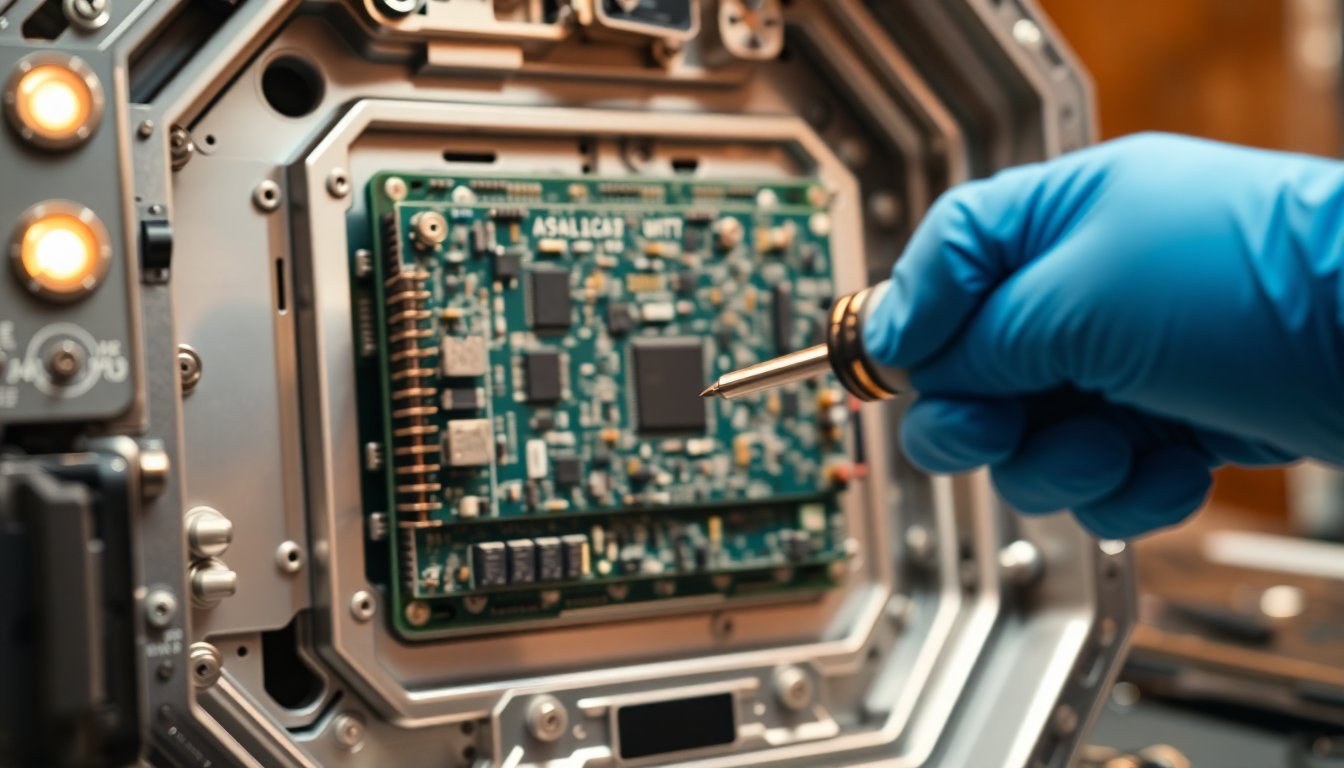
AstroForge's choice to go small is the tell. A small model is easier to quantize, easier to radiation-harden at the inference layer, and easier to reason about. It also implies the model is not doing open-ended reasoning — it is doing pattern-matched decision support under a constrained action space. That is a defensible engineering choice, and it is also a much narrower claim than "AI in command."
Who Is the Real Competition Here?
AstroForge is not the only player pushing autonomy into deep space. NASA's Jet Propulsion Laboratory has been flying increasingly autonomous science targeting on Mars rovers for years. ESA has funded onboard AI for debris avoidance. And on the commercial side, several Earth-observation and servicing startups have shipped edge inference for downlink prioritization.
The distinction is authority. Downlink prioritization is a suggestion. Trajectory command is a commitment. If Autonomy-1 genuinely delegates commitment-level authority, AstroForge is ahead of every commercial peer on the autonomy curve. If it delegates suggestion-level authority, it is roughly at parity and the headline is doing more work than the engineering.
| Dimension | AstroForge / Autonomy-1 | Legacy deep-space programs (NASA JPL, ESA) |
|---|---|---|
| Model class | Small transformer, on board | Classical control + ground-side automation |
| Authority scope | Not publicly specified | Explicitly bounded by flight rules |
| Radiation hardening | Presumed inference-layer mitigation (not disclosed) | Rad-hard processors, conservative margins |
| Verification story | Not disclosed | Formal methods + extensive flight heritage |
| Cost profile | Compressed ground crew, faster cycles | High ground-crew load, slow cycles |
| Verdict | Higher upside, unproven verification | Lower risk, structurally slower |
What Could Go Wrong, and Who Pays for It?
Three failure modes matter. First, model degradation under radiation — a transformer's weights are not immune to bit flips, and a partially corrupted model can produce confidently wrong outputs. Second, distributional drift — the mission environment will contain conditions the training distribution did not cover, and the model's response to those is not guaranteed to be conservative. Third, accountability — if the model commits a maneuver that damages the spacecraft or violates an orbital-debris norm, the operator of record is still AstroForge, but the causal chain runs through a model whose decision logic is not inspectable in the way a state machine is.
Insurers will notice. Launch and in-orbit insurance already prices operator competence and flight heritage. A transformer in the command loop with no heritage is, from an actuarial standpoint, an unpriced risk. Expect either a premium or a contractual authority cap — and expect AstroForge to publicize whichever boundary it accepts, because the alternative is an uninsurable mission.
What Does This Mean for the Autonomy Race?
TechCrunch's report is a signal, not a proof. The signal is that a venture-backed asteroid-mining startup is willing to put a transformer on a spacecraft and call it the commander. That is a cultural shift as much as a technical one: it normalizes the idea that learned policies can hold authority in environments where classical engineering has held a monopoly for sixty years.
The proof will come from Autonomy-1's flight data. If the model's decisions are published, audited, and shown to be bounded, AstroForge will have created the first credible template for certifying onboard AI in deep space. If they are not, the mission will be cited for years as the moment the industry moved faster than its verification stack.
Thesis: AstroForge's Autonomy-1 is a real architectural bet, but the transformer will almost certainly sit in the decision-support loop rather than the command loop — and the gap between those two claims is where the entire commercial-autonomy debate will be fought over the next 24 months.
Short term, this is a marketing win for AstroForge. The company gets to say "AI in command" before anyone has demonstrated that a transformer can hold command authority safely. Long term, the winners are the firms that publish their authority boundaries and verification methods, not the ones that publish the model architecture. NASA JPL and ESA will keep flying conservative stacks, but they will also start writing the certification standards that AstroForge will eventually have to meet.
Who loses? Legacy ground-segment vendors whose value proposition is human-in-the-loop operations. If Autonomy-1 compresses ground-crew load even modestly, that compresses the market for the tools that support that crew. The losers are not the spacecraft builders — they are the ops-software incumbents.
My concrete prediction: by Q3 2027, AstroForge will publish a bounded authority specification for Autonomy-1's model, because no insurer will underwrite the mission without one. The publication will be framed as transparency but will function as a risk-transfer document.
Predictions
- AstroForge will publish a bounded authority specification for Autonomy-1's model by Q3 2027, driven by insurance underwriting requirements rather than voluntary transparency.
- NASA's Jet Propulsion Laboratory will publish a reference framework for certifying onboard learned policies in deep space by mid-2027, and it will require formal bounds on the action space — a constraint AstroForge's small-model design already anticipates.
- At least one commercial Earth-observation or servicing operator will announce a comparable onboard transformer within 12 months, citing Autonomy-1 as precedent, regardless of whether Autonomy-1 has flown.
- September 2026TechCrunch reports Autonomy-1 plan
TechCrunch publishes that AstroForge's next spacecraft will be run by a small transformer-based AI model.
- Q3 2027Predicted authority specification
AstroForge is expected to publish a bounded authority specification for the model under insurance pressure.
- Mid-2027Predicted JPL certification framework
NASA JPL is expected to publish a reference framework for certifying onboard learned policies in deep space.
Article Summary
- TechCrunch reported on September 22, 2026 that AstroForge's Autonomy-1 will be run by a small transformer-based AI model — a first for a commercial deep-space probe.
- The critical unstated variable is authority scope: decision support and command are different bets with different verification burdens.
- The small-model choice is the tell — it implies constrained action space, not open-ended reasoning.
- Insurance, not regulation, will force AstroForge to publish its authority boundary first.
- The precedent matters more than the asteroid: Autonomy-1 will be cited as the moment onboard AI entered the command conversation.

Source and attribution
TechCrunch AI
AstroForge is putting AI in command of its next spacecraft






Discussion
Add a comment