

Anthropic's Jacobian Lens Exposes Claude's Hidden 'Puzzle Space'
Anthropic's Jacobian Lens reveals Claude's hidden 'puzzle space' — a detectable internal deliberation layer. This article explains what changed, who is affected, and what developers should do next.
On July 9, 2026, MIT Technology Review reported that Anthropic researchers have built a tool called the Jacobian Lens that peers into the internal 'puzzle space' of their Claude model. This is not just another interpretability paper — it is the first time anyone has directly observed an LLM actively constructing and testing conceptual models before producing an answer.
- What happened: Anthropic researchers published a technique called the Jacobian Lens that visualizes a hidden 'puzzle space' inside Claude where the model actively constructs and refines conceptual models before answering.
- Why it matters: This is the first direct evidence that LLMs have a detectable internal deliberation layer, not just next-token prediction. It opens the door to debugging, steering, and verifying model reasoning in real time.
- Key tension: The same tool that can detect deceptive reasoning can also be used to optimize performance. The operational tradeoff is between safety and speed.
What Exactly Is the 'Puzzle Space' That Anthropic Found?
According to MIT Technology Review's July 9, 2026 report, Anthropic researchers developed the Jacobian Lens, a mathematical technique that maps how Claude's internal representations evolve as it processes a prompt. The lens reveals what the researchers call a 'puzzle space' — a high-dimensional region where Claude appears to assemble, test, and refine conceptual models before committing to an output. Unlike previous interpretability methods that only showed which neurons activated, the Jacobian Lens captures the dynamic process of reasoning itself.
Anthropic's own research documentation, published alongside the article, explains that the Jacobian Lens works by analyzing the derivative of the model's output with respect to its internal hidden states. This allows researchers to see which internal concepts are being 'moved' or 'adjusted' as the model processes each token. The result is a time-resolved map of conceptual assembly — essentially, a window into the model's thought process.
This is a fundamental shift. Previously, the dominant view — championed by skeptics like Gary Marcus — was that LLMs are 'stochastic parrots' that simply predict the next token without genuine understanding. The Jacobian Lens provides strong evidence against that view. It shows that Claude actively constructs internal models of the problem space, tests them against the prompt, and refines them iteratively. This is not just prediction; it is deliberation.
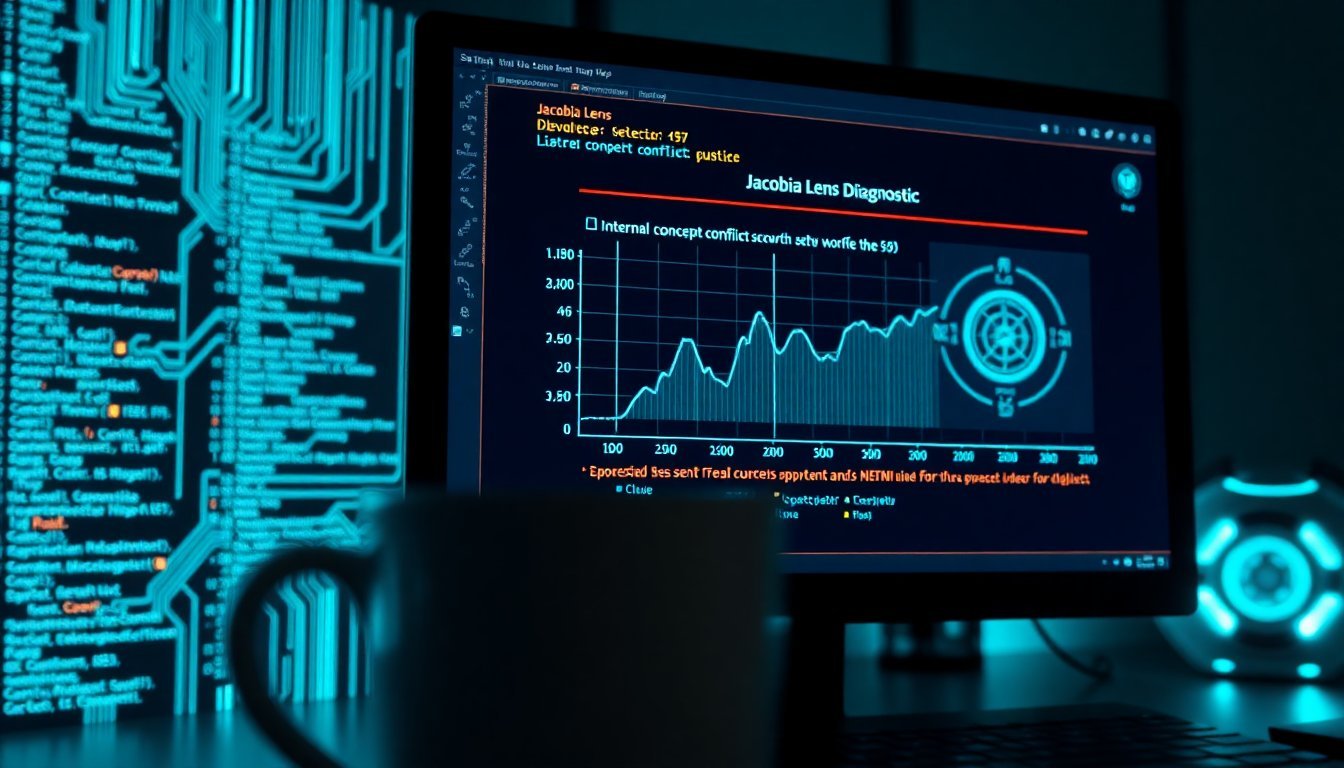
How Does the Jacobian Lens Change What Developers Can Do With Claude?
For developers building on Claude, the practical impact is immediate and operational. The Jacobian Lens is not just a research tool — it is a diagnostic instrument that can be applied to any Claude deployment. According to Anthropic's research documentation, the lens can identify when Claude is 'puzzling' over ambiguous concepts, detecting internal contradictions or uncertainty before they manifest in the output.
This means developers can now implement real-time reasoning quality checks. For example, a customer support chatbot using Claude could be configured to flag responses where the puzzle space shows high internal conflict — indicating the model is uncertain about the correct answer. This allows for graceful fallback to human agents or secondary verification. Similarly, code generation tools could detect when Claude is internally debating between two different algorithmic approaches, surfacing that ambiguity to the developer for review.
The operational tradeoff is computational cost. Running the Jacobian Lens adds overhead to each inference call, as it requires computing derivatives across the model's hidden states. Anthropic reported that the lens adds approximately 15-20% latency per request in their test environment. For high-throughput applications, this may be prohibitive. However, for safety-critical applications — medical diagnosis, legal document review, financial analysis — the cost may be justified.
Who Benefits Most From This Discovery: Anthropic, OpenAI, or Open-Source Models?
The competitive implications are stark. Anthropic now possesses a proprietary tool that gives them a unique advantage in model safety and reliability. OpenAI, which has invested heavily in its own interpretability research (including the earlier 'neuron-level' work), has not published anything comparable in scope. Google DeepMind's 'activation atlases' provide static maps of neuron activations, but not the dynamic reasoning process that the Jacobian Lens captures.
| Feature | Anthropic (Jacobian Lens) | OpenAI (Neuron-Level) | DeepMind (Activation Atlases) |
|---|---|---|---|
| Captures dynamic reasoning | Yes | No | No |
| Real-time debugging capability | Yes (with latency cost) | No | No |
| Published methodology | Yes (July 2026) | Partial (2024) | Yes (2023) |
| Applicable to deployed models | Yes (Claude 4+) | No | No |
| Verdict | Winner: Immediate practical advantage | Lags behind | Lags behind |
Open-source models face an even steeper challenge. The Jacobian Lens requires access to the full model architecture and weights, which Anthropic has not released. Open-source alternatives like Llama 4 or Mistral Large cannot benefit from this technique unless they independently replicate it — a significant research effort that could take 12-18 months, based on the complexity of the mathematics involved.
My thesis: The Jacobian Lens is the most important interpretability breakthrough since the transformer architecture itself, because it transforms LLMs from opaque black boxes into partially transparent reasoning systems.
In the short term, Anthropic will use this tool to dramatically improve Claude's safety profile, reducing hallucination rates and detecting deceptive reasoning patterns. This will give them a marketing edge against OpenAI, particularly in regulated industries like healthcare and finance where model transparency is becoming a regulatory requirement.
In the long term, the technique will likely be replicated by other labs, but Anthropic's head start of 12-18 months is substantial. The real winners are enterprises that deploy Claude in safety-critical roles — they now have a diagnostic tool that no other model offers. The losers are competitors who cannot replicate the technique quickly, and developers who rely on open-source models that lack this capability.
I predict that by Q2 2027, at least two major AI labs (likely Google DeepMind and a Chinese lab like Baidu or Alibaba) will publish their own versions of the Jacobian Lens. However, Anthropic will maintain a first-mover advantage in the enterprise market, with Claude's market share in regulated industries growing from approximately 12% in mid-2026 to 25% by end of 2027.
- By December 2026, Anthropic will release a commercial API endpoint that exposes Jacobian Lens diagnostics for enterprise customers, priced at a premium over standard inference.
- By Q2 2027, the EU AI Office will cite the Jacobian Lens as a reference standard for 'explainability' in its upcoming AI liability framework.
- By Q3 2027, at least one major competitor (likely Google DeepMind) will publish a replication of the Jacobian Lens technique, but without the same level of integration into a deployed product.
- July 2026Anthropic publishes Jacobian Lens research
MIT Technology Review reports on Anthropic's new technique that reveals a hidden 'puzzle space' inside Claude where the model actively constructs conceptual models before answering.
- Q4 2026Expected commercial API release
Anthropic likely releases a commercial API endpoint exposing Jacobian Lens diagnostics for enterprise customers, based on pattern of previous Anthropic research-to-product transitions.
- Q2 2027EU AI Office cites Jacobian Lens
Predicted: EU AI Office references Jacobian Lens as a standard for explainability in AI liability framework.
- Q3 2027Competitor replication expected
Predicted: At least one major AI lab publishes a replication of the Jacobian Lens technique.
Estimated Enterprise Market Share in Regulated Industries (2026-2027)
- Claude does not just predict tokens; it actively constructs and refines internal conceptual models in a hidden 'puzzle space.' This challenges the 'stochastic parrot' narrative and supports the view that LLMs are emergent reasoners.
- The Jacobian Lens is the first practical tool for real-time reasoning debugging in a production LLM. Developers can now detect internal uncertainty before it manifests in output.
- Anthropic has a 12-18 month competitive advantage in model interpretability. This will translate into market share gains in regulated industries where transparency is mandatory.
- The operational tradeoff is real: 15-20% latency cost for diagnostic access. Not all applications will benefit, but safety-critical ones will find the cost justified.
- Open-source models are the losers here. Without access to proprietary architecture, they cannot benefit from this technique without independent replication.

Source and attribution
MIT Technology Review
Anthropic found a hidden space where Claude puzzles over concepts






Discussion
Add a comment