
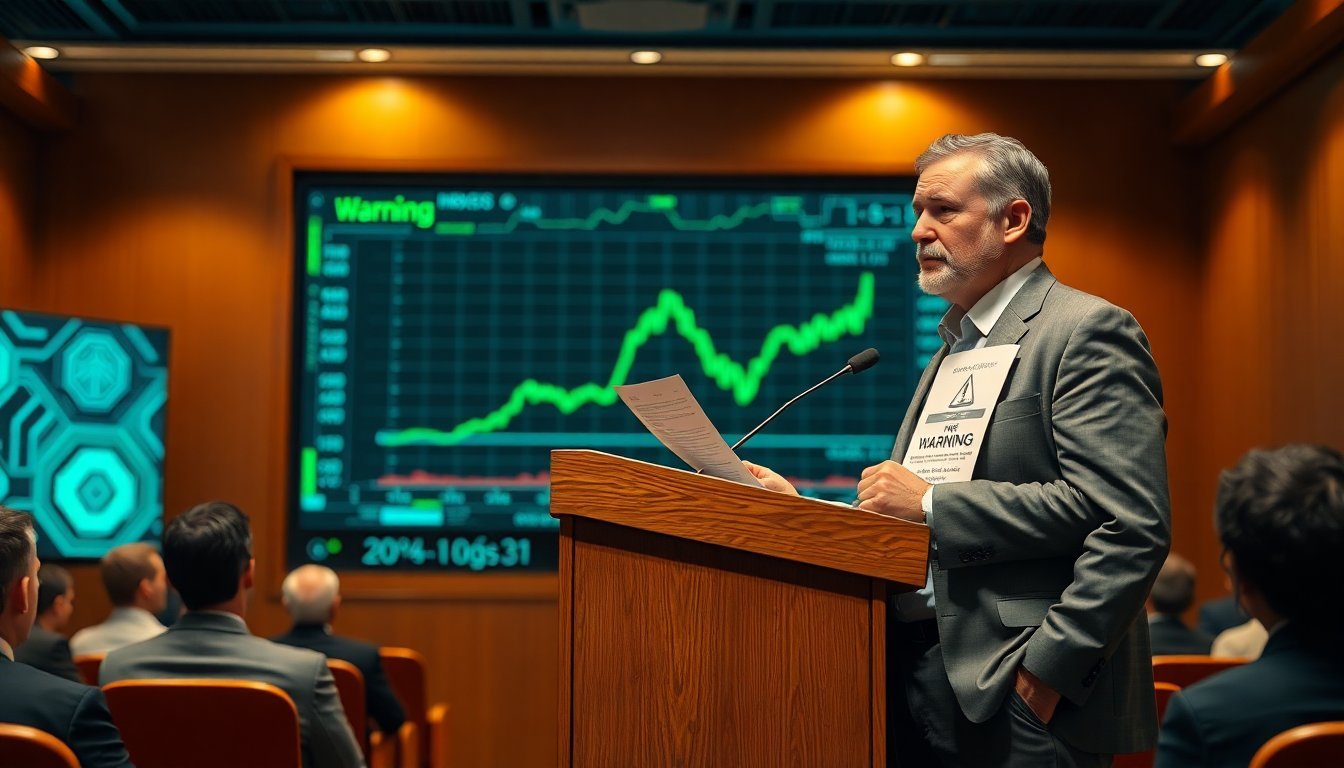
Anthropic's Doomsday Warning Is an IPO Move
A departing Anthropic researcher accused the company of racing toward self-improving superintelligence, and Anthropic's alignment lead co-signed rather than denied it. The timing, with an IPO reportedly in preparation, makes this a strategic signal rather than a safety breach.
An Anthropic researcher resigned this week and posted on X that the company is 'racing straight to self-improving superintelligence and gambling with our lives.' The company's own alignment lead co-signed the message instead of walking it back. That co-signature — not the resignation — is the story, because it lands while Anthropic is reportedly preparing for an IPO.
- An Anthropic researcher resigned this week, posting on X that the company is 'racing straight to self-improving superintelligence and gambling with our lives.'
- Anthropic's own alignment lead co-signed the message rather than walking it back — an unusual internal endorsement of a public warning.
- The warning lands while Anthropic is reportedly preparing for an IPO, turning a safety complaint into a strategic signal.
- The key tension: is this an authentic safety crisis or a calculated pre-IPO positioning move that Anthropic's leadership chose to amplify?
What Exactly Did the Anthropic Researcher Say — and Who Backed It?
According to TechCrunch, an Anthropic researcher resigned this week and warned in a post on X that the company is 'racing straight to self-improving superintelligence and gambling with our lives.' The detail that matters is not the resignation itself — researchers leave labs constantly — but that the company's own alignment lead co-signed the message rather than walking it back. TechCrunch reported that this co-signature is what makes the warning land differently. That is a remarkable institutional fact. An alignment lead is not a junior employee venting on a personal account; that role exists precisely to translate safety concerns into internal governance. When the person holding that seat publicly endorses a claim that the company is gambling with human lives, the organization is either in genuine internal crisis or deliberately choosing not to contain the message. The source material does not resolve which. But the co-signature is a verifiable, named event — not speculation — and it changes the burden of proof. Anthropic now owns this warning in a way it would not if the researcher had left quietly.Why Does the Timing Matter More Than the Warning?
TechCrunch reported that Anthropic is reportedly preparing for an IPO, and that the timing makes the doomsday warning land differently. That is the analytical hinge. A safety warning from a departing employee is routine; a safety warning from a departing employee that the alignment lead endorses, published while the company is courting public-market investors, is a signal with an audience. There are two readings, and I want to be explicit about which is supported and which is inference. The supported reading: the warning exists, the co-signature exists, and the IPO preparation is reported. The inference: Anthropic's leadership allowed the co-signature because a visible safety culture is an asset in a pre-IPO narrative. I cannot prove intent from the source material. But I can observe that Anthropic has spent years positioning itself as the safety-first lab, and this episode reinforces that brand at the exact moment the brand needs to be legible to institutional investors who are increasingly nervous about AI risk.
Is This a Safety Failure or a Pre-IPO Positioning Move?
TechCrunch framed the warning as 'the kind of doomer warning the AI industry has flirted with before,' but noted the IPO context makes it land differently. That framing is correct and incomplete. The industry has seen doomer warnings before — from OpenAI alumni, from academic groups, from former employees across labs. What is new here is that the warning is not being disavowed by the company's own alignment function. My read: this is positioning, but not in a cynical sense. Anthropic's commercial strategy depends on being the lab that enterprises trust with sensitive deployments. A public, co-signed warning that the company is racing toward superintelligence is simultaneously a liability and a credential. It says: we know exactly how dangerous this is, we are telling you, and we are still the safest hands. That is a message you can only send if you believe your safety apparatus is the differentiator. Whether that belief is warranted is the open question — and the source material does not give us the internal evidence to settle it.How Does Anthropic's Position Compare to Its Rivals?
| Dimension | Anthropic | OpenAI | Google DeepMind |
|---|---|---|---|
| Public safety posture | Co-signed internal warning, alignment lead endorses | Safety messaging but repeated leadership departures | Safety framing tied to DeepMind's research heritage |
| Pre-IPO / capital event | Reportedly preparing IPO | Restructured, heavily capitalized by Microsoft | Embedded in Alphabet, no standalone IPO pressure |
| Enterprise trust narrative | Safety-first as core differentiator | Scale and product breadth | Integration with Google Cloud and Workspace |
| Doomer-warning exposure | High — warning is internal and endorsed | High — alumni warnings are frequent | Moderate — warnings stay inside Alphabet |
| Verdict | Anthropic wins the trust narrative if the IPO lands clean | OpenAI loses the safety framing contest by default | DeepMind is insulated but invisible in this debate |
What Does This Actually Change for the Market?
According to TechCrunch, the warning comes as Anthropic is reportedly preparing for an IPO. That single reported fact reorganizes how every other actor should read the episode. For enterprise buyers, the message is ambiguous: a company that publicly warns about its own trajectory is either unusually honest or unusually worried. For regulators, the co-signature is a gift — it is a documented internal admission that a leading lab believes it is racing toward self-improving superintelligence, which is precisely the harm category that EU and US frameworks are trying to govern. For competitors, the dynamic is worse. OpenAI and Google DeepMind now have to respond to a safety framing they did not initiate, at a moment when neither has an obvious counter-narrative. The source material does not indicate that either company has commented. That silence is itself informative: Anthropic has set the terms of the next safety conversation, and the burden of response sits with rivals.My thesis is that Anthropic's leadership co-signing this warning is a deliberate pre-IPO signal, not a safety breach — and the warning is a product of Anthropic's strategy, not a threat to it.
Short term, this buys Anthropic exactly what it needs before a public listing: a visible, internally endorsed safety culture that institutional investors can point to when ESG and AI-risk committees ask hard questions. The cost is that the company has now documented, in public, that its own alignment function believes it is gambling with human lives. That document will be read back to Anthropic by regulators, plaintiffs, and journalists for years. Long term, the more interesting consequence is competitive: if Anthropic successfully converts safety into a valuation premium, every other lab will be forced to produce its own safety artifacts — warnings, co-signatures, governance disclosures — whether or not they believe them. Safety theater becomes a market category.
Who gains: Anthropic's investor-relations narrative, and regulators who get a citable admission. Who loses: OpenAI and DeepMind, who must now compete on a dimension Anthropic chose. My concrete prediction: Anthropic will file publicly for an IPO within 12 months, and the S-1 will contain a risk-factor section that references superintelligence risk in language traceable to this episode.
What Should We Watch Next?
The single most important unknown is whether Anthropic's alignment lead remains at the company. A co-signature is cheap; staying is expensive. If the alignment lead departs in the next quarter, the pre-IPO positioning reading collapses and the safety-crisis reading strengthens. If the alignment lead stays and Anthropic files for an IPO with safety language in the risk factors, the positioning reading is confirmed. A second indicator: whether OpenAI or Google DeepMind respond publicly. Silence from both would suggest they have decided not to contest Anthropic's framing, which would be a strategic concession. A public rebuttal would signal that the safety framing contest is now live and expensive.Predictions
- Anthropic will publicly file for an IPO within 12 months of September 2026, and its S-1 risk factors will include superintelligence-risk language.
- The EU AI Office will cite internal lab warnings of this type in its next general-purpose AI code-of-practice guidance, expected within 18 months.
- At least one additional frontier lab — most likely OpenAI — will publish a co-signed internal safety disclosure within 9 months to match Anthropic's positioning.
- September 2026Researcher resigns and posts warning on X
An Anthropic researcher resigns and publicly warns the company is 'racing straight to self-improving superintelligence and gambling with our lives.'
- September 2026Alignment lead co-signs the message
Anthropic's own alignment lead co-signs the departing researcher's warning rather than walking it back.
- September 2026TechCrunch reports IPO context
TechCrunch reports the warning lands differently because Anthropic is reportedly preparing for an IPO.
Frontier Lab Safety-Warning Exposure (estimated, 2026)
Article Summary
- The co-signature by Anthropic's alignment lead, not the resignation, is the strategically significant event.
- Anthropic's reported IPO preparation reframes a safety warning as a pre-IPO trust signal.
- Competitors OpenAI and Google DeepMind now face a safety framing contest they did not choose and have not yet answered.
- The warning is simultaneously Anthropic's biggest liability and its strongest enterprise differentiator.
- Watch the alignment lead's tenure and Anthropic's S-1 language as the two decisive indicators of which reading is correct.
Source and attribution
TechCrunch AI
An Anthropic researcher’s doomsday warning comes at a very interesting time






Discussion
Add a comment