
Anthropic Built a Bio Lab to Force the Discovery Question
Anthropic's new molecular biology lab pairs Claude agents with human experimentalists, creating a test case for AI-driven discovery. The article examines what changed, who benefits, and why attribution remains unresolved.
Anthropic confirmed last Wednesday that it launched a molecular biology lab earlier this year, where Claude agents read literature and generate conjectures about hard biology problems while human scientists run the experiments. The move collapses the distance between AI-generated hypotheses and wet-lab validation, forcing the field to confront a question it has dodged: when does an AI actually get credit for a discovery?
- Anthropic announced last Wednesday that it launched a molecular biology lab earlier this year, pairing Claude agents that generate biological conjectures with human scientists who run experiments.
- The lab structure makes Anthropic a direct participant in hypothesis generation, not just a tool provider, raising immediate questions about credit, safety, and competitive positioning against academic labs.
- The core tension: AI systems can now produce plausible, testable scientific conjectures, but there is no agreed standard for when a discovery should be attributed to the AI versus the humans who validated it.
- MIT Technology Review frames the story around the definitional problem, signaling that the scientific community is not ready to answer the attribution question Anthropic's lab forces.
What Did Anthropic Actually Announce?
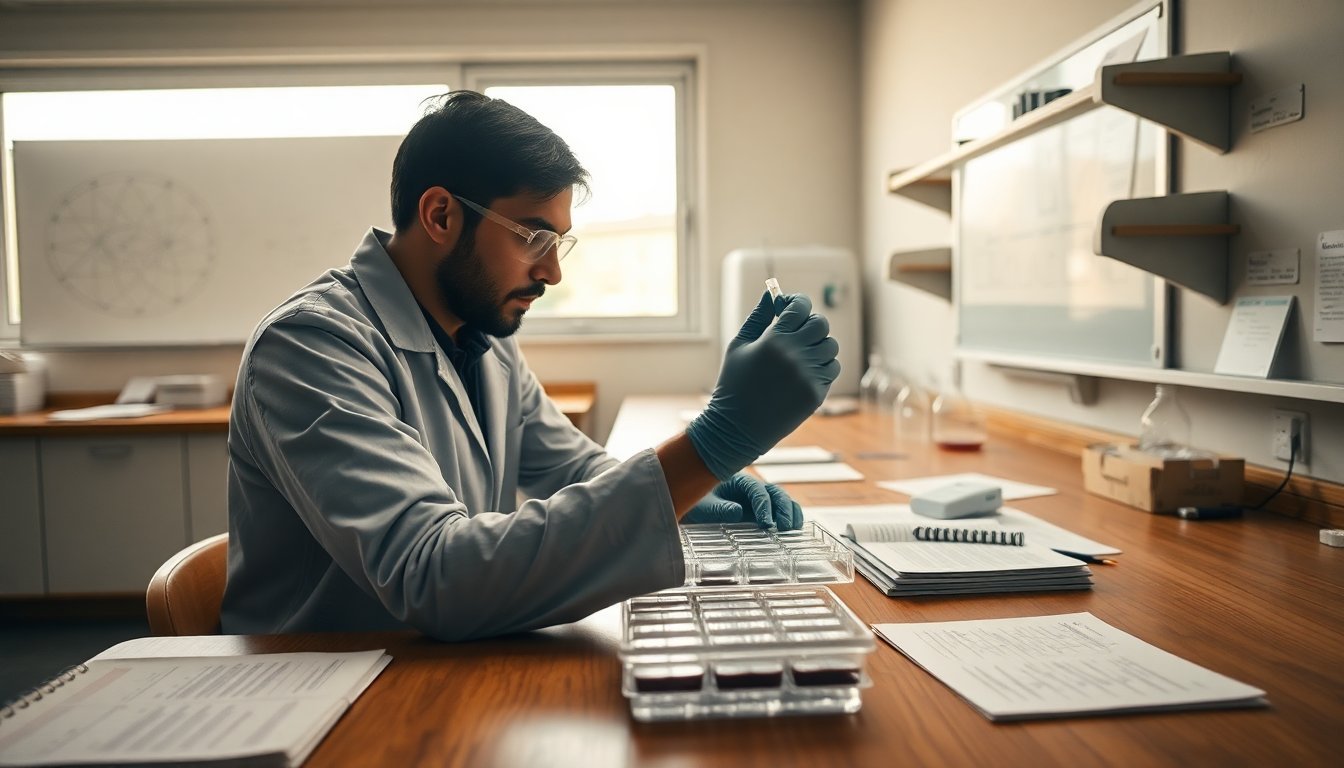
According to MIT Technology Review, Anthropic announced last Wednesday that it had launched a molecular biology lab earlier this year. The lab's structure is specific: Claude agents read and conjecture about hard biology problems, and human scientists run experiments on what the agents propose. This is not a PR-friendly research grant or a benchmark release. It is a physical and organizational commitment to a loop where AI generates hypotheses and humans test them. The timing matters. The announcement came months after the lab was already operational, meaning Anthropic had results or at least operational experience before going public. That sequencing suggests the company wanted evidence before claiming a new capability category.Why Does the Lab Structure Matter More Than the Model?
MIT Technology Review reported that the lab pairs Claude agents with human experimentalists in a continuous cycle. That structure is the actual innovation here, not the underlying model. Most AI-for-science efforts to date have been retrospective: train a model on known protein structures, then celebrate its predictions. Anthropic's lab is prospective: generate a conjecture that does not yet exist in the literature, then design and run an experiment to test it. This changes the failure mode. A retrospective model that gets a prediction wrong is a benchmark miss. A prospective lab that generates a wrong conjecture wastes real reagents, real time, and real postdoc hours. The cost structure of being wrong is completely different, which is why the human-in-the-loop design is not a safety afterthought but an economic necessity.
Who Gets Credit for an AI-Assisted Discovery?
This is the question MIT Technology Review puts at the center of the story, and it is the right one. If a Claude agent generates a novel conjecture about a biological mechanism, and a human scientist designs and executes the experiment that confirms it, who discovered it? The agent cannot hold a grant. The human cannot claim sole intellectual priority if the hypothesis originated in a model trained on the collective output of the field. The practical answer will be negotiated, not derived. Journals, funders, and institutions will set norms through individual cases. Anthropic's lab is effectively creating the first test cases by operating before those norms exist. That is either bold or reckless, depending on whether the company has a plan for attribution disputes.How Does This Compare to Other AI-for-Science Efforts?
| Organization | Approach | Human Role | Attribution Model |
|---|---|---|---|
| Anthropic | Claude agents generate conjectures; humans run experiments | Experimental validation | Unresolved, likely shared |
| DeepMind (AlphaFold) | Model predicts protein structures from known data | Training data providers | Model credited for prediction accuracy |
| Academic labs | Human hypothesis generation, AI as tool | Primary investigator | Human-first, AI as method |
| OpenAI (GPT-based research assistants) | General-purpose models used ad hoc for literature review and ideation | Variable, user-dependent | No formal framework |
| Verdict | Anthropic is the only major lab operating a dedicated wet-lab loop with its own models, making it the current leader in prospectively testing AI-generated biological hypotheses. |
What Evidence Would Prove AI Made a Discovery?
According to MIT Technology Review, the story's framing implies that no such standard currently exists. That is the real bottleneck. A discovery claim requires reproducibility, novelty, and significance. An AI-generated conjecture that leads to a validated novel mechanism would satisfy novelty and significance. Reproducibility is where it gets messy: if the same Claude agent, given the same literature, generates the same conjecture for another lab, is the discovery the conjecture or the validation? The field will likely converge on a standard that requires the AI system to have generated a hypothesis that human experts had not previously proposed and that experimental validation confirmed. That standard is achievable. It is also gameable, because proving a negative — that no human had proposed the hypothesis — is structurally difficult.
The thesis here is that Anthropic is not trying to win a discovery race; it is trying to define the terms of the race before anyone else can. By building a wet lab and staffing it with human experimentalists, Anthropic is manufacturing the conditions under which an AI-attributed discovery becomes possible, and in doing so, it is forcing the scientific community to negotiate attribution norms on Anthropic's timeline rather than its own.
In the short term, expect noise. Anthropic will publish results that are ambiguous — conjectures that humans might have reached anyway, validations that are incremental. Critics will call this marketing. They will be partly right. But the long-term consequence is structural: once a major AI lab operates a wet lab, the distinction between "AI company" and "research institution" erodes. That has implications for talent, funding, and regulatory treatment.
Who gains? Anthropic gains optionality: if AI-attributed discovery becomes a recognized category, it owns the first credible example. Academic labs gain a well-funded competitor but also a potential collaborator with resources they lack. Who loses? Smaller AI-for-science startups that cannot afford wet-lab infrastructure and will be relegated to tool-provider status. Also, potentially, the norm-setting bodies — journals and funders — that will be forced to react rather than lead.
My concrete prediction: by the end of 2027, at least one peer-reviewed paper will list a Claude agent as a named contributor or co-author on a molecular biology result originating from this lab, and the resulting attribution debate will be more consequential than the scientific finding itself.
Predictions
1. Anthropic will publish at least one peer-reviewed molecular biology paper by Q4 2027 that explicitly describes Claude-generated conjectures as the originating hypotheses, forcing journals to formalize AI contribution disclosure rules. 2. At least one major research university will announce a competing AI-wet-lab partnership by mid-2027, most likely MIT or Stanford, in response to Anthropic's move. 3. The NIH or an equivalent funding body will issue draft guidance on AI attribution in grant applications by 2028, explicitly addressing whether AI systems can be listed as contributors.- Early 2026Anthropic launches molecular biology lab
Anthropic quietly launches a wet-lab operation pairing Claude agents with human experimentalists, before any public announcement.
- September 2026Anthropic announces the lab publicly
Anthropic confirms the lab's existence and structure, months after it became operational.
- Q4 2027 (predicted)First peer-reviewed paper with AI-originated hypotheses
Anthropic is predicted to publish a molecular biology paper explicitly describing Claude-generated conjectures as originating hypotheses.
Article Summary
- Anthropic's molecular biology lab is the first dedicated wet-lab operation by a major AI company, pairing Claude agents with human experimentalists in a prospective hypothesis-testing loop.
- The lab's structure, not the model, is the real innovation: it changes the cost of being wrong from a benchmark miss to real experimental waste.
- Attribution remains unresolved, and Anthropic is operating before norms exist, effectively forcing the field to negotiate on its timeline.
- The comparison table shows Anthropic alone in operating a dedicated wet-lab loop with its own models, making it the current leader in prospectively testing AI-generated biological hypotheses.
- The most consequential outcome may be the attribution debate, not the scientific finding, because it will reshape how journals, funders, and institutions treat AI contributions.

Source and attribution
MIT Technology Review
When can we say AI made a scientific discovery?






Discussion
Add a comment