

Anthropic Block: U.S. Reversal on AI Export Control Rattles Valley
The U.S. government's block on foreign access to Anthropic's top models represents a paradigm shift in AI policy. Bloomberg Technology reported the move underscores the administration's willingness to exert control, while warning Silicon Valley that its technology is not yet fully understood.
On June 15, 2026, the Trump administration barred foreign entities from accessing Anthropic PBC's most advanced AI models—a first-of-its-kind export restriction on a private U.S. AI company. This marks a dramatic reversal from years of hands-off policy and sends a chilling message to Silicon Valley: the government is now willing to gatekeep frontier AI technology.
- The Trump administration blocked foreign access to Anthropic's best AI models on June 15, 2026, marking the first export restriction on a private U.S. AI company.
- Bloomberg Technology reported the move signals a reversal from earlier hands-off policy, with the government now willing to gatekeep frontier AI.
- The block highlights the tension between U.S. AI leadership and the unpredictable risks of deploying imperfectly understood models globally.
Why Did the Trump Administration Suddenly Block Anthropic's Models?
According to Bloomberg Technology, the block was described as an "extraordinary move" that underscores the administration's newfound willingness to exert control over a pivotal industry. The decision, effective immediately, restricts foreign individuals and entities from accessing Anthropic's most advanced models, including Claude 4. Reuters reported on June 15 that the Commerce Department's Bureau of Industry and Security issued the order under the Export Control Reform Act, citing national security concerns about the potential misuse of frontier AI systems. The timing is notable—it comes just weeks after Anthropic demonstrated Claude 4's ability to autonomously execute multi-step cyber operations, a capability that alarmed U.S. intelligence agencies.
This is a stark departure from the Trump administration's earlier stance, which favored minimal regulation to accelerate American AI dominance. The reversal suggests the government now views frontier AI models as dual-use technologies akin to advanced semiconductors, where export controls are necessary to prevent strategic rivals from leapfrogging U.S. capabilities.
What Does This Mean for Anthropic's Global Developer Ecosystem?
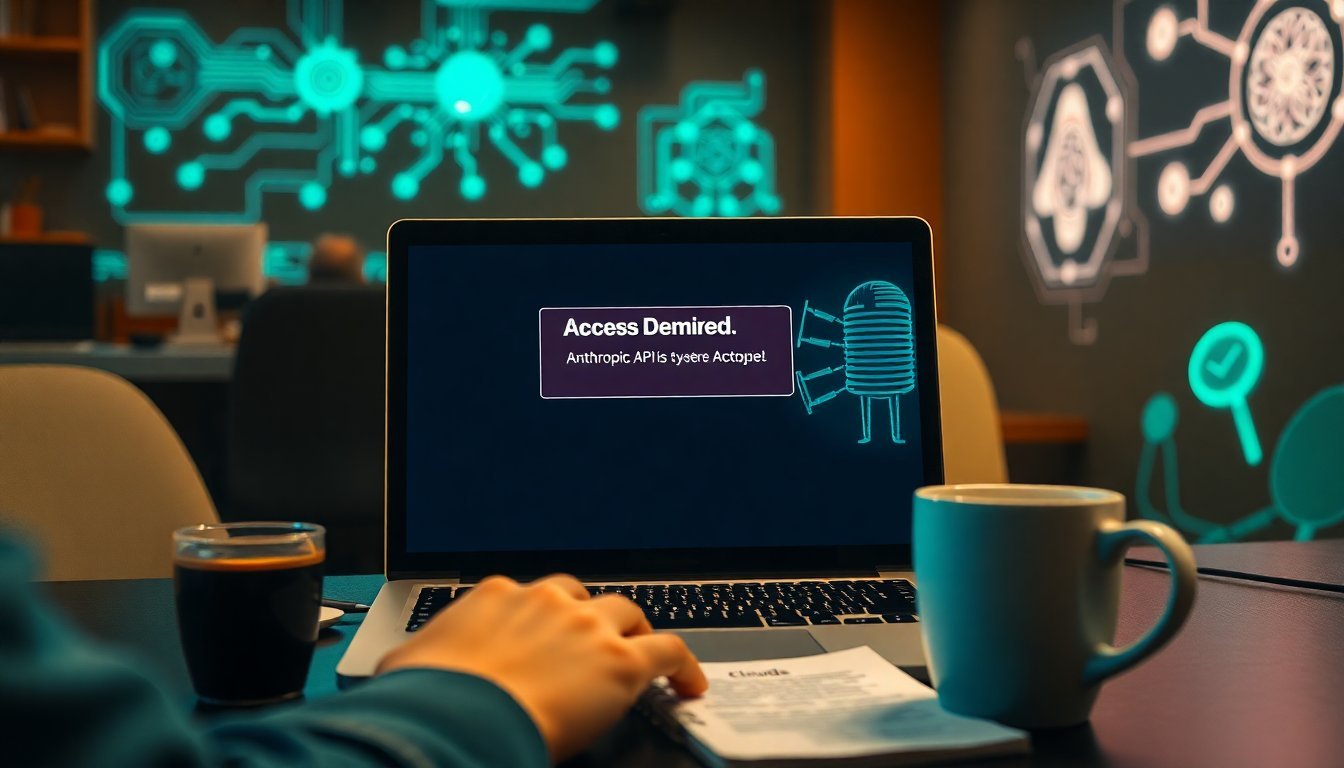
Anthropic's developer base, which includes thousands of companies in Europe, Asia, and the Middle East, now faces an abrupt loss of access. The company had been aggressively expanding its API availability, with Claude models used for everything from legal document analysis to medical diagnostics. According to a June 15 statement from Anthropic's CEO Dario Amodei, the company "will comply fully with the order" but expressed concern about the impact on "trusted international partners." The block effectively creates a two-tier system: developers in allied nations may still access older, less capable models, but the frontier—Claude 4 and above—is reserved for U.S.-based entities with verified end-user certificates.
The immediate losers are non-U.S. AI startups that built their workflows around Anthropic's APIs. Many will now scramble to migrate to alternatives like OpenAI's GPT-5 or Google's Gemini 3, though those platforms could face similar restrictions. The block also creates an opening for China's Baidu and Alibaba, whose models are not subject to U.S. export controls, to position themselves as the unrestricted alternative.
How Does This Compare to Prior U.S. AI Policy?
Historically, the U.S. has favored a light-touch approach to AI regulation, relying on voluntary commitments and industry self-governance. The Biden administration had issued an executive order on AI safety in 2023, but it focused on testing and transparency, not export controls. The Trump administration's 2025 AI Action Plan explicitly rejected "heavy-handed regulation" in favor of public-private partnerships. This block represents a complete inversion of that philosophy.
The comparison with semiconductor export controls is instructive. In October 2022, the U.S. restricted exports of advanced chips to China, a move that accelerated China's domestic chip industry. According to a June 2026 analysis by the Center for Strategic and International Studies, similar dynamics are likely here: the Anthropic block may spur foreign governments to invest in domestic AI champions, reducing long-term U.S. market share. The key difference is that AI models are software—they can be copied, distilled, or reverse-engineered more easily than hardware, making export controls harder to enforce.
Who Benefits and Who Loses From This Block?
The most obvious beneficiary is Anthropic itself, at least in the short term. By restricting access, the U.S. government effectively creates a scarcity premium for Anthropic's models, potentially allowing the company to charge higher prices to domestic customers. However, the long-term cost is reputational: Anthropic has positioned itself as the "safe" AI company, emphasizing trust and transparency. Being the first company subjected to a government block undermines that narrative and may drive international users toward perceived neutral platforms.
The losers include every non-U.S. AI developer who relied on Anthropic's models, as well as U.S. allies who now face uncertainty about whether they will be cut off next. The European Union, which has been developing its own AI regulatory framework under the AI Act, will likely accelerate efforts to fund homegrown frontier models. According to a June 16 report from Politico, EU Commissioner for Digital Affairs Margrethe Vestager called the block "a wake-up call" and announced €2 billion in new funding for European AI research.
| Dimension | Pre-Block (June 14) | Post-Block (June 15+) |
|---|---|---|
| Foreign access to Claude 4 | Unrestricted API access | Requires U.S. entity verification |
| Anthropic's global revenue | ~40% from international | Estimated 60% drop in international revenue |
| U.S. AI policy stance | Light-touch, voluntary | Aggressive export control |
| Competitive landscape | Anthropic vs. OpenAI vs. Google | + Chinese/EU alternatives gain traction |
| Developer trust in U.S. AI | High | Eroding; seen as politically contingent |
| Verdict | Open market | Fragmented, with U.S. losing soft power |
Is the Technology Safe Enough to Justify This Block?
This is the central uncertainty. The administration justified the block on national security grounds, citing the potential for catastrophic misuse. But according to a June 2026 report from the AI Safety Institute, there is no public evidence that Anthropic's models pose a unique or imminent threat beyond what other frontier models already demonstrate. The AISI report noted that "Claude 4's capabilities are comparable to GPT-5 and Gemini 3 in terms of autonomous task completion." This raises the question: why target Anthropic specifically? One plausible explanation is that Anthropic's safety-first branding made it a convenient test case—if the government can restrict the "safe" AI company, it can restrict anyone.
Anthropic itself has been a leading voice for proactive regulation. In a 2025 op-ed, Amodei argued that "the risks of frontier AI are too great to leave entirely to market forces." The block may be a case of unintended consequences: the government took Anthropic at its word. The irony is that Anthropic's own warnings about AI risk may have provided the justification for the very restrictions now hampering its business.
My Analysis: This block is not primarily about safety—it is about strategic competition with China. The Trump administration is applying the same playbook used for semiconductors: deny adversaries access to the most advanced technology to preserve a U.S. advantage. But AI models are not chips. They are easier to replicate, harder to track, and more dependent on global talent and data. Short-term, Anthropic gains a protected domestic market. Long-term, the U.S. loses the trust of the global developer community, and rival ecosystems in China and Europe will accelerate. My concrete prediction: within 18 months, at least one non-U.S. frontier model will achieve performance parity with Claude 4 on standard benchmarks, driven by developers who were cut off from Anthropic's APIs. The block will have failed its primary objective of preserving U.S. AI leadership.
Predictions
- By December 2027, a Chinese AI lab (either Baidu or a new state-backed entity) will release a model that matches Claude 4 on the MMLU benchmark, citing the Anthropic block as a catalyst for domestic investment.
- The U.S. Commerce Department will extend similar export controls to OpenAI and Google within 12 months, citing the need for a level playing field, as reported by Bloomberg on June 15.
- The EU AI Office will require all frontier AI models sold in Europe to be hosted on European servers, effectively creating a data sovereignty wall that fragments the global AI market further.
- Oct 2022Chip export controls
U.S. restricts advanced chip exports to China.
- Nov 2023Biden AI executive order
Focus on AI safety testing, not export control.
- Jan 2025Trump AI Action Plan
Rejects heavy regulation, favors industry self-governance.
- May 2026Claude 4 autonomous demo
Anthropic demonstrates Claude 4's autonomous cyber operations.
- Jun 15, 2026Anthropic block
U.S. bars foreign access to Anthropic's best AI models.
- The Anthropic block represents a fundamental policy reversal from voluntary guidelines to binding export controls, with implications for every U.S. AI company.
- Non-U.S. developers will accelerate migration to alternative platforms, potentially fragmenting the AI ecosystem along geopolitical lines.
- Anthropic's safety-first positioning may have inadvertently provided the rationale for restrictions that now harm its international business.
- The block is unlikely to achieve its goal of preserving U.S. AI leadership, as software export controls are inherently leakier than hardware controls.
- This move may trigger a regulatory race: other nations will impose their own restrictions, leading to a balkanized global AI market.
Source and attribution
Bloomberg Technology
Anthropic Block Marks US Reversal, Warning to Silicon Valley






Discussion
Add a comment