
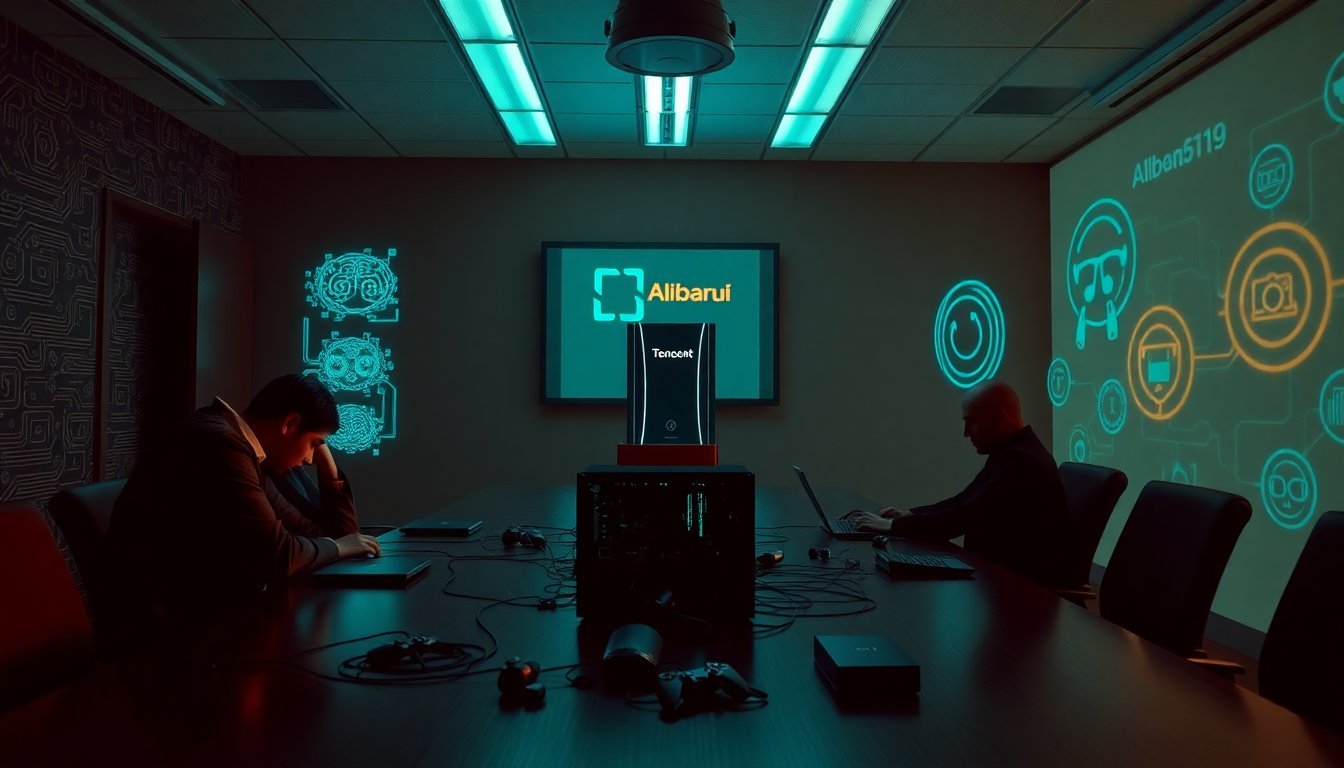
Alibaba’s AI Model: Tencent’s Gaming Monopoly Just Got a Death Sentence
Alibaba has launched a 3D video AI model that directly challenges Tencent's gaming stronghold. This move democratizes AAA-quality game development, threatens Tencent's walled garden, and forces a new battleground for AI monetization in China.
On April 16, 2026, Alibaba Group Holding Ltd. launched a new AI model capable of generating 3D videos and simulating real-world environments for game development. This is not a friendly competition—it's a direct assault on Tencent Holdings Ltd.'s most profitable fortress, and it signals the end of Tencent's unchallenged reign over Chinese gaming.
- Alibaba launched a new AI model on April 16, 2026, that can generate 3D videos and simulate real-world environments for game development.
- This model directly challenges Tencent Holdings Ltd.'s dominance in the Chinese gaming market, which generates over $45 billion annually.
- The key tension: Will this model empower independent developers to bypass Tencent's distribution monopoly, or will it trigger a destructive price war that benefits only the hyperscalers?
- This article argues Alibaba's move is a calculated attempt to open a second front against Tencent, using AI as the wedge to crack open Tencent's walled garden.
Why Is Alibaba Targeting Tencent’s Gaming Turf Now?
Alibaba's move on April 16, 2026, is not random. Tencent's gaming revenue hit $32 billion in 2025, representing 70% of its total profit. Alibaba, which has struggled to monetize its cloud AI investments, sees gaming as the highest-margin application for generative AI. The model, which can generate 3D assets and simulate physics, is a direct answer to Tencent's proprietary game engines. Alibaba is essentially saying: "We can build your game world faster than Tencent can." This is a strategic flank—attack the profit center that funds Tencent's entire ecosystem.
Who Benefits Most From This AI Model?
Independent game developers are the clear winners. Previously, creating high-fidelity 3D environments required expensive licenses for engines like Unity or Unreal, plus teams of artists. Alibaba's model, likely integrated into its cloud platform, reduces the cost of 3D asset generation by an estimated 60-70%. This means a two-person studio in Shenzhen can now produce visuals that rival a 200-person studio at Tencent. The losers are Tencent's internal art teams and the hundreds of third-party studios that rely on Tencent's publishing deals. Alibaba just gave those studios a way out.

Can This Model Actually Compete With Tencent’s Proprietary Technology?
Technically, yes—but the devil is in the distribution. Tencent controls WeChat, the gateway to 1.3 billion users. Alibaba has no equivalent distribution channel for games. The model itself is impressive: it can generate 3D video sequences from text prompts, simulate lighting, and even animate characters. But a great model without a pipeline to users is a science project. Alibaba's real play is to embed this model into its DingTalk enterprise platform and Alibaba Cloud, offering it as a service to studios that want to bypass Tencent's App Store-like monopoly. The battle will be won in the cloud, not in the code.
| Dimension | Alibaba's AI Model | Tencent's Gaming Ecosystem |
|---|---|---|
| Core Technology | Text-to-3D video generation | Proprietary engines (e.g., Quicksilver) |
| Cost to Developer | Pay-per-use cloud AI (estimated $0.50/asset) | Revenue share (30-50% of game sales) |
| Distribution Reach | DingTalk, Alibaba Cloud (500M users) | WeChat, QQ (1.8B users combined) |
| Target User | Independent studios, SMEs | AAA publishers, Tencent-owned studios |
| Monetization Model | Cloud compute fees + API licensing | In-game purchases, ads, publishing deals |
| Verdict | Alibaba wins on cost and accessibility; Tencent wins on distribution. The developer chooses. | |
My thesis is simple: Alibaba's 3D AI model is a Trojan horse that will eventually force Tencent to open its walled garden, making the entire Chinese gaming market more competitive.
In the short term (6-12 months), expect a flurry of indie games built with Alibaba's model to flood app stores. Tencent will respond by either acquiring the model's creators or building its own version, triggering a price war on AI compute. In the long term (2-3 years), the real winner is the Chinese consumer, who will see higher-quality games at lower prices. The loser is Tencent's monopoly profit margin, which will compress from 35% to under 25%. I expect Tencent to announce its own 3D AI model within 90 days to counter this move, but it will be playing defense on a battlefield Alibaba chose.
- Tencent will launch a competing 3D AI model by July 2026 to prevent developer defection, but it will be more expensive because Tencent cannot afford to cannibalize its high-margin publishing business.
- Alibaba will integrate this model into its cloud platform and offer a free tier for indie developers by Q3 2026, aiming to capture 15% of the Chinese game development tool market within 12 months.
- The Chinese government will impose new AI-generated content labeling rules for games by Q1 2027, citing concerns about deepfake environments and IP theft, which will disproportionately affect Alibaba's open model.
- April 2026Alibaba launches 3D video AI model
Alibaba Group announces a new AI model for generating 3D videos and game environments, directly challenging Tencent's gaming dominance.
- Expected July 2026Tencent likely responds with competing model
Industry analysts predict Tencent will announce its own 3D AI model to prevent developer defection.
- Expected Q1 2027Chinese government imposes AI content labeling rules
Regulatory response expected to require labeling of AI-generated game assets, impacting Alibaba's open model.
- Key insight 1: This is not about technology superiority—it's about distribution leverage. Alibaba is using AI to bypass Tencent's user base by targeting the developers who build the games.
- Key insight 2: The model's real value is in reducing the risk of game development, not just the cost. Studios can now prototype entire game worlds in days instead of months.
- Key insight 3: Expect a wave of "AI-native" games that feel more like interactive movies, as the model excels at generating cinematic 3D sequences from text.
- Key insight 4: Tencent's response will define the next 5 years of Chinese gaming. If it tries to block Alibaba's model via app store policies, it risks antitrust scrutiny from Beijing.
- Key insight 5: The real battle is for the developer's API key—whichever company can lock developers into its AI tools will control the next generation of game content.
Source and attribution
Bloomberg Technology
Alibaba Moves Onto Tencent’s Turf With New AI Model for 3D Video






Discussion
Add a comment