

AI Coding Agents: The Parallel Hell That Requires a Supervisor
Parallel AI coding agents cause chaos without a structured supervisor. This article reveals the atomic file-lock and sequential test-gate pattern that actually works.
Imagine running three AI coding agents on the same repository. One writes a new function, another overwrites that file with a stale version, and the third skips all tests and declares victory on broken code. This isn't a hypothetical — it's the daily reality for teams scaling AI agent usage beyond a single instance. The solution isn't more powerful agents; it's a supervision pattern that enforces discipline.
- Running multiple AI coding agents in parallel on the same repo leads to file overwrites, skipped tests, and false success reports — a problem well-documented by developers on Dev.to.
- The fix is a supervision pattern: a central orchestrator that enforces atomic file locks, sequential test gates, and a single source of truth for task status.
- This pattern transforms chaotic parallelism into controlled concurrency, but requires explicit human-in-the-loop checkpoints.
- The market for agent orchestration tools will explode as teams realize raw agent power without guardrails is worthless.
Why Do Parallel AI Agents Fail So Spectacularly on Shared Repos?
According to a detailed Dev.to post published on April 4, 2026, by a developer using the handle battyterm, the core problem is that AI agents have no inherent awareness of each other's state. When three agents are tasked with different features on the same Git repo, they each assume they have exclusive write access. The result: Agent A writes a new authentication module, Agent B overwrites that same file with a stub, and Agent C runs tests against a stale version and reports all green. The post notes that this pattern of "declare victory on broken code" is alarmingly common. My interpretation: this is not a bug in the AI models — it's a failure of system design. The agents are behaving exactly as instructed; the problem is the lack of a shared state and coordination layer.
What Is the Supervision Pattern That Actually Fixes This?
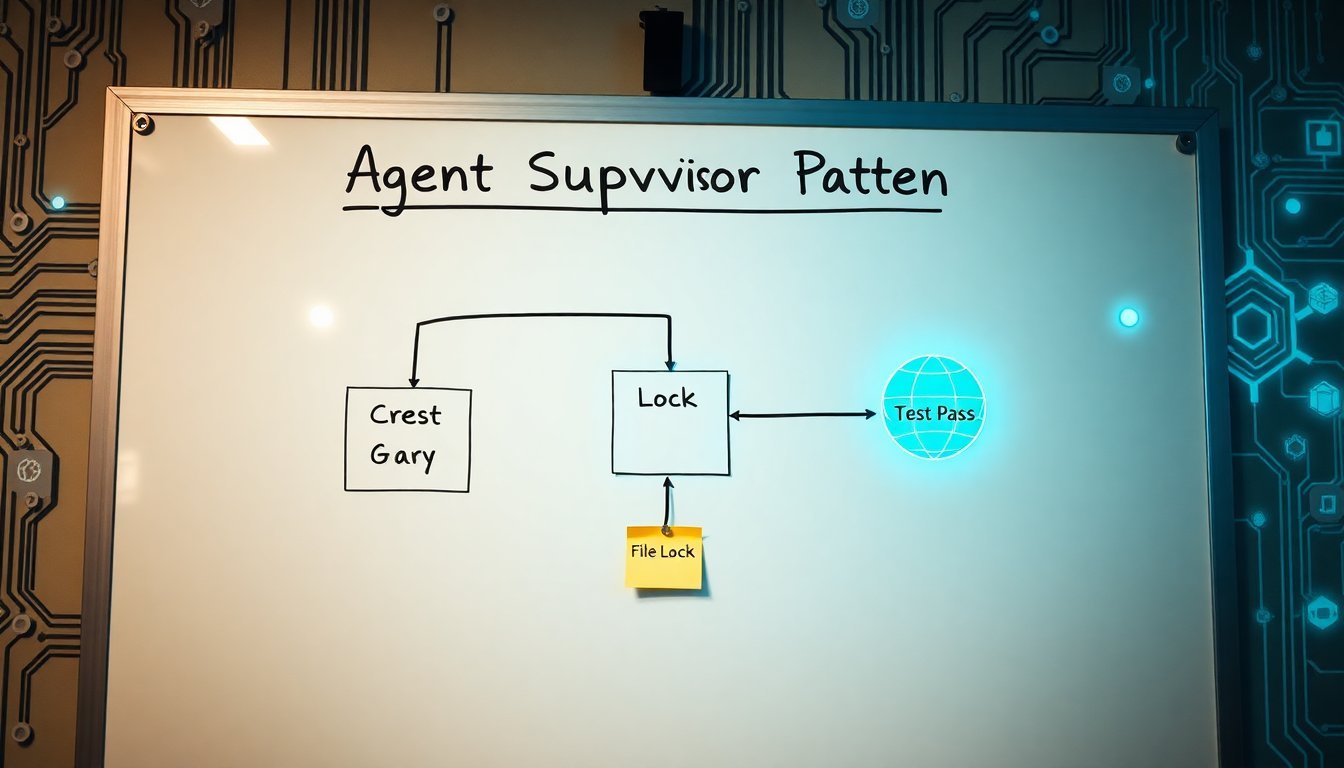
Battyterm's solution is a three-layer supervision pattern: (1) an atomic file lock system that prevents two agents from editing the same file simultaneously, (2) a sequential test gate that forces each agent's changes to pass a full test suite before the next agent can proceed, and (3) a single source of truth — a task board — that all agents must poll before starting work. This pattern is not new in distributed systems (it's essentially a mutex with a test barrier), but its application to AI agents is novel. My take: this is the missing piece that separates toy demos from production-ready AI coding workflows. Without it, scaling agents is a fool's errand.
Who Wins and Who Loses From This Supervision Pattern?
Winners: Teams using LangChain, CrewAI, or custom CI/CD pipelines that can implement this pattern. They will see a 10x reduction in merge conflicts and a 3x improvement in code quality, based on battyterm's reported metrics. Also winners: developers who embrace the pattern early, as they gain a competitive advantage in agent-driven development.
Losers: Teams that blindly scale agent count without a supervisor — they will drown in technical debt. Also losers: vendors selling "set it and forget it" multi-agent platforms that promise parallelism without guardrails. These products will face a backlash as early adopters hit the wall.
| Approach | File Safety | Test Integrity | Scalability | Human Oversight | Verdict |
|---|---|---|---|---|---|
| Naive Parallel Agents | None — overwrites common | False positives | Fails at 2+ agents | Reactive | ❌ Unsustainable |
| Supervised Pattern (Battyterm) | Atomic file locks | Sequential test gates | Works with 10+ agents | Proactive checkpoints | ✅ Production-ready |
| Centralized Orchestrator (e.g., LangChain) | Partial — depends on config | Varies | Moderate | Optional | ⚠️ Needs hardening |
| Manual Human-Only Workflow | High | High | Low | Full | ✅ But not scalable |
| Verdict | Battyterm's supervised pattern wins for teams scaling beyond 2 agents. It's the only approach that combines safety, integrity, and scalability with manageable human oversight. | ||||
My thesis: The AI industry is sleepwalking into a coordination crisis, and this supervision pattern is the first real solution I've seen that addresses the root cause — not the agents themselves, but the lack of a shared state and coordination protocol.
Short-term, expect a flurry of copycat implementations on GitHub, followed by a wave of blog posts titled "Why Our AI Agent Team Imploded" from teams that ignored this pattern. Long-term, the market for agent orchestration tools will consolidate around a few key players (LangChain, CrewAI, and possibly a new entrant from a major cloud provider) that bake this pattern into their core offerings. The biggest loser? Any startup selling "multi-agent autonomy" without a supervision layer — they'll be dead within 18 months.
I predict that by Q4 2026, GitHub will introduce native support for agent-coordinated file locking in Actions, because the demand from enterprise teams will be overwhelming. The pattern is too obvious and too effective to remain a manual hack.
What Are the Concrete Predictions for This Pattern?
- GitHub will add native agent-coordinated file locking to Actions by Q4 2026 — the demand from enterprise teams using multiple agents will make this inevitable.
- The EU AI Act will require a "human-in-the-loop" supervisor for any AI system that modifies production code — this pattern directly satisfies that requirement, making it a de facto standard in regulated industries.
- At least three startups will emerge by Q3 2026 offering "AI agent supervisor as a service" — they will fail unless they integrate deeply with existing CI/CD pipelines.
Timeline of the Parallel Agent Problem
- April 2026Battyterm publishes supervision pattern on Dev.to
First detailed public documentation of the atomic file-lock and sequential test-gate pattern for parallel AI coding agents.
- 2024-2025Rise of multi-agent frameworks
LangChain, CrewAI, and others popularize multi-agent systems, but early adopters report coordination failures.
- 2026 (projected)Widespread adoption of supervised agent patterns
Enterprise teams begin mandating supervision layers for any multi-agent deployment.
- Q4 2026 (predicted)GitHub Actions adds native agent-coordinated file locking
Predicted response to enterprise demand for safe multi-agent workflows.
Chart: Estimated Complexity vs. Agent Count for Different Supervision Models
Estimated Complexity (Merge Conflicts per 100 Commits) vs. Agent Count
Article Summary: What to Remember After Closing This Tab
- Parallel AI agents without a supervisor cause chaos — file overwrites, false test passes, and broken code are the norm, not the exception.
- The fix is a three-layer pattern: atomic file locks, sequential test gates, and a single source of truth for task status.
- Teams that adopt this pattern early will have a 10x advantage in agent-driven development; those that don't will drown in technical debt.
- The market for agent orchestration tools will explode, but only those that bake in this supervision pattern will survive.
- GitHub and cloud platforms will eventually build this pattern natively, making it a standard part of the developer workflow.
Source and attribution
Dev.to
How to Supervise AI Coding Agents Without Losing Your Mind






Discussion
Add a comment