

AgentGlass: Universal Mission Control for AI Coding Agents
AgentGlass is a real-time Mission-Control dashboard for AI coding agents, unifying visibility across providers and projects. It promises to solve agent observability, but faces adoption hurdles around trust and data privacy.
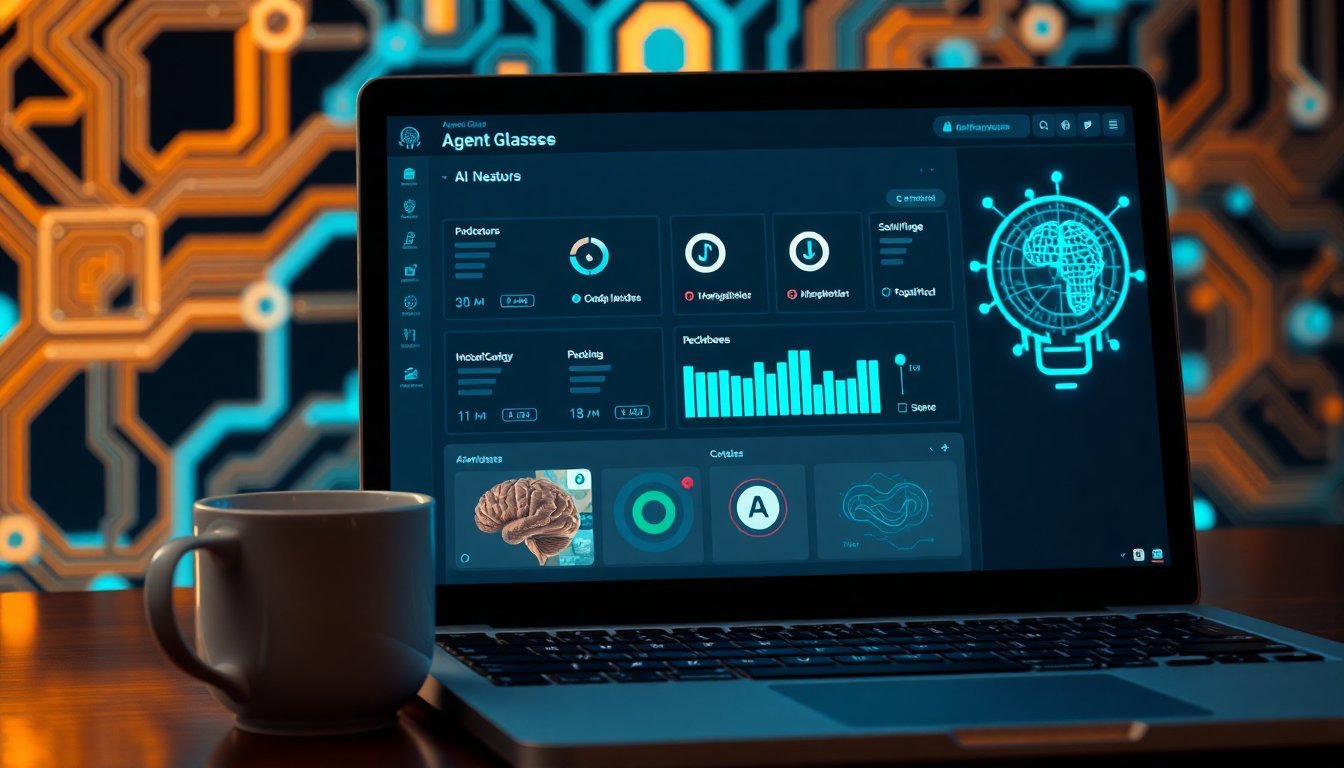
SirAllap released AgentGlass, an open-source TypeScript dashboard that gives developers real-time visibility into AI coding agents across every provider and project on their machine. With 122 stars on GitHub as of July 2026, this tool addresses a growing pain point: the lack of a unified interface to monitor, debug, and manage multiple agent instances.
- AgentGlass provides a real-time dashboard for monitoring AI coding agents across all providers and projects on a local machine.
- Released on GitHub with 122 stars in TypeScript, it targets the growing need for agent observability as multi-agent workflows become common.
- The tool's success hinges on developer trust in a third-party tool that accesses sensitive agent telemetry.
What Problem Does AgentGlass Solve for AI Coding Agents?
According to the GitHub repository description, AgentGlass acts as "a loupe for your agents," offering a real-time Mission-Control dashboard and workspace for AI coding agents across every provider and every project on your machine. This addresses a fundamental gap in the current AI toolchain: as developers increasingly rely on multiple coding agents from providers like OpenAI, Anthropic, and Google, they lack a single pane of glass to monitor agent behavior, resource usage, and output quality. SirAllap, the developer behind the project, reported that the tool is built in TypeScript and is open-source, suggesting a community-driven approach to solving agent observability.
The timing is critical. In July 2026, the AI coding agent market is fragmented, with each provider offering proprietary tools that often operate in silos. AgentGlass claims to unify these disparate systems into one interface, which could significantly reduce context switching and debugging time for developers managing multiple agents. However, the tool's reliance on local machine data raises questions about data security and privacy, especially for enterprise teams handling sensitive codebases.
How Does AgentGlass Compare to Existing Agent Monitoring Tools?
To understand AgentGlass's position, we must compare it with existing solutions like LangSmith (LangChain's observability platform) and Weights & Biases Prompts. According to LangChain's documentation, LangSmith offers tracing and evaluation for LLM chains but is tightly coupled to the LangChain ecosystem. Similarly, Weights & Biases Prompts focuses on prompt management and evaluation but lacks real-time agent-level monitoring. AgentGlass differentiates itself by being provider-agnostic and operating at the machine level, capturing all agent activity regardless of the underlying framework or API provider.
| Feature | AgentGlass | LangSmith | Weights & Biases Prompts |
|---|---|---|---|
| Provider Agnostic | Yes | No (LangChain-focused) | Partial |
| Real-Time Dashboard | Yes | Yes | No |
| Local Machine Data | Yes | No (cloud-based) | No (cloud-based) |
| Open Source | Yes | No | No |
| Agent-Level Monitoring | Yes | Partial (traces) | No |
| Verdict | Winner: Universal access, real-time, open-source | Winner: Deep integration with LangChain | Winner: Prompt optimization |
This comparison highlights AgentGlass's unique value proposition: it is the only tool that offers real-time, local, provider-agnostic agent monitoring. However, it lacks the ecosystem depth of LangSmith and the prompt optimization features of Weights & Biases, meaning it may serve as a complementary tool rather than a replacement.
Who Benefits Most From AgentGlass's Open-Source Approach?
According to the GitHub repository, AgentGlass is released under an open-source license, which immediately appeals to the developer community that values transparency and customization. Independent developers and small teams working on multiple agent projects stand to gain the most, as they can adapt the dashboard to their specific workflows without vendor lock-in. SirAllap stated on the repository that the tool is designed for "every provider and every project on your machine," which aligns with the needs of developers who use a mix of AI services like Claude Code, GitHub Copilot, and custom agents.
Enterprise teams, however, may hesitate. The tool's local data capture could conflict with corporate security policies that restrict third-party software from accessing codebases. Additionally, the lack of cloud-based collaboration features means that teams cannot share dashboards or aggregate data across developers, limiting its utility in larger organizations. The open-source nature mitigates some trust concerns, as developers can audit the code, but it also places the burden of maintenance and security updates on the community.
What Are the Key Uncertainties Around AgentGlass's Adoption?
The primary uncertainty is whether AgentGlass can achieve critical mass in a market where developers are already inundated with tools. As of July 2026, the project has 122 stars on GitHub, which is modest compared to established observability tools. SirAllap has not disclosed any funding or corporate backing, suggesting this is a solo or small-team effort. Without a clear monetization strategy or enterprise support, the project may struggle to sustain development and address user issues.
Another uncertainty is the tool's compatibility with rapidly evolving agent APIs. According to the GitHub issues page, early users have reported challenges with certain providers' rate limits and authentication flows. If AgentGlass cannot keep pace with API changes from providers like OpenAI and Anthropic, its utility will degrade quickly. The open-source community can help, but it may not be sufficient for enterprise-grade reliability.
My Analysis: AgentGlass is a necessary but risky bet. The thesis is that agent observability is the next bottleneck in AI development, and a universal dashboard is the obvious solution. In the short term, AgentGlass will gain traction among early adopters and indie developers who value open-source flexibility. However, its long-term success depends on three factors: first, whether the community can sustain development and fix compatibility issues; second, whether enterprises will trust a local, third-party tool with their agent telemetry; and third, whether larger players like LangChain or Weights & Biases will integrate similar features, rendering AgentGlass obsolete. The biggest loser if AgentGlass fails is the developer ecosystem, which will remain fragmented. The biggest winner if it succeeds is the independent developer, who gains unprecedented visibility into their agent workflows without vendor lock-in. I predict that by January 2027, AgentGlass will either be acquired by a major observability platform or will have pivoted to a cloud-based model to attract enterprise customers.
Predictions
- By December 2026, AgentGlass will reach 1,000 GitHub stars as word spreads about its unique cross-provider capability, but enterprise adoption will remain below 5% of total users due to privacy concerns.
- By March 2027, LangChain will announce a competitive feature in LangSmith that offers agent-level monitoring across providers, challenging AgentGlass's core differentiator.
- By June 2027, AgentGlass will either be acquired by a cloud observability vendor (e.g., Datadog or New Relic) or will introduce a paid enterprise tier with cloud sync and team collaboration features.
Article Summary
- AgentGlass fills a real gap in agent observability, but its success is not guaranteed.
- The open-source nature is a double-edged sword: it builds trust but places maintenance burden on the community.
- Enterprise adoption will be slow without cloud-based collaboration and security certifications.
- Larger players may co-opt AgentGlass's features, threatening its long-term relevance.
- The tool's true test will be its ability to keep pace with API changes from major AI providers.






Discussion
Add a comment