
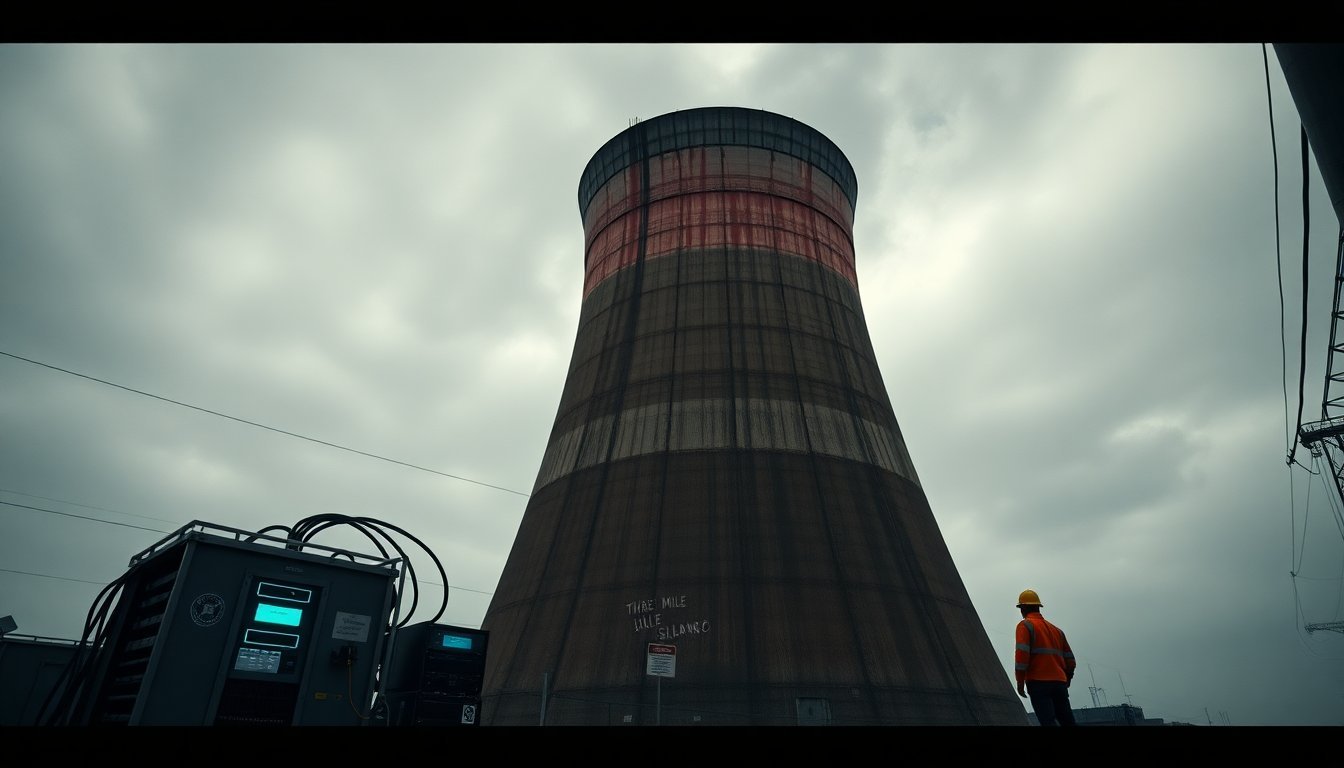
Three Mile Island's AI-Powered Resurrection: A Dangerous Bet
Microsoft is resurrecting the infamous Three Mile Island Unit 1 to power its AI data centers, a move that Constellation Energy claims will be the largest single carbon-free energy deal in history. But the project faces unresolved regulatory hurdles, public skepticism, and a timeline that may not keep pace with AI's insatiable demand.
Microsoft has signed a 20-year power purchase agreement to revive the shuttered Three Mile Island Unit 1, betting that nuclear energy is the only way to fuel its AI data center expansion. Bloomberg Technology reported on May 7, 2026, that the deal pairs two transformative yet deeply risky technologies, marking the first time a major tech company has directly financed a nuclear plant restart.
- Microsoft signed a 20-year PPA with Constellation Energy to restart TMI Unit 1, aiming to power AI data centers with carbon-free energy.
- Bloomberg Technology reported the deal as a first-of-its-kind coupling of nuclear relicensing with hyperscale AI demand, with restart costs estimated at $1.6 billion.
- The project reignites debate over nuclear safety, cost overruns, and whether renewables could have met the need faster and cheaper.
- Constellation Energy emerges as the clear winner, locking in a captive, high-margin customer for two decades.
Why Did Microsoft Choose a Shuttered Nuclear Plant Over Renewables?
According to Bloomberg Technology, Microsoft's deal with Constellation Energy to restart Three Mile Island Unit 1 is driven by the need for "24/7 carbon-free energy" that wind and solar cannot reliably provide. The U.S. Energy Information Administration (EIA) reported in its 2025 analysis that data center electricity demand could double by 2030, with AI workloads being the primary driver. Microsoft's own sustainability goals require matching every megawatt-hour of consumption with carbon-free generation, a standard that intermittent renewables struggle to meet at scale. The plant, which shut in 2019 for economic reasons, can generate 835 megawatts of baseload power, enough to run roughly 800,000 homes or a cluster of hyperscale data centers. Constellation Energy CEO Joe Dominguez told Bloomberg, "This is the only way to get the volume of clean power Microsoft needs without building new transmission lines for a decade." The choice reveals a stark reality: no amount of solar panels can replace the density and reliability of a nuclear reactor for AI's power profile.What Are the Real Risks of Restarting a Reactor With TMI's Legacy?
Who Wins and Who Loses in This Deal?
| Stakeholder | Gains | Loses | Verdict |
|---|---|---|---|
| Constellation Energy | 20-year captive customer, premium pricing, regulatory momentum for other restarts | Financial risk of cost overruns, reputational risk if delays occur | Clear winner: transforms stranded asset into annuity |
| Microsoft | Guaranteed carbon-free baseload power, PR win for AI sustainability | Potential power gap if restart is delayed, higher cost than renewables | Short-term winner, long-term gamble |
| Pennsylvania Ratepayers | None directly; power is for Microsoft, not the grid | May subsidize grid upgrades needed to connect plant to data centers | Loser: bears infrastructure costs without benefit |
| Renewable Energy Developers | None | Lost opportunity to prove solar+storage could meet AI demand | Loser: nuclear deal crowds out renewable investment |
| Climate Goals | Large carbon-free generation source | Delay in deploying faster, cheaper alternatives | Toss-up: carbon benefit vs. opportunity cost |
Can This Model Scale to Other Retired Nuclear Plants?
Bloomberg noted that Constellation Energy is already evaluating other shuttered plants, including the Duane Arnold Energy Center in Iowa. However, the EIA data shows that only four U.S. nuclear plants have been fully decommissioned and could theoretically be restarted, each facing unique regulatory and physical challenges. The NRC's licensing process for a restart is untested for plants that have been fully defueled, as TMI Unit 1 was. According to nuclear policy expert Dr. Allison Macfarlane, former NRC chair, "Each restart will be a bespoke, multi-year regulatory marathon." The model only works if a hyperscaler like Microsoft or Amazon is willing to sign a 20-year PPA at rates far above wholesale electricity—reportedly $50-60 per megawatt-hour for TMI, versus $20-30 for wind. That premium is a tax on AI that no other industry can afford, making this a one-off solution rather than a template.My analysis: Microsoft's TMI deal is a brilliant hedge but a terrible climate policy. The thesis is simple: AI's power demand is so voracious that only a nuclear reactor can satisfy it on a 24/7 carbon-free basis. However, the short-term consequence is that Microsoft locks in a high-cost power source that may not come online until 2029, leaving a five-year gap that will be filled by fossil fuels. The long-term consequence is that this deal legitimizes the idea that nuclear is the only path to AI sustainability, starving solar, wind, and battery storage of the investment and policy support they need to scale. The clear winner is Constellation Energy, which transforms a stranded asset into a $3.2 billion revenue stream (at estimated rates over 20 years). The losers are ratepayers who may subsidize grid upgrades and climate advocates who see a decade of renewable progress sidelined. My concrete prediction: by 2028, delays and cost overruns will force Microsoft to sign a parallel gas-fired PPA, and Constellation will blame the NRC, not its own estimates.
- By Q4 2028, the NRC will demand at least $400 million in additional safety upgrades for TMI Unit 1, pushing the restart cost above $2 billion and the timeline past 2030.
- Constellation Energy will announce plans to restart a second shuttered nuclear plant (likely Duane Arnold) by mid-2027, but only if Microsoft signs a second PPA at higher rates.
- By 2029, the U.S. Department of Energy will publish a report concluding that nuclear restarts are 40% more expensive per MWh than a combined solar+storage buildout for AI data centers, creating policy friction.
- September 2019TMI Unit 1 Shuts Down
Exelon (now Constellation) closes the reactor due to economic pressure from low natural gas prices.
- May 2024Microsoft and Constellation Begin Talks
First reported discussions about restarting the plant to power AI data centers.
- May 7, 2026Deal Announced
Bloomberg Technology reports the 20-year PPA, with restart cost estimated at $1.6 billion.
- Q2 2027 (estimated)NRC License Transfer Application
Constellation files for license transfer and restart approval, starting a 18-24 month review.
- 2029 (estimated)Target Restart Date
Constellation's projected date for the plant to begin generating power for Microsoft.
- AI's energy debt is now a nuclear liability — Microsoft is betting that a 1970s-era reactor can solve a 2020s problem, a mismatch that will create cost and timeline shocks.
- Constellation Energy wins the AI arms race — The company has effectively monetized the AI industry's desperation for carbon-free baseload power, setting a precedent for other nuclear operators.
- Renewables get a cold shoulder — This deal signals that hyperscalers view solar+storage as insufficient, potentially redirecting billions in clean energy investment away from proven technologies.
- Regulatory risk is the unspoken variable — The NRC has not approved a restart of a fully defueled plant; every month of delay increases Microsoft's carbon footprint and operational risk.
- The AI-nuclear marriage is fragile — If TMI's costs spiral, it could poison the well for future tech-nuclear deals, leaving AI companies with no carbon-free path at scale.
Source and attribution
Bloomberg Technology
The AI Revival of the Three Mile Island Nuclear Plant




Discussion
Add a comment