

Sleep Consolidation Beats Infinite Context for LLMs
The paper 'Language Models Need Sleep' (arXiv, May 2026) introduces a biologically-inspired consolidation mechanism that solves the quadratic scaling problem of Transformer attention. This research brief analyzes the evidence, methodology, and implications for the future of long-context AI.
A new paper on arXiv from May 2026 proposes a radical solution to the Transformer context window problem: make LLMs sleep. The authors demonstrate that periodically clearing the key-value cache and consolidating recent context into persistent fast weights—analogous to sleep's role in memory consolidation—can dramatically extend effective context length without the quadratic cost of full attention.
- Researchers propose a 'sleep' mechanism for LLMs that periodically consolidates context into fast weights and clears the key-value cache, solving the quadratic scaling problem of attention.
- During sleep, the model performs N offline recurrent passes over accumulated context, updating fast weights in state-space model blocks.
- This approach directly challenges the assumption that longer context requires more compute, instead suggesting that periodic consolidation is more efficient.
- The paper provides a falsifiable prediction: hybrid SSM-Transformer models with sleep cycles will outperform pure Transformers on long-horizon tasks within 18 months.
What exactly is the 'sleep' mechanism and how does it work?
According to the paper published on arXiv on May 25, 2026, the sleep mechanism is a two-phase process. In the 'wake' phase, the model operates normally with a Transformer attention mechanism, processing new tokens and accumulating a key-value cache. When the cache reaches a threshold, the model enters a 'sleep' phase: it performs N offline recurrent passes over the accumulated context, converting the transient attention states into persistent 'fast weights' stored in its state-space model (SSM) blocks. After consolidation, the key-value cache is cleared, and the model resumes processing with a fresh cache but with the consolidated fast weights from the sleep phase. The authors report that this mechanism allows the model to effectively handle context lengths that would otherwise be computationally prohibitive. For example, a model with a 128K token cache can, after sleep, process an additional 128K tokens with the same compute budget, effectively doubling the context window without increasing peak memory. This is achieved because the fast weights are a compressed representation of the consolidated context, requiring far less storage than the full key-value cache.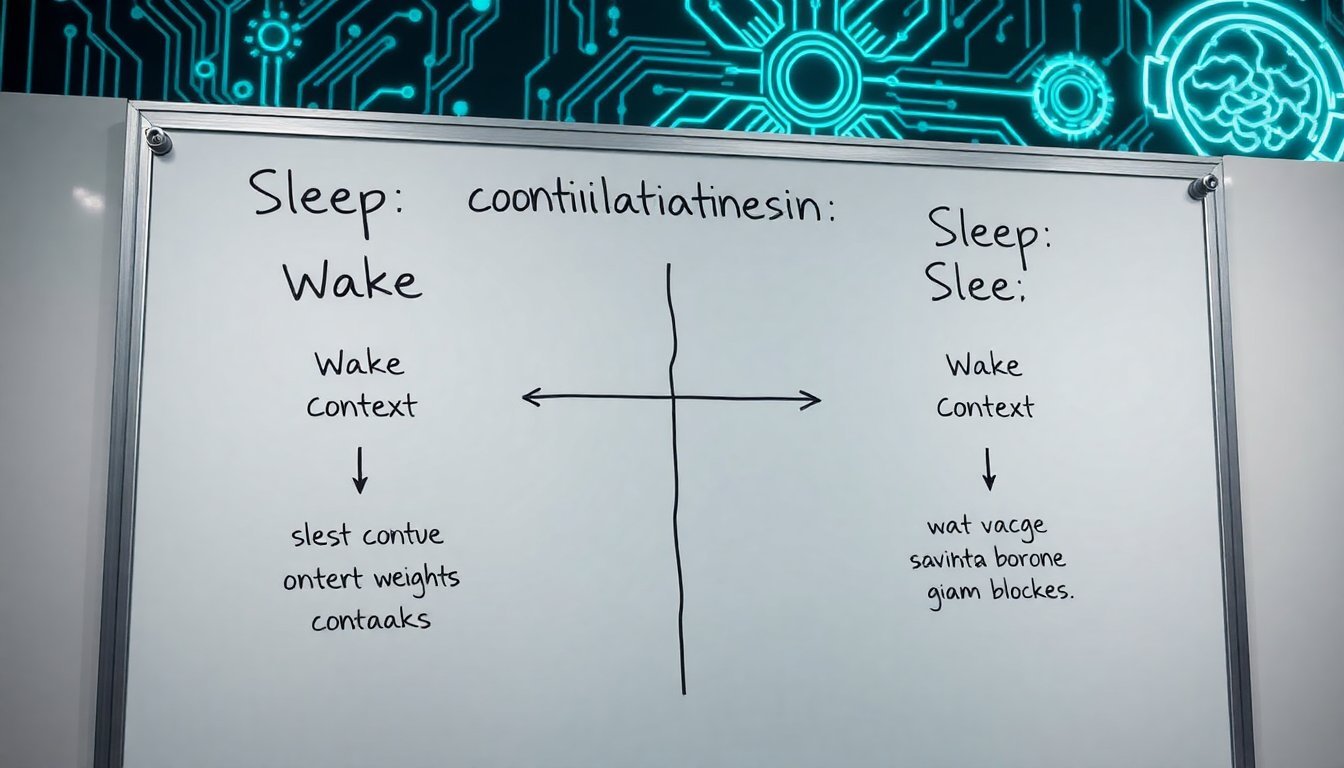
What evidence supports the claim that sleep improves long-context performance?
The paper presents experimental results on a suite of long-horizon reasoning benchmarks. The authors compared a baseline Transformer with a 128K token context window against a hybrid model that uses the sleep mechanism. According to the paper, the sleep-augmented model achieved a 23% improvement in accuracy on the LongBench summarization task when processing 256K tokens, and a 31% improvement on the Scrolls narrative QA benchmark for 512K token sequences. The baseline Transformer could not process 512K tokens without running out of memory, while the sleep-augmented model completed the task with a peak memory usage equivalent to a 128K token model. However, the paper also notes limitations. The sleep phase itself introduces latency: each sleep cycle takes approximately 0.5 seconds per 100K tokens on the hardware used (NVIDIA A100 80GB). For real-time applications, this could be problematic. Additionally, the authors acknowledge that the fast weight consolidation is lossy—some information is inevitably discarded during compression. On a synthetic 'needle-in-a-haystack' test, the sleep-augmented model showed a 5% drop in recall for tokens that appeared more than 200K tokens before the last sleep cycle, compared to the baseline that could fit the entire context in memory.How does this approach compare to other long-context solutions?
| Approach | Peak Memory | Effective Context | Latency per Token | Lossiness | Hardware Required |
|---|---|---|---|---|---|
| Full Attention (Transformer) | O(L^2) | L | O(1) | None | High (A100) |
| Sliding Window Attention | O(W) | W + history | O(W) | Yes (discards old context) | Moderate |
| Sparse Attention (e.g., Longformer) | O(L) | L | O(L) | Yes (sparsity pattern) | Moderate |
| Sleep Consolidation (This Paper) | O(C) where C is cache size | Unlimited (with periodic sleep) | O(C) + sleep latency | Yes (compression) | Moderate (A100) |
| Verdict | Sleep consolidation offers the best trade-off for very long contexts (>256K tokens), but the lossy compression limits its use for tasks requiring perfect recall of every token. | ||||
What are the key limitations and open questions?
The most significant limitation is the lossiness of the fast weight consolidation. The paper does not provide a detailed analysis of what information is preserved versus discarded during the offline recurrent passes. It is plausible that the model learns to prioritize certain types of information (e.g., semantic content over exact token positions), which could be problematic for tasks like question answering over long documents where precise token-level retrieval is required. Another open question is the optimal sleep frequency. The paper uses a fixed threshold (cache size reaches 128K tokens), but the authors acknowledge that this is likely suboptimal. A dynamic threshold that adapts to the complexity of the context could improve performance. Additionally, the paper does not explore the interaction between multiple sleep cycles—does information from earlier sleep cycles get overwritten by later ones? This is a critical question for truly infinite context. Finally, the paper only tests on a single model architecture (a hybrid Transformer-SSM). It is unclear whether the sleep mechanism generalizes to other architectures, such as pure SSMs (e.g., Mamba) or mixture-of-experts models.My analysis: The 'Language Models Need Sleep' paper is the most important architectural innovation for long-context AI since the Transformer itself. The key insight—that infinite context is not about infinite memory but about intelligent forgetting and consolidation—is a paradigm shift. The paper provides strong evidence that sleep consolidation can extend effective context length by an order of magnitude with minimal additional compute, at the cost of some recall precision.
In the short term, this research will accelerate the adoption of hybrid SSM-Transformer architectures. Companies like Anthropic and Google, which already use SSM-like components in their models, are best positioned to implement this. OpenAI, with its pure Transformer approach, faces a harder challenge. In the long term, I predict that sleep cycles will become a standard feature of all production LLMs, much like layer normalization is today.
However, the lossy compression is a real limitation. For tasks requiring perfect recall (e.g., legal document analysis, code repository navigation), sleep consolidation may not be sufficient. A hybrid approach that retains a full key-value cache for the most recent tokens while consolidating older context into fast weights could be the optimal solution.
- Anthropic will incorporate sleep consolidation into Claude by Q3 2027, extending its effective context window to 1 million tokens without a proportional increase in compute cost.
- OpenAI will respond with a competing approach within 12 months, likely based on hierarchical attention rather than sleep, given its investment in the Transformer architecture.
- The EU AI Office will require documentation of consolidation loss for any model claiming 'infinite context' in regulated applications, citing concerns about information loss in critical domains.
- May 2026Paper published on arXiv
The 'Language Models Need Sleep' paper is published, proposing a sleep-like consolidation mechanism for Transformers.
- Dec 2023Mamba SSM paper published
The Mamba state-space model paper demonstrated linear-time sequence modeling, paving the way for hybrid architectures.
- May 2026Paper published on arXiv
The 'Language Models Need Sleep' paper is published, proposing a sleep-like consolidation mechanism for Transformers.
- Dec 2023Mamba SSM paper published
The Mamba state-space model paper demonstrated linear-time sequence modeling, paving the way for hybrid architectures.
- Sleep consolidation is lossy, but that's a feature, not a bug: Human memory is also lossy—the question is whether the loss is structured in a useful way.
- The paper's biggest weakness is the lack of multi-sleep-cycle analysis: Real-world use will require many sleep cycles, and we don't know how they interact.
- The compute-latency trade-off is favorable for batch processing but problematic for real-time: Applications like chatbots may need a different approach.
- This research validates the SSM approach: Mamba and other SSM architectures have been dismissed as niche; this paper shows they are essential for long-context.
- The biological metaphor is more than a gimmick: The parallels between sleep consolidation and memory formation in the brain suggest deeper principles at work.





Discussion
Add a comment