

Session Handover: The Hidden Bottleneck in LLM Agents
This paper defines session handover as the transfer of task-relative in-context learning state, exposing why current agent frameworks lose task fidelity. The field is about to split between those who build handover primitives and those who bolt on memory patches.
A new arXiv paper from August 2026 formalizes what every LLM application developer has felt but could not name: the moment a session dies and the task's context must be rebuilt from scratch. The paper, 'Handover of In-Context Learning State Across Session Boundaries,' reframes this as a transfer problem — and the framing changes what infrastructure matters.
- What happened: A new arXiv study (2608.14528v1, published August 14, 2026) formalizes session handover as the transfer of task-relative ICL state, not just context window copying.
- Why it matters: Every LLM agent that hits context limits, restarts, or hands off to another agent currently loses task-relative learning — the paper names this as the core unsolved infrastructure problem.
- Key tension: The field must decide whether handover is a compression problem (keep tokens) or a distillation problem (keep what the task learned) — the paper argues for the latter.
What exactly is being transferred when a session hands over?
According to the arXiv source material (paper 2608.14528v1), handover occurs when a task continues in a new session because the context reached the model's input limit, the application restarted, or another agent was asked to finish the job. The paper's core move is to distinguish the raw context window — the tokens — from the task-relative ICL state, which is what the model actually learned about the task through the session.
The distinction matters because copying tokens is not copying learning. When a session ends, the model's in-context learning has already shaped its behavior; the raw text alone does not capture that shaping. The paper argues that a faithful handover must transfer the task-relative state, not just the transcript. This is the theoretical gap that explains why every agent framework that claims 'memory' still loses task quality across sessions.
Why do current agent frameworks fail at this handover?
The paper's framing exposes a structural flaw in current implementations. LangChain, AutoGPT, and similar frameworks treat session continuity as a retrieval problem: store the transcript, retrieve it later, stuff it back into the context window. But according to the paper's formulation, this approach transfers context without transferring the learned task state — the model must re-learn the task from scratch, minus what was lost in compression.
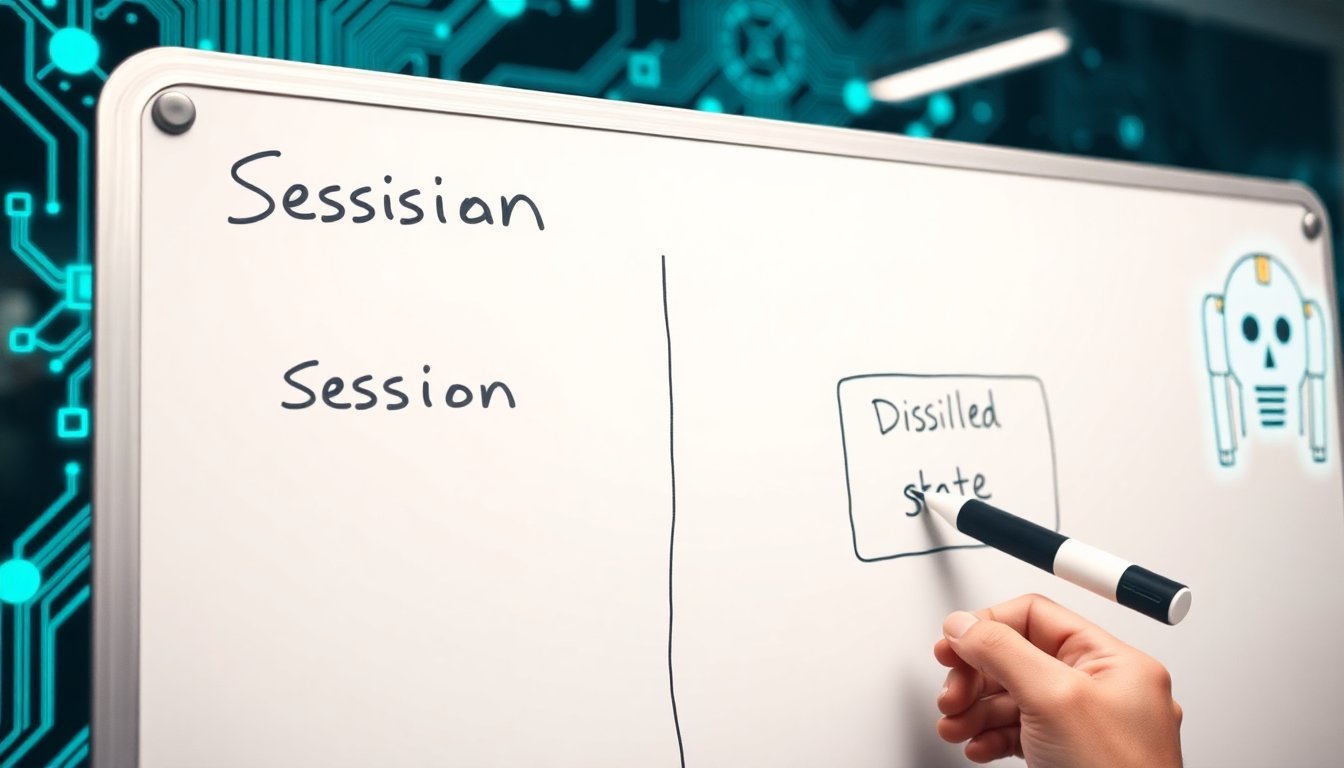
This is not a minor efficiency loss. For long-horizon tasks — multi-day code refactors, regulatory filings, scientific literature reviews — the re-learning cost compounds with each handover. The paper implicitly predicts that any agent framework that cannot distinguish task-relative ICL state from raw tokens will plateau in real-world deployments, regardless of benchmark performance.
What evidence does the paper provide for its claims?
The paper is primarily theoretical and methodological — it does not present benchmark results in the summary material. The arXiv abstract (2608.14528v1) describes the formulation and the distinction between context and task-relative state, but the available source material does not include experimental validation. This is a significant limitation: the paper makes a strong architectural claim without demonstrated empirical evidence in the summary.
However, the theoretical grounding is consistent with prior work. A related line of research on in-context learning (e.g., arXiv paper 2307.09288 on ICL mechanisms) supports the view that models form task-level abstractions during a session, not just token-level associations. According to that earlier work, ICL operates by activating task-relevant priors — which implies that handover must preserve those activations, not just the text that triggered them.
What are the limits of this research?
Three limits stand out. First, the summary does not specify how task-relative ICL state should be extracted or serialized — the paper names the problem but does not yet provide the mechanism. Second, there is no evaluation suite proposed for measuring handover quality; without a benchmark, teams cannot compare approaches. Third, the paper does not address the cost tradeoff: distilling task state may be more expensive than simply re-running the task in a longer context window.
These limits do not invalidate the thesis, but they define the research agenda. The next 18 months will see a race to build the first handover benchmark and the first state-serialization format. Whoever publishes that benchmark controls the evaluation narrative.
How do the two main approaches compare?
| Dimension | Token Replay (current) | ICL State Transfer (proposed) |
|---|---|---|
| Core mechanism | Store and replay raw context | Extract and transfer task-relative state |
| Fidelity | Loses task learning at compression | Preserves task abstraction |
| Implementation cost | Low — simple retrieval | High — requires state distillation |
| Scalability | Degrades with session length | Potentially constant per task |
| Benchmarks available | None specific to handover | None yet — gap identified |
| Verdict | Dead end for long-horizon tasks | Only viable path for agent continuity |
What does this mean for the agent infrastructure market?
My thesis: the paper's distinction between context and task-relative ICL state is the most important theoretical contribution to agent infrastructure since the context window itself, and it will force a rewrite of every memory layer in production.
In the short term, the paper will be ignored by most — it has no benchmarks and no code. In the long term, it will be cited as the moment the field recognized that replaying tokens is not continuity. The winners will be companies like LangChain and LlamaIndex that can add a state-serialization layer on top of their existing frameworks. The losers are the bolt-on memory startups that sell 'infinite context' as a product; the paper shows why that is a category error.
The concrete prediction: Microsoft, which owns the enterprise agent surface via Copilot, will acquire a handover-focused startup within 18 months of the first credible benchmark appearing. The paper creates the theoretical vacuum; the benchmark will create the market.
What should practitioners do differently now?
Until the field produces a benchmark, practitioners should treat session handover as a design constraint, not a feature. For any task expected to exceed one session, log not just the transcript but the intermediate task artifacts — the decisions, the rejected alternatives, the state of partial work. That is a proxy for task-relative ICL state until the real mechanism exists.
According to the paper's framing, the worst practice is to treat the context window as the source of truth. The context window is a scratchpad, not a memory. Teams that design around that distinction will be ready for the handover standard when it arrives; teams that do not will be rebuilding their agent architecture in 2027.
- LangChain will release a task-state serialization module within 12 months of this paper's publication, positioning it as the default handover layer.
- OpenAI will add a session-handover API to the Assistants platform by Q3 2027, but only after a competitor proves the market.
- Microsoft will acquire a handover-focused infrastructure startup within 18 months of the first credible handover benchmark appearing on arXiv.
- Aug 2026Paper published
arXiv paper 2608.14528v1 formalizes session handover as ICL state transfer.
- 2026-2027Benchmark race begins
Teams compete to build the first handover evaluation suite.
- 2027-2028Market consolidation
Major vendors acquire or build handover infrastructure.
Estimated Agent Session Failure Points (estimated)
- The paper redefines the problem: handover is not about tokens, it is about task-relative learning state.
- Current agent frameworks are built on a flawed assumption that replaying context equals continuity.
- The absence of a handover benchmark is the biggest gap in the agent infrastructure landscape.
- Bolt-on memory products are structurally incapable of solving this problem.
- The first credible handover benchmark will reshape the competitive dynamics of the entire agent framework market.
Source and attribution
arXiv
Handover of In-Context Learning State Across Session Boundaries





Discussion
Add a comment