
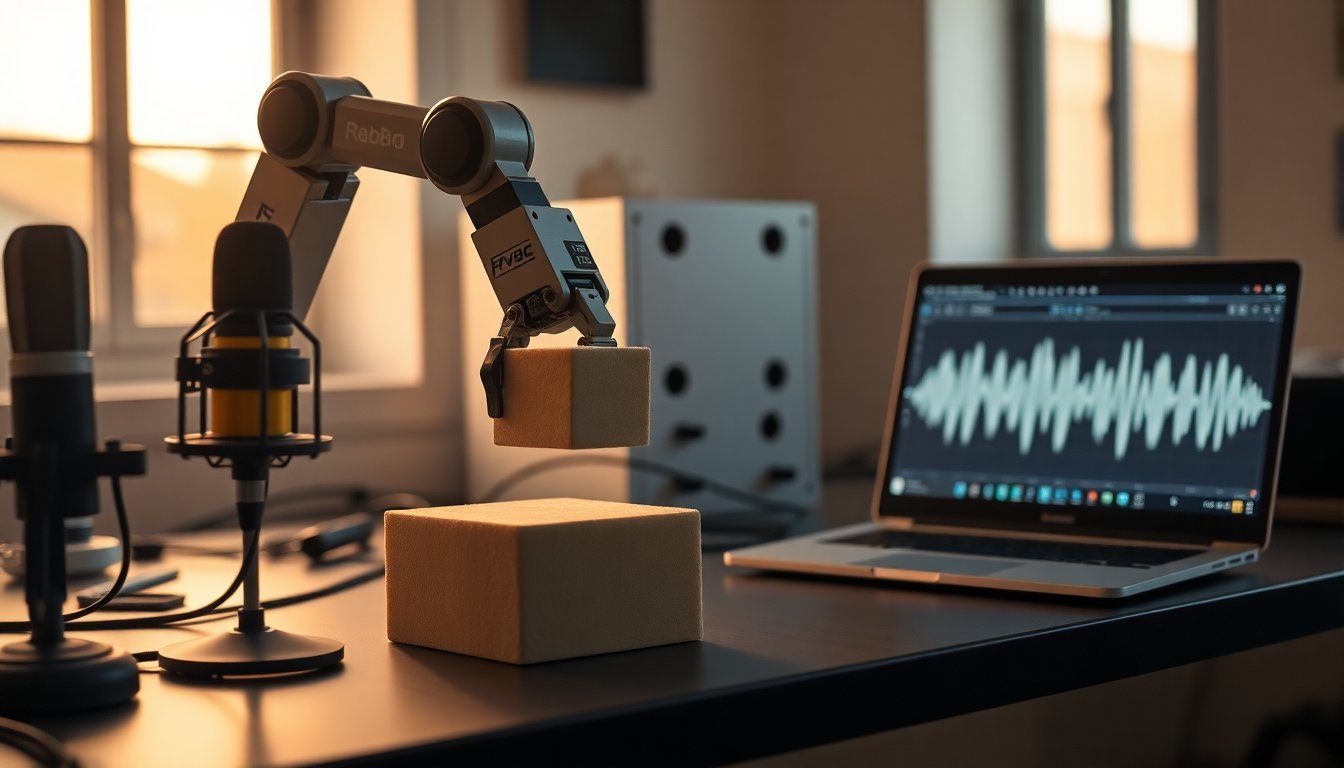
Robots Learn Contact Force From Dreamed Sound
A new arXiv paper argues that generated contact sound can supply the force information that video-only robot learning lacks. If the pipeline holds, contact-rich manipulation data becomes a generation problem rather than a hardware problem.
The arXiv paper 'Dreaming the Sound of Contact' proposes using generated contact audio to shape a bounded, time-varying force profile for zero-shot manipulation. It attacks the exact failure mode that has stalled video-only robot learning: purely kinematic trajectories that break the moment a task requires real contact force.
- The arXiv paper 'Dreaming the Sound of Contact' (submitted 2026-09-16) proposes augmenting generated video with generated contact audio to produce a bounded, time-varying desired-force profile.
- Existing video-generation manipulation pipelines produce purely kinematic trajectories and fail on contact-rich tasks where contact force determines success.
- The core tension: loudness of generated contact sound is a proxy for force, not a measurement — and proxies can be gamed by the generator.
- If validated, this reframes contact-rich robot data as a generative modeling problem and shifts competitive advantage to labs with joint audio-video pretraining.
What Exactly Did This Paper Change?
The paper, posted to arXiv on 2026-09-16, states plainly that recent video generation lets robots learn manipulation trajectories from generated video, but that these approaches "produce purely kinematic trajectories that lack force information, causing failures in contact-rich tasks where appropriate contact forces are essential for success." Its proposed fix is to augment generated video with audio and use the loudness of generated contact sounds to shape a bounded, time-varying desired-force profile. That is a narrow but real change. For two years the dominant critique of video-based robot learning has been that pixels do not encode force. This paper does not refute that critique — it routes around it by adding a second modality that correlates with force. The phrase "bounded, time-varying" matters: the authors are not claiming audio gives an absolute force reading, only a shaped profile. That is a much weaker and much more defensible claim.Why Does Audio Beat Vision for Contact Force?
Contact sound is generated at the moment of impact, friction, or slip — precisely the events where force matters. Vision captures the before and after of a grasp; audio captures the event itself. According to the arXiv abstract, the pipeline "jointly" generates video and audio, then uses loudness as the force-shaping signal. The interpretation here is that the authors are exploiting a physical regularity rather than learning an arbitrary mapping. Harder contact generally produces louder, sharper sound. If that regularity holds across materials and geometries, then loudness is a cheap, dense, time-aligned force proxy. If it does not hold — soft materials, quiet surfaces, noisy environments — the whole signal collapses. The paper's own framing as "explore" suggests the authors know this is not yet settled.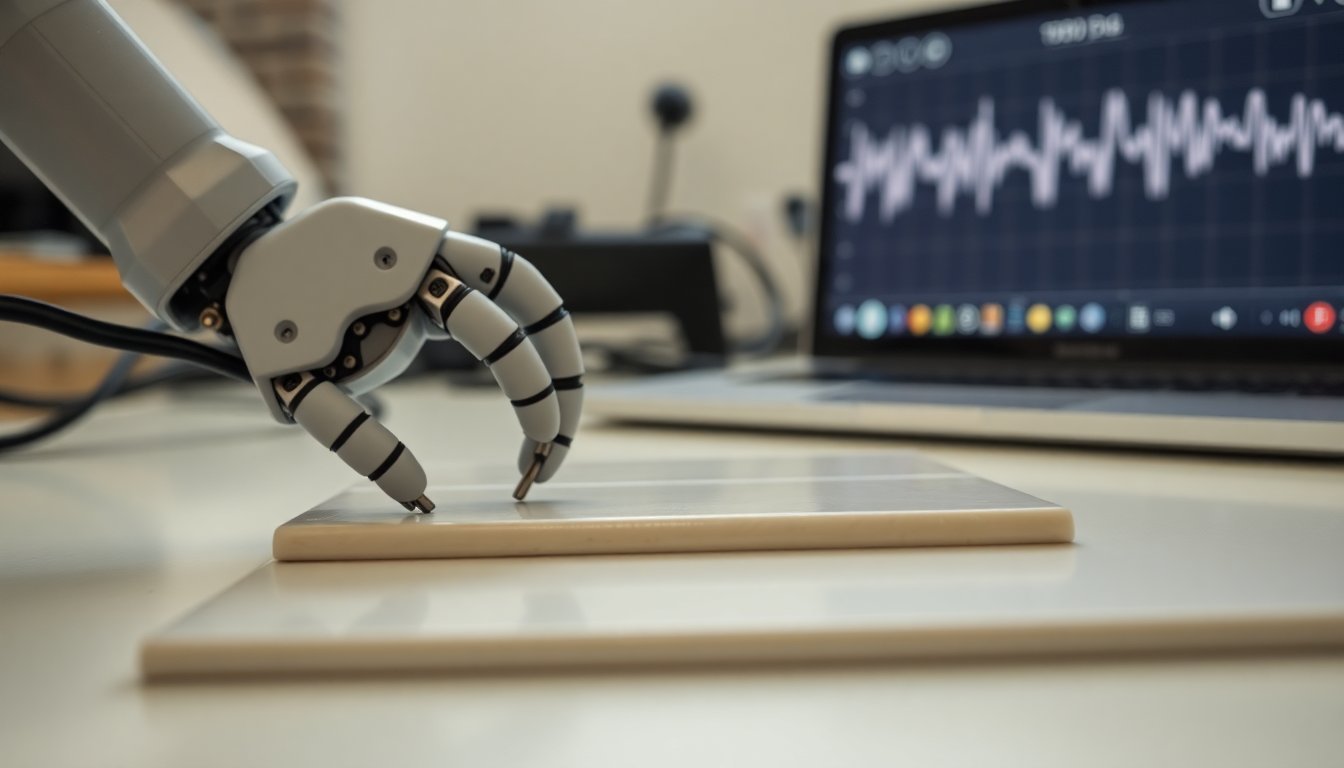
Who Wins and Who Loses If This Works?
The winners are labs that already own joint audio-video generative models — the same pretraining that powers video generation with synchronized sound. The losers are teams that built their entire manipulation stack on kinematic video generation and teleoperation data collection. If contact sound becomes a usable force proxy, the marginal cost of generating contact-rich training data drops toward zero, which devalues large physical teleoperation datasets. The arXiv listing for cs.RO shows a steady stream of video-generation manipulation papers, which means the competitive field is crowded. The differentiator will not be the idea of using audio — it will be the fidelity of the joint generator and the calibration between loudness and force. According to the paper's own summary, the pipeline is presented as a joint generation approach, which implies the audio and video models must be trained together, not stitched post hoc.Where Does the Evidence Break Down?
Three gaps stand out. First, loudness is not force: the same impact on different materials produces different sound levels, so a bounded profile derived from audio may be systematically wrong across object categories. Second, generated audio is itself a model output — if the audio generator hallucinates a loud contact where none occurred, the force profile becomes fiction. Third, the abstract does not report quantitative success rates on contact-rich benchmarks, so the claim that this fixes failures is currently a hypothesis, not a result.How Does This Compare to Existing Approaches?
| Approach | Force Signal | Data Cost | Contact-Rich Reliability |
|---|---|---|---|
| Video-only generation | None | Low (generated) | Poor — kinematic only |
| Physical teleoperation | Direct force/torque | Very high | Strong but unscalable |
| Sim-to-real with contact models | Simulated force | Medium | Sim gap on real materials |
| Dreamed audio (this paper) | Loudness proxy | Low (generated) | Unproven — bounded profile only |
| Verdict | Dreamed audio is the most scalable force proxy proposed to date, but it is a proxy, not a measurement — treat it as a research bet, not a production method. | ||
Thesis: Audio-augmented video generation is the first credible path to scalable force-aware robot data, and it will be validated or killed within 18 months by whether joint audio-video generators can produce calibrated contact sound.
Short term, this paper changes little on factory floors. The abstract describes an exploration, not a deployed system, and no quantitative benchmark results are reported in the source material. Long term, if loudness-to-force calibration holds across materials, the economics of contact-rich manipulation data invert: instead of buying robot time, labs buy GPU time. The gainers are generative-model labs with synchronized audio-video pretraining; the losers are teleoperation data vendors and teams whose moat is physical data collection.
My concrete prediction: by mid-2028, at least one major robotics lab will publish a contact-rich manipulation benchmark result using generated audio as the force signal, and the result will be reported as a bounded-profile controller rather than an absolute force estimate — because that is the only claim the loudness proxy can honestly support.
Predictions
- By Q3 2027, at least two major robotics labs (one of which will be a joint audio-video model owner) will publish contact-rich manipulation results using generated contact audio as a force proxy, per arXiv submission tracking.
- By 2028, teleoperation data vendors will reposition from selling force/torque datasets to selling calibration and validation services, because generated audio will undercut their raw data pricing.
- The first serious failure case will be soft or quiet materials, where loudness-to-force calibration breaks — expect a follow-up paper explicitly scoping the method to rigid-body contact.
- September 2026Paper posted to arXiv
'Dreaming the Sound of Contact' is submitted to arXiv on 2026-09-16, proposing audio-augmented video generation for force-aware manipulation.
- 2024-2026Video-generation manipulation wave
Multiple labs publish video-generation-based robot learning pipelines that produce purely kinematic trajectories.
- Mid-2028Predicted validation window
Expected timeframe for the first contact-rich benchmark result using generated audio as the force signal.
Force Signal Availability by Manipulation Data Source (estimated)
Article Summary
- The paper's real contribution is not audio generation — it is treating loudness as a bounded force profile rather than an absolute force measurement.
- Video-only manipulation pipelines fail on contact-rich tasks because pixels do not encode force; audio captures the contact event itself.
- The method is unproven: no quantitative benchmark results appear in the source material, and loudness-to-force calibration is material-dependent.
- If validated, the competitive moat shifts from physical data collection to joint audio-video generative model quality.
- The honest framing is a research bet with an 18-month validation window, not a production-ready force controller.





Discussion
Add a comment