

Researchers Unveil Dual Mechanisms for Spatial Reasoning in Vision-Language Models
The study demonstrates that VLMs compute spatial relations through separate mechanisms in the language backbone and visual encoder, rather than a unified process. This discovery provides a new framework for diagnosing and improving model robustness in multimodal tasks like visual question answering.
A pivotal study published on arXiv challenges existing assumptions about how vision-language models (VLMs) process spatial relationships, revealing a bifurcated computational strategy. The research, titled 'The Dual Mechanisms of Spatial Reasoning in Vision-Language Models,' identifies two concurrent pathways within model architectures that handle object-property associations, with significant implications for model interpretability and performance.
The capacity to associate objects with their properties and spatial relations is fundamental to multimodal AI tasks such as image captioning and visual question answering (VQA). Yet, the internal computations that enable vision-language models (VLMs) to perform this reasoning have remained largely opaque. A new preprint by an interdisciplinary research team, uploaded to arXiv on March 23, 2026, provides a mechanistic breakdown of this process, revealing that VLMs do not rely on a single, integrated system but rather on two distinct, concurrent pathways (arXiv:2603.22278v1, 2026). This finding shifts the understanding of how these models ground language in visual perception and opens new avenues for architectural intervention.
What Happened: Isolating the Dual Pathways
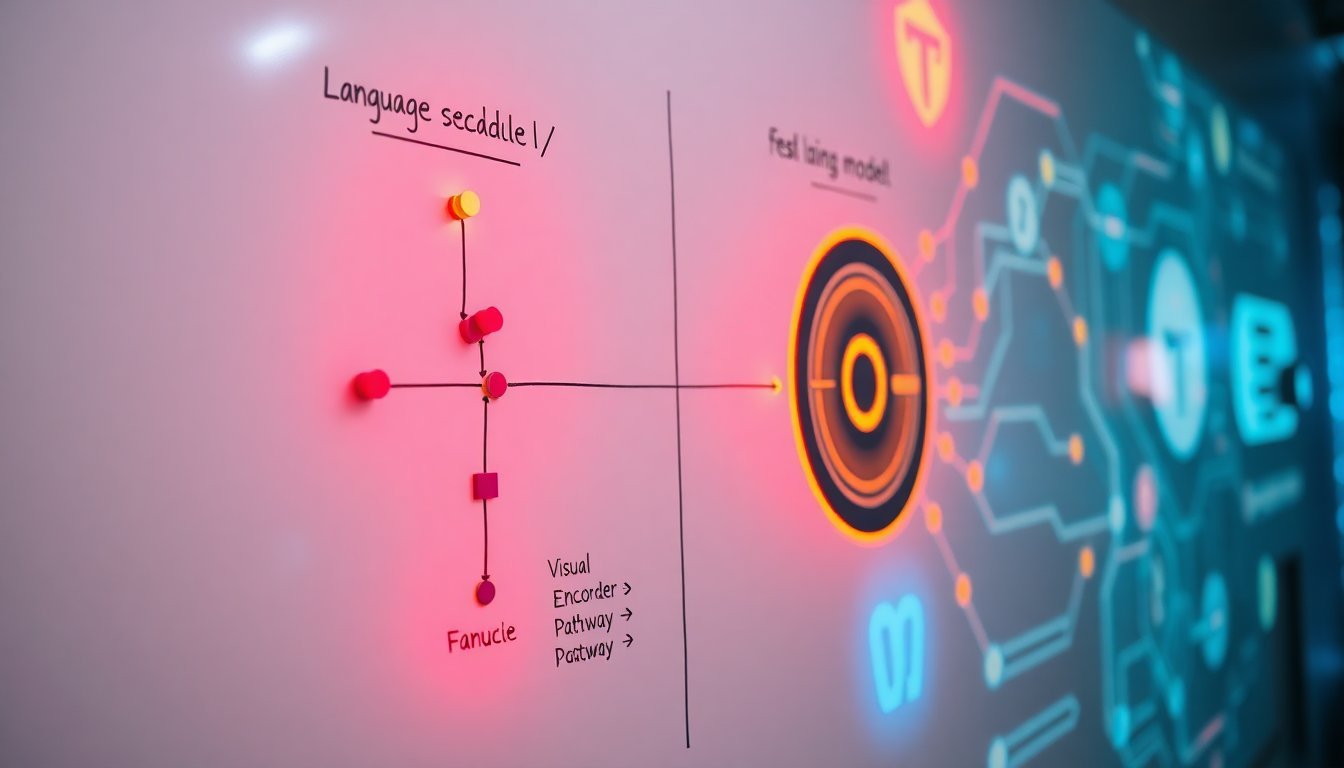
The research team conducted a series of probing and intervention experiments on established VLM architectures, including models based on the CLIP and LLaVA frameworks. By analyzing activation patterns and performing causal mediation analysis, they isolated two separate computational streams. First, in the intermediate layers of the large language model (LLM) backbone, they found representations of content-independent spatial relations—such as 'left of' or 'above'—that are computed on top of visual tokens corresponding to object regions. Second, within the visual encoder's later layers, they identified a mechanism that binds specific object identities to these abstract spatial templates. As cited in the paper, "the language model layers appear to create a spatial scaffold, while the visual encoder fills it with concrete visual entities" (arXiv:2603.22278v1, 2026). This separation indicates that spatial reasoning is not an emergent property of a fused representation but a coordinated, dual-process operation.
Why This Matters for AI Development and Applications
This mechanistic dissection has direct consequences for the design, evaluation, and deployment of VLMs. For model architects, the findings suggest that improving spatial reasoning may require targeted enhancements to both the visual binding mechanism and the LLM's relational scaffolding, rather than simply scaling up data or parameters. In practical terms, understanding this duality can help diagnose frequent VLM failures, such as when a model correctly identifies objects but misplaces them spatially in a generated description. For enterprise applications in robotics, autonomous systems, or accessibility tools, where precise spatial understanding is critical, this research provides a blueprint for building more reliable and interpretable models. The separation of concerns also aligns with cognitive theories of human vision and language, offering a bridge between AI engineering and neuroscience.
The Research Context and Competitive Landscape
This work enters a crowded field of research into multimodal model interpretability, responding to prior studies that often treated VLMs as black boxes. Recent efforts from organizations like Anthropic, OpenAI, and academic labs have focused on evaluating VLM outputs, but less on isolating internal computational mechanisms (e.g., benchmarking studies from the EMMET workshop at NeurIPS 2025). The arXiv paper distinguishes itself by employing circuit-based analysis techniques borrowed from transformer interpretability research, as pioneered by work like that of Connor J. Davis on foundational transformer circuits. By applying these methods to the multimodal domain, the authors provide a more granular map of where specific capabilities reside, challenging the assumption that all multimodal reasoning is consolidated in late-layer fusion points.
What Happens Next: Directions for Future Work
The immediate next step, as outlined by the authors, is to explore whether this dual-mechanism structure is a consistent feature across diverse VLM architectures, including newer models with fully integrated encoders. Further research could investigate if artificially strengthening the connection between these two pathways—for instance, through novel attention mechanisms or training objectives—leads to gains on benchmark tasks requiring spatial precision, like Referring Expression Comprehension. Additionally, this discovery may inform the development of more sophisticated evaluation suites that separately stress-test the relational and binding components. The broader AI community is likely to incorporate these insights into the next generation of multimodal models, potentially leading to architectures that explicitly model these separate processes for greater transparency and control.
Source and attribution
arXiv
The Dual Mechanisms of Spatial Reasoning in Vision-Language Models





Discussion
Add a comment