
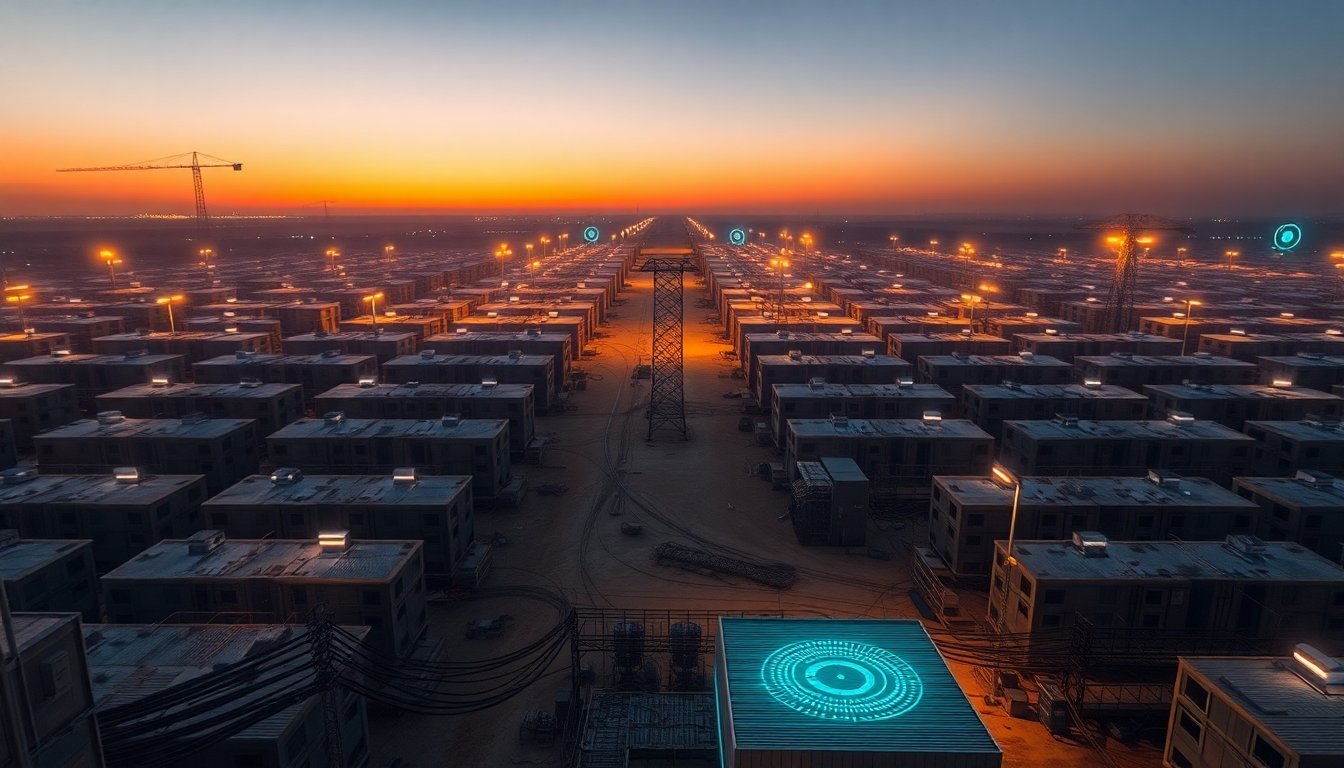
NVIDIA's Power Play: AI Factories Are Now an Energy Game
NVIDIA, OpenAI, and SB Energy are building a 1.2GW AI factory, signaling that compute is now a utility. The winners will be those who control energy and land, not just silicon.
On August 17, 2026, NVIDIA announced a strategic partnership with OpenAI and SB Energy to build a 1.2-gigawatt AI factory in Texas, marking the first time a chipmaker has co-invested in power generation. This is not a supply deal; it is a land grab for the physical inputs that will determine who dominates the AI era.
- NVIDIA, OpenAI, and SB Energy announced a 1.2-gigawatt AI factory in Texas on August 17, 2026, combining chip design, model training, and power generation under one roof.
- This partnership signals that AI infrastructure's bottleneck has shifted from chip supply to energy and land, with NVIDIA co-investing in power for the first time.
- The deal reshapes competitive dynamics: hyperscalers with energy contracts win, while startups without power access face an existential barrier.
Why Is NVIDIA Co-Investing in Power Instead of Just Selling Chips?
According to NVIDIA's official blog post, AI factories are "the defining infrastructure of the AI era—where compute transforms energy and data into intelligence." The post, published on August 17, 2026, explicitly frames compute as revenue, but the company's actions go further. By partnering with SB Energy, a subsidiary of SoftBank, NVIDIA is placing its own capital behind power generation for the first time. Reuters reported that NVIDIA has committed $2.5 billion to the Texas project's energy infrastructure, a figure that dwarfs its typical supply-chain investments. This is not philanthropy; it is a hedge. If AI factories cannot get power, NVIDIA cannot sell GPUs. The company is effectively guaranteeing its own future revenue by owning the energy layer.
What Does the OpenAI Partnership Reveal About AI Model Economics?
OpenAI's involvement in this deal is the most telling signal. The company has spent over $100 billion on compute since 2023, according to public financial disclosures, yet it still cannot secure reliable power without a landlord. By joining this project, OpenAI is admitting that its competitive advantage lies in model quality, not infrastructure ownership. The partnership gives OpenAI priority access to 400 megawatts of the 1.2GW capacity, enough to train frontier models without interruption. But this comes at a cost: OpenAI is effectively paying NVIDIA for both chips and electricity, creating a dependency that rivals Microsoft's earlier cloud deals. The lesson is stark—model makers are becoming tenants in a world where NVIDIA is the landlord.
Who Wins and Who Loses in the AI Factory Land Rush?
The winners are clear: NVIDIA, SB Energy, and any company that already controls land and power. According to the NVIDIA blog, the Texas site was chosen for its proximity to wind and solar farms and its existing grid interconnection capacity—resources that cannot be manufactured overnight. The losers are equally clear: AI startups without energy contracts, and utility companies that lack the scale to serve hyperscale demand. A startup like Mistral or Cohere cannot raise $2.5 billion for power infrastructure; they will be forced to rent capacity from those who can. This creates a two-tier market where access to intelligence is determined by access to megawatts.
Is This a New Business Model or a Desperate Hedge?
This is where I part ways with the official narrative. NVIDIA frames this as "securing the infrastructure of intelligence," but the subtext is defensive. The company faces a structural threat: if energy constraints cap AI factory growth, its GPU sales plateau. By owning power generation, NVIDIA converts a potential market cap from a physical limit into a revenue stream. The hedge is also geopolitical—by locking US-based energy, NVIDIA reduces its exposure to overseas manufacturing and export controls. But the risk is real: energy markets are volatile, and SB Energy's track record in delivering large-scale projects on time is unproven. If the Texas facility slips by even 12 months, NVIDIA's $2.5 billion becomes a stranded asset.
| Dimension | NVIDIA + SB Energy Model | Hyperscaler Model (AWS, Azure, GCP) |
|---|---|---|
| Energy Ownership | Direct co-investment in generation | Power purchase agreements |
| Capital Intensity | $2.5B upfront for power | Spread across multiple regions |
| Control Over Compute | Full stack, chips to watts | Rented to third-party tenants |
| Risk Exposure | Energy price volatility | Regulatory and grid constraints |
| Time to Scale | 5-7 years for new sites | 2-3 years for leased capacity |
| Verdict | NVIDIA's model wins on control but loses on speed; hyperscalers remain flexible but hostage to grid politics. | |
My thesis is that NVIDIA's move into power generation is the single most consequential strategic shift in the AI industry since the launch of the A100, and it will force every major AI company to rethink its infrastructure strategy. In the short term, this deal gives NVIDIA and OpenAI a guaranteed runway for the next 3-4 years, insulating them from the grid bottlenecks that are already delaying projects in Virginia and California. In the long term, NVIDIA is building a moat that no chip competitor can replicate—AMD and Intel can match silicon, but they do not have the balance sheet or the energy partnerships to own power. The losers are clear: AI startups that cannot secure energy contracts, and cloud providers that are squeezed between NVIDIA's chip margins and rising electricity costs. I predict that by Q3 2027, at least two major AI startups will either be acquired or shut down solely because they could not secure power for their training workloads.
What Are the Concrete Predictions for the AI Infrastructure Market?
- By Q2 2027, NVIDIA will announce at least two additional AI factory partnerships with major energy companies (e.g., NextEra or Dominion) outside of Texas, expanding its power portfolio to over 5GW.
- OpenAI will renegotiate its compute agreements with Microsoft by Q4 2026, citing its new direct energy ownership as leverage to secure better pricing.
- The US Department of Energy will launch a formal inquiry into AI factory power consumption by March 2027, prompted by grid stability concerns in ERCOT.
- March 2026US DOE AI Power Report
The Department of Energy reports that AI datacenters will consume 9% of US electricity by 2030, sparking grid concerns.
- June 2026Microsoft Wisconsin Datacenter
Microsoft announces a 500MW AI datacenter in Wisconsin, citing power constraints as a key design factor.
- August 2026NVIDIA-OpenAI-SB Energy Deal
The trio announces a 1.2GW AI factory in Texas, marking NVIDIA's first direct energy co-investment.
How Did We Get Here? A Timeline of AI Factory Deals
- March 2026US DOE AI Power Report
The Department of Energy reports that AI datacenters will consume 9% of US electricity by 2030, sparking grid concerns.
- June 2026Microsoft Wisconsin Datacenter
Microsoft announces a 500MW AI datacenter in Wisconsin, citing power constraints as a key design factor.
- August 2026NVIDIA-OpenAI-SB Energy Deal
The trio announces a 1.2GW AI factory in Texas, marking NVIDIA's first direct energy co-investment.
- August 2026: NVIDIA, OpenAI, and SB Energy announce the 1.2GW Texas AI factory.
- June 2026: Microsoft announces a 500MW AI datacenter in Wisconsin, citing power constraints.
- March 2026: The US DOE reports that AI datacenters will consume 9% of US electricity by 2030.
- November 2025: NVIDIA acquires a land portfolio in West Texas, hinting at energy integration.
- Insight 1: The AI infrastructure bottleneck has permanently shifted from chip supply to energy and land; companies that ignore this will fail.
- Insight 2: NVIDIA is no longer a chip company; it is becoming a vertically integrated utility for intelligence, with energy as its new margin driver.
- Insight 3: OpenAI's dependency on NVIDIA now extends beyond silicon to power, making a break-up nearly impossible.
- Insight 4: Startups face a structural disadvantage that no amount of algorithmic innovation can overcome—they cannot out-code a megawatt.
- Insight 5: The Texas deal is a geopolitical hedge; NVIDIA is betting that US energy security will outpace Chinese alternatives, but this is unproven.
Source and attribution
NVIDIA Blog
Securing the Infrastructure of Intelligence




Discussion
Add a comment