

Nvidia's MediaTek Cash: Arm PC Alliance Shakes Qualcomm and Intel
Nvidia's convertible bond investment in MediaTek signals a coordinated push into Arm-based AI PCs and edge devices. The deal reshapes competitive dynamics in the PC chip market, threatening Qualcomm's Snapdragon momentum and Intel's last x86 stronghold.
Nvidia is putting $3.5 billion into MediaTek via convertible bonds, a move Bloomberg reported on August 31, 2026. This is not a passive portfolio play — it is Nvidia buying a seat at the Arm PC table, and the targets are Qualcomm and Intel.
- Nvidia announced a $3.5 billion investment in MediaTek through convertible bonds, per Bloomberg's Ed Ludlow (August 31, 2026).
- The deal gives Nvidia a strategic foothold in Arm-based PC and edge AI chip development without a full merger.
- This alliance directly challenges Qualcomm's Snapdragon X series and Intel's Core Ultra lineup in the emerging AI PC category.
Why is Nvidia buying convertible bonds instead of equity?
According to Bloomberg's Ed Ludlow, Nvidia will purchase bonds that convert into MediaTek shares, a structure that limits immediate dilution while securing future upside. This is a hedge — Nvidia gets board-level influence without the regulatory scrutiny of a direct stake. The convertible structure also signals that Nvidia sees MediaTek's stock as undervalued relative to its AI roadmap. Reuters reported on the same day that the deal includes a collaboration agreement for co-developed Arm-based PC chips targeting 2027. The structure matters because it allows Nvidia to walk away if the AI PC market stalls, but it also locks MediaTek into Nvidia's CUDA ecosystem — a software moat Qualcomm cannot match.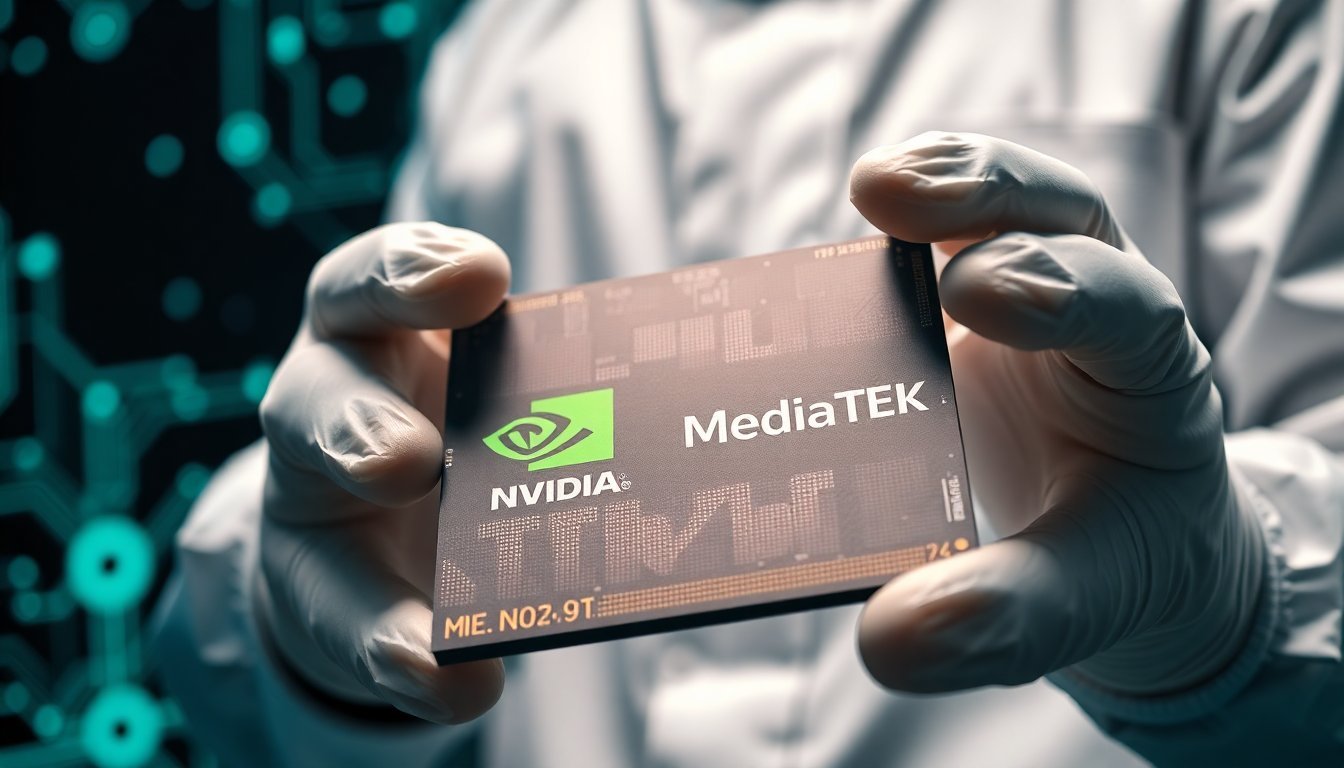
What does MediaTek gain beyond the cash infusion?
MediaTek gets two things it desperately needs: Nvidia's AI software stack (CUDA, TensorRT) and data center credibility. According to Reuters, the companies will co-develop a chip that combines MediaTek's modem and CPU expertise with Nvidia's GPU and AI acceleration cores. MediaTek has struggled to break into premium laptops — its Dimensity chips dominate budget Android phones but lack the AI horsepower for Copilot+ PCs. This deal changes that calculus. Nvidia's TensorRT optimization can deliver 2x to 3x inference performance gains on the same hardware, which would make a MediaTek+Nvidia chip competitive with Qualcomm's Snapdragon X Elite on paper. MediaTek also gains access to Nvidia's enterprise sales channels, opening doors to commercial laptop deals it could never win alone.How does this threaten Qualcomm's AI PC dominance?
Qualcomm has been the default Arm PC player, with its Snapdragon X series powering most Copilot+ laptops. The threat is not just technical — it is economic. Nvidia's $3.5 billion gives MediaTek the R&D runway to undercut Qualcomm on price while matching performance. Qualcomm's licensing model, which generates revenue per device, becomes vulnerable if MediaTek+Nvidia chips ship at scale in 2027. Qualcomm also loses its exclusivity with Microsoft's Windows on Arm optimization — if Nvidia brings CUDA compatibility to Windows on Arm, developers will prioritize that platform. The comparison below shows how the two alliances stack up.| Dimension | MediaTek + Nvidia | Qualcomm Snapdragon X |
|---|---|---|
| AI Software Stack | CUDA, TensorRT (mature, widely adopted) | Qualcomm AI Engine (proprietary, limited) |
| CPU Architecture | Arm (MediaTek) | Arm (custom Oryon) |
| Data Center Credibility | Nvidia (dominant) | None |
| Integration Timeline | 2027 (projected) | Available now |
| Modem Expertise | MediaTek (strong) | Qualcomm (strongest) |
| Verdict | Qualcomm wins on immediate availability, but MediaTek+Nvidia wins on ecosystem depth and long-term AI capability. | |
What does this mean for Intel's x86 stronghold?
Intel has been losing data center share to Nvidia's GPUs, but it has held the PC market through x86 compatibility. This deal attacks that last fortress. If MediaTek+Nvidia delivers competitive AI PC chips in 2027, Intel's Core Ultra series loses its performance-per-watt argument. Intel's foundry business also suffers — MediaTek was rumored to be evaluating Intel 18A for some chips, but this Nvidia deal pushes MediaTek firmly toward TSMC, given Nvidia's existing relationship there. Intel's response will likely be aggressive pricing on Core Ultra 200 series, but that erodes margins Intel cannot afford to lose. The timeline below shows how we got here.- October 2023Nvidia-ARM acquisition collapses
Regulatory pressure kills Nvidia's $40 billion ARM deal, forcing alternative partnership strategies.
- May 2024Qualcomm launches Snapdragon X
Qualcomm establishes early lead in Arm-based AI PCs with Copilot+ certification.
- June 2025MediaTek-Nvidia rumors surface
Industry analysts report secret co-development talks between the two companies.
- August 2026Nvidia announces $3.5B MediaTek investment
Convertible bond purchase formalizes the strategic alliance between Nvidia and MediaTek.
Who are the hidden losers in this transaction?
Beyond Qualcomm and Intel, the quiet losers are AMD and Arm Holdings itself. AMD's Ryzen AI chips lose mindshare as the AI PC narrative shifts to Nvidia-powered Arm devices. Arm Holdings, ironically, sees its licensing power diluted — if MediaTek becomes Nvidia's proxy, Nvidia can dictate Arm roadmap priorities through MediaTek's volume commitments. Arm's neutrality erodes, which could push other licensees like Amazon (Graviton) and Google (Axion) to accelerate custom RISC-V alternatives. The deal also pressures Microsoft: Windows on Arm was Qualcomm's exclusive playground, but now Nvidia's CUDA compatibility demands could force Microsoft to split optimization efforts across two competing Arm partners.My Analysis: Nvidia's $3.5 billion convertible bond purchase is the cheapest strategic insurance policy in semiconductor history — it buys Arm PC entry without the $40 billion price tag of an outright acquisition. In the short term, expect Qualcomm to accelerate Snapdragon X Elite Gen 2 timelines and announce its own AI software partnerships to counter Nvidia's CUDA gravity. In the long term, this deal cements Arm's dominance in client computing, pushing Intel toward a foundry-only future by 2030. The biggest winner is TSMC, which gains another high-volume Nvidia-linked product line. The biggest loser is Qualcomm, which loses its Arm PC exclusivity narrative. My specific prediction: by Q3 2027, MediaTek+Nvidia will hold at least 15% of the AI PC chip market, forcing Qualcomm to cut Snapdragon X prices by 20% or exit the segment.
Predictions
- By December 2027, MediaTek and Nvidia will announce a co-branded AI PC chip that achieves 40+ TOPS NPU performance, directly competing with Qualcomm's Snapdragon X Elite Gen 3.
- Qualcomm will file a complaint with the FTC or EU competition authorities by mid-2027, alleging Nvidia's CUDA lock-in creates unfair barriers in the Arm PC market.
- Intel will announce a strategic partnership with a major Arm licensee (likely Samsung) by Q2 2027 to produce Arm chips on Intel 18A, desperate to keep its foundry business viable.
- Convertible bonds are the key signal: Nvidia wants influence without ownership risk, meaning it still doubts the AI PC market's speed.
- CUDA is the real asset in this deal — MediaTek is buying software, not just silicon.
- Qualcomm's exclusivity with Microsoft Windows on Arm is effectively over, forcing a renegotiation of optimization priorities.
- Intel's x86 PC fortress has a visible crack; its foundry pivot is no longer optional.
- Arm Holdings faces an uncomfortable future as a proxy for Nvidia's ambitions, which may accelerate RISC-V adoption among hyperscalers.
Source and attribution
Bloomberg Technology
Nvidia Investing $3.5 Billion in Chipmaker MediaTek





Discussion
Add a comment