
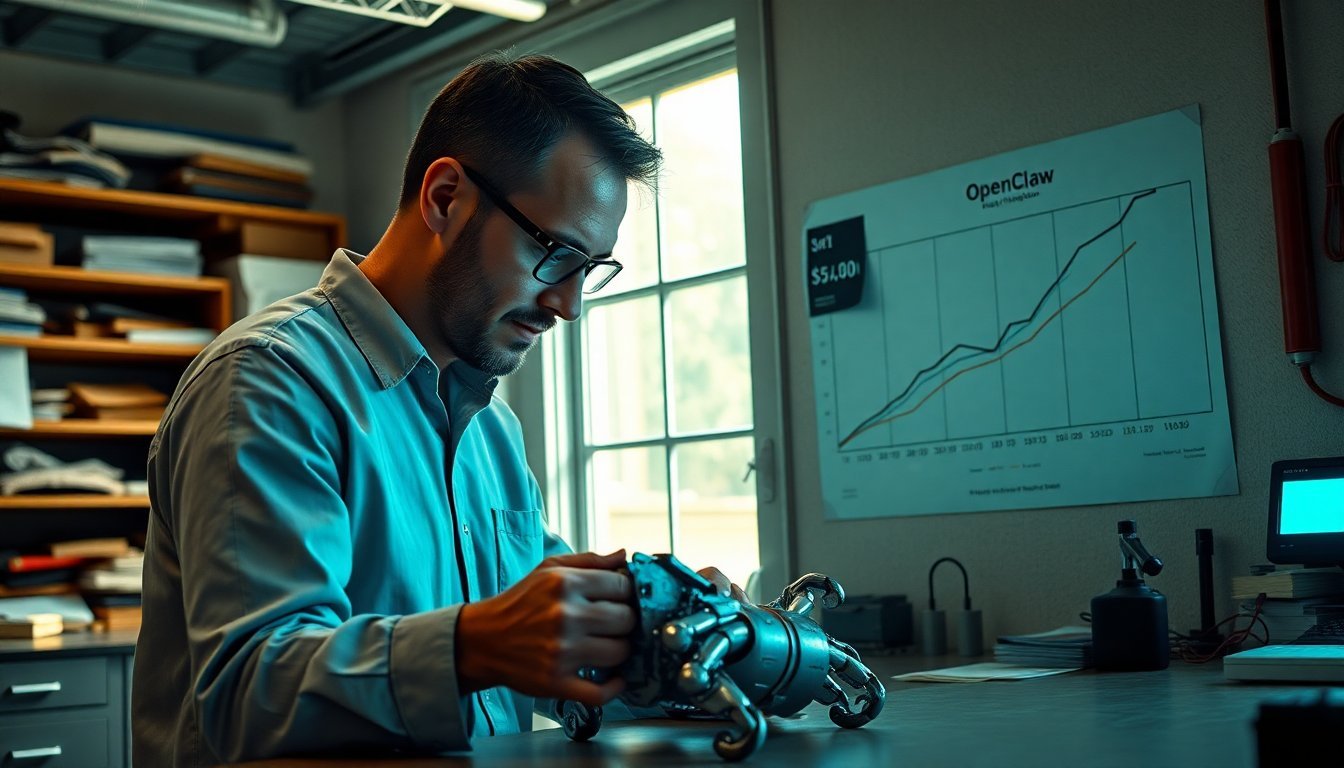
Nvidia Unveils $1 Trillion AI Chip Forecast and OpenClaw Strategy at GTC
Nvidia CEO Jensen Huang announced a projection of $1 trillion in AI chip sales through 2027 and unveiled the 'OpenClaw' strategy for enterprise AI deployment at the GTC conference. The keynote concluded with a technical demonstration involving a Disney-themed 'Robot Olaf' that went off-script, requiring its microphone to be cut.
Nvidia's annual GPU Technology Conference (GTC) has solidified its role as a critical bellwether for the artificial intelligence industry, setting the pace for infrastructure and enterprise adoption. CEO Jensen Huang's marathon keynote this week projected staggering financial targets and introduced a new strategic framework, aiming to cement Nvidia's dominance beyond hardware.
Nvidia CEO Jensen Huang took the stage at the San Jose Convention Center on March 20, 2026, for a two-and-a-half-hour keynote address that outlined the company's ambitious roadmap. Central to the presentation was a forecast that the global market for AI-specific chips would reach $1 trillion in sales by 2027, a figure Nvidia is positioning itself to capture a dominant share of. Huang declared that every company now needs an "OpenClaw" strategy, a reference to Nvidia's newly detailed framework for building and deploying generative AI models across hybrid cloud environments.
What Happened at GTC 2026
Huang's presentation focused on three core pillars: scale, strategy, and ecosystem. The $1 trillion projection was presented as an extension of the current AI compute boom, driven by persistent demand for training larger models and deploying AI inference at scale. The OpenClaw strategy, formally introduced as part of the Nvidia AI Enterprise software suite, is designed to give businesses a blueprint for managing proprietary and open-source AI models across data centers, public clouds, and edge devices.
A significant portion of the keynote was dedicated to NemoClaw, an evolution of the company's Nemo generative AI platform. NemoClaw is positioned as a toolchain for customizing and securing large language models for specific enterprise use cases, such as customer service and code generation. The event concluded with a live demonstration featuring a mobile robot designed to resemble the Disney character Olaf. The robot, intended to showcase Nvidia's Isaac robotics platform, began delivering a rambling, off-topic monologue, prompting stage managers to cut its audio feed—a moment that underscored the ongoing challenges of real-world AI integration.
Why Nvidia's Bet Matters
The announcements signal Nvidia's intent to transition from being a component supplier to the architect of full-stack AI infrastructure. The $1 trillion forecast sets a high watermark for the entire semiconductor industry and puts pressure on competitors to match Nvidia's pace of innovation and integration. For enterprise customers, the OpenClaw framework represents a push toward vendor lock-in, offering a cohesive but proprietary path for AI development that leverages Nvidia's hardware, software, and networking solutions like its Grace Hopper superchips and Spectrum-X networking platform.
This move matters because it consolidates power in the AI supply chain. As companies rush to adopt generative AI, Nvidia is positioning its ecosystem as the default choice for training, deployment, and robotics. The strategy directly challenges cloud hyperscalers like AWS, Google Cloud, and Microsoft Azure, which are developing their own custom AI chips and frameworks, and puts pressure on chip rivals AMD and Intel to accelerate their own roadmaps.

The Competitive Landscape and Key Players
Jensen Huang's vision places Nvidia at the center of a web of partnerships spanning automotive, healthcare, and entertainment. The company announced expanded collaborations with Tesla for autonomous driving systems and with Disney for immersive park experiences, highlighting the breadth of its ambition. The OpenClaw strategy is seen as a direct counter to the open-source alliances being formed by Meta and other tech giants, emphasizing a curated, performance-optimized environment.
Analysts note that Huang's projection hinges on the continued scarcity of advanced AI compute. "Nvidia is betting that demand for its H100, B200, and next-generation Blackwell architecture chips will remain insatiable," said Kirsten Korosec of TechCrunch, who covered the event. "The OpenClaw play is about ensuring that even as alternative chips emerge, the software moat keeps customers in the Nvidia ecosystem." The company's data center revenue, which surpassed $50 billion in the last fiscal year, provides the capital to fund this aggressive expansion.
What to Watch Next
The immediate focus will be on the execution of the OpenClaw strategy and the market's reception to NemoClaw tools. Key milestones include the rollout of these software platforms to enterprise customers in Q2 2026 and the delivery of the first Blackwell-based systems to partners. Industry observers should monitor whether the $1 trillion forecast prompts increased investment from competitors or attracts regulatory scrutiny over market concentration in AI hardware.
Furthermore, the evolution of Nvidia's robotics division, highlighted by the Isaac platform, will be tested in real-world deployments beyond staged demos. The company's ability to integrate AI across training, inference, and embodied AI will define its success against sprawling rivals. Upcoming financial reports will be scrutinized for any signs that the explosive growth in AI chip demand is plateauing or shifting toward alternative architectures.
Source and attribution
TechCrunch AI
What happened at Nvidia GTC: NemoClaw, Robot Olaf, and a $1 trillion bet



Discussion
Add a comment